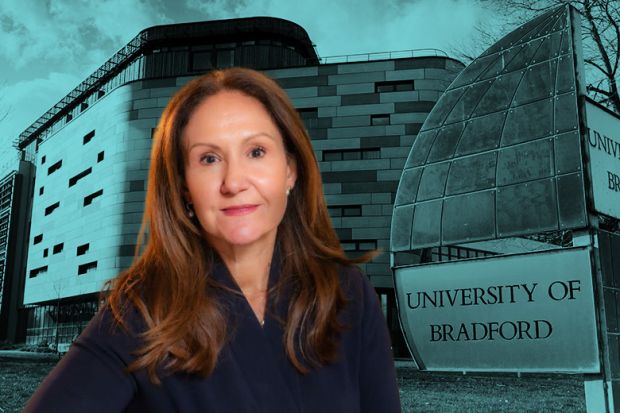
In many ways the University of Bradford sits at the heart of many of the policy debates currently rippling through the UK’s higher education sector.
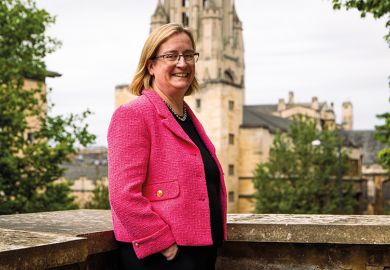
On new vice-chancellor Gillian Murray’s 100th day in the job, the government confirmed a new train station for the city – part of a devolution drive that is close to the heart of prime minister Andy Burnham.
Westminster says its backing for Bradford Interchange will “transform the city’s connections” and generate up to £1 billion in associated economic benefits.
Murray, who has only recently made Bradford her home, is passionate about the project and will be hoping more investment and attention comes the way of such places, with talk of regionalised research spending and skills planning.
Investing in “the fifth or sixth largest city in the UK” is a no-brainer, believes Murray, but “focusing locally doesn’t mean you take your eye off the ball in terms of national and global [concerns]”.
It is the Burnham government’s international approach that is causing more of a headache for Murray.
in response to calls to bring down immigration, rates of visa rejections are rising – with universities at risk of losing their sponsorship licence if their refusal rate tips above five per cent.
Those from India, Pakistan and Nigeria are significantly more likely to be turned down. In Bradford, where about 25 per cent of the population is of Pakistani descent, it is very much a live issue.
“It’s a really big concern,” said Murray. “When I came in here, I had to make some hard decisions about not supporting certain markets internationally going forward because of that risk.
“However, we have a multicultural city…about 80 per cent of our students [are] from the local area here in Bradford, and a high percentage of those will be from [families from] the countries and communities that UK Visas and Immigration are not accepting at the moment.
“So that’s a difficult cultural decision to come in as a leader who’s welcoming of different cultures and willing to bring people together.”
Murray said she had faced lobbying from local leaders to rethink her decision. “We do get letters from the community and letters from the local MP about what’s happening,” she said. “It’s a really challenging time for all universities but for us in particular because of that multicultural dynamic.”
The Bradford leader was until recently deputy principal for enterprise and business at Heriot-Watt University in Edinburgh. But the Scottish higher education expert has been rapidly getting to grips with her new home and the English sector.
Murray sees “similarities” between her hometown of Glasgow and Bradford, chalking it up to a shared “gritty warmth”, but acknowledges: “I’ve been on a big learning curve in terms of joining the English system.”
But Murray said the degree of contrast is sometimes overstated. “I think the challenges are similar across the sector.
“What we talk about in Scotland is what we talk about here, in terms of the cost to universities to supply education – it’s maybe more acute in Scotland because of lower fees, but equally they’ve got government funding, so there’s some benefit [in that].
“There are slightly different dynamics. But I think the general trajectory is about how we show our relevance and how we drive forward opportunity, wherever we are in the country.”
When it comes to showing relevance and making Bradford fighting fit for the future, Murray is determined to put her business experience at the heart of her role.
This year, the university is celebrating 60 years since it received its Royal Charter, with its first chancellor being Labour politician Harold Wilson. Murray recalled his famed party conference speech calling for a “new Britain” forged in the “white heat” of “scientific revolution”.
Her plan for Bradford is to make sure it can play a leading role in technological transformation and to educate those working to support it – believing that the university’s Centre for Space AI could make it “the NASA of the North”.
But to do that, Bradford might need to prove more agile.
In recent years, former vice-chancellor Shirley Congdon set about trying to make £10 million worth of cuts.
Last year, university staff voted for strikes after the university mooted plans to cull hundreds of jobs.
Bradford’s most recent financial statements, meanwhile, reveal that its staff headcount fell from 1,740 in 2023-24 to 1,566 in 2024-25.
Asked whether more redundancies are expected, Murray said she didn’t have “a crystal ball”.
“I think the most important thing is there’s always going to be turbulence and change in the sector,” she said. “I’m focusing on how we draw on my entrepreneurial mindset and the entrepreneurial spirit that has been in Bradford since its inception, really, to embrace that and work out potentially how we can be more agile, how we can be more innovative, how we can be entrepreneurial in our approach.”
But Murray didn’t deny the possibility of further streamlining: “I don’t think we can say we’ve had one change, we’re never going to have any change again. I just don’t think the world’s like that. I don’t think business operates like that.”
She added: “You see it in corporate [ventures] all the time: stuff happens and they have to make changes and adapt.”
Register to continue
Why register?
- Registration is free and only takes a moment
- Once registered, you can read 3 articles a month
- Sign up for our newsletter
Subscribe
Or subscribe for unlimited access to:
- Unlimited access to news, views, insights & reviews
- Digital editions
- Digital access to THE’s university and college rankings analysis
Already registered or a current subscriber?