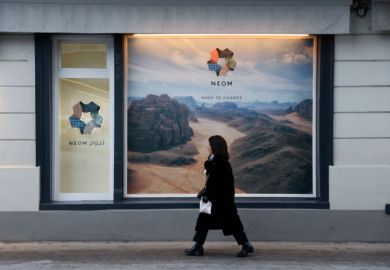
A major research-intensive university that was supposed to be built in the Saudi Arabian desert is unlikely to materialise, experts have predicted, after all official references to it were erased and its president transferred to a different initiative.
The future of Neom University was cast into doubt earlier this year amid reports that the country was massively scaling back its plans for the futuristic “megacity” where it would be located. Announced by Saudi Arabia’s crown prince Mohammed bin Salman in 2017, Neom was supposed to reinvent modern living, with flying taxis and robot servants. But the city’s main project, a 112-mile horizontal skyscraper known as The Line, has been all but been abandoned, with workers leaving the site, the Times and the Washington Post have reported. And there are now growing concerns that one of the scheme’s other flagship offerings – a brand-new university – will also fall by the wayside.
Hailed at the time of its launch as having the potential to become “Saudi Arabia’s premier and best-resourced research institution”, rivalling the likes of King Abdullah University of Science and Technology (KAUST) as one of the Middle East’s most prestigious universities, Neom University now appears to have no leader.
Last month, its founding president, Andreas Cangellaris, former provost of the University of Illinois Urbana-Champaign, was unveiled as senior adviser to the Riyadh University of the Arts, which is due to open in September. According to his Linkedin account, the engineering professor left his role as Neom U president in March after nearly four years in post.
And Donal Bradley, previously a physics professor at the University of Oxford, left his role as president of the Neom Education, Research, and Innovation Foundation in July, ending a three-and-a-half-year stint in the role, his Linkedin profile shows.
All mention of Neom U has also disappeared from the wider Neom project’s website, with descriptions of proposed courses and research initiatives replaced with generic posts about the project’s commitment to education, research and innovation.
Neom did not respond to a request for comment by Times Higher Education but those who have studied similar “mega-projects” in the Middle East say a public acknowledgement of its demise will probably never happen.
“The Middle East is full of relics of huge projects where ambitions exceeded reality – Neom is just the latest,” said Christopher Davidson, former reader in Middle East politics at Durham University.
“They are usually left to fade away quietly or [are] consolidated into other political projects. There is rarely an outright cancellation because this would mean a loss of face and reputation for those initiating these mega-projects,” said Davidson, adding that “failure is not really admitted because politics, especially [regarding] these grand projects, are so linked to personalities – in this case, Mohammed bin Salman”.
“We’ve seen the same with LIV Golf,” explained Davidson, referring to the lavishly funded breakaway professional golf tour backed by Saudi money, which is expected to end shortly as political interest wanes and funds dry up.
Annalisa Pavan, an independent researcher and consultant on Saudi Arabia, said it was clear the Neom U project was unlikely to proceed but added that it would be wrong to be too harsh about the ambition of the original plans, which were conceived in a different geopolitical era.
“It was far too easy for many to criticise Mohammed bin Salman, who was proposing an entirely different lifestyle for millions of Saudis,” Pavan said. “The timelines were very ambitious and were likely to shift, but he always acknowledged this project was very ambitious and challenging.”
Moreover, Pavan added: “Placing Neom U within this larger project made complete sense and, in principle, it was a good idea to create a more Saudi-focused university to compete on research with KAUST”, the graduate-only research university founded in 2009.
“KAUST has delivered on research and innovation but its students are almost entirely foreign and its staff are foreign. Having a more Saudi university which could compete and collaborate with KAUST would have been a useful addition to the research and innovation landscape,” she said.
“However, it was never really clear if Neom U was a public or private university or to which ministry it belonged. KAUST is linked to energy, Riyadh University of the Arts is overseen by the culture ministry and other universities run by education. That question was never resolved for Neom U,” said Pavan.
“Neom U was always going to be very expensive and it lacked any real design from the start, but it was a good idea.”
Register to continue
Why register?
- Registration is free and only takes a moment
- Once registered, you can read 3 articles a month
- Sign up for our newsletter
Subscribe
Or subscribe for unlimited access to:
- Unlimited access to news, views, insights & reviews
- Digital editions
- Digital access to THE’s university and college rankings analysis
Already registered or a current subscriber?