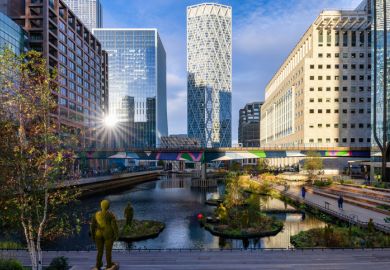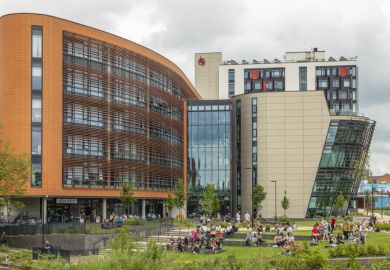
With about two dozen London campuses opened by UK universities in the past 15 years, it is fair to wonder whether the market is becoming oversaturated – a challenge De Montfort University is hoping to overcome.
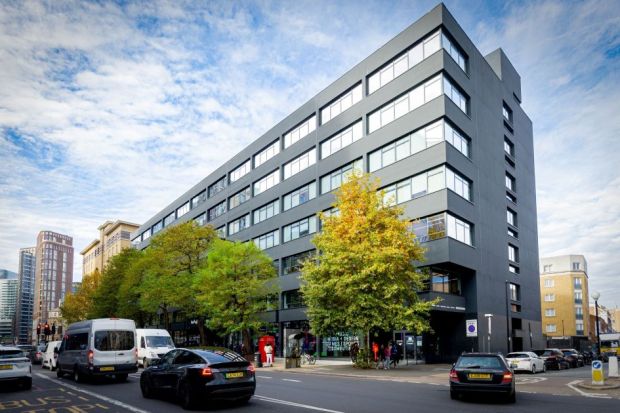
Its new outpost in the east of the capital is just a stone’s throw away from similar offerings from the universities of Coventry and Northumbria – while Nottingham Trent is even based in the same building.
The universities of Liverpool, Newcastle and East Anglia have all previously launched campuses in the city, only to close a few years later – while the buildings have been labelled by unions as “vanity projects”.
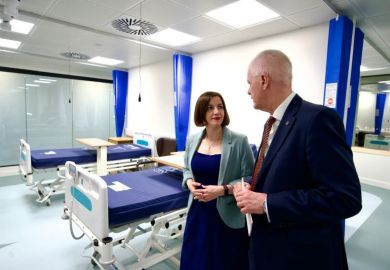
But speaking at the official launch of the Whitechapel site, Katie Normington, DMU vice-chancellor, told Times Higher Education that several demographic factors are in the institution’s favour.
“If you look at Ucas data, 5 per cent more undergraduates applied to London this year, against 1 per cent in East Midlands, so we’re still seeing that growth of demand.
“The other bit that we’re seeing is people wanting to live at home. And again, in a big, populated area, they may be travelling less outside of London and staying more in London, so I think the demand is there.”
Another key reason DMU thinks it will do well in London is due to its specific offering – one that revolves around block teaching and two-day-a-week timetabling.
Normington said the campus will offer a “new agile way of working” that is focused on employability, relationships with business, skills for the future and artificial intelligence sustainability.
“We’ve got a really clear niche and a really clear focus of why we’re coming in, in terms of the focus on business, focus on sustainability, etc. It gives us that specific focus and drive, I think, to be able to work here.”
The Commercial Road site will be industry focused, with businesses having directly helped to shape the curriculum. It is soft-launching in the vein of a “start-up” with around 100 students, but has room to expand across the one-floor site to 1,500.
DMU London will also be heavily invested in sustainability, with links to its United Nations’ Academic Impact Hub in Leicester and all courses involving ethics sustainability.
There have been repeated concerns around the quality of London campuses, while they have also been criticised as backdoor immigration routes for non-genuine students by the shadow home secretary.
DMU London hopes to draw half of its students from overseas, and Normington said student recruitment will follow the same process as the main university.
“[Using] really clear credibility checks for all of our students to ensure that…they can afford it, their English is good and that they are a credible student who understands where they’re going to be studying, where they’re living…so it’s set up in the same way as that.”
While DMU has one of the largest deficits as a proportion of total income in the sector, it holds strong cash reserves – which Normington said is far more important when setting up such a venture.
“We’ve got a really, really strong cash position so we’re in one of the rare positions where we can actually invest to grow as opposed to people who are just cutting.
“We’ve got over six months’ cash that we hold, which would probably be the envy of quite a lot of universities.”
DMU moved from a £12.6 million surplus to a £22.6 million deficit last year as a result of increased costs, a reduction in the real-terms value of tuition fees, and a fall in international students.
It will be hoping that its new London site does not suffer the same fate as that of Glasgow Caledonian University – its London campus witnessed a collapse in enrolment after visa rules tightened. Or Sheffield Hallam, where staff blamed the new campus in Brent for the university cutting jobs at home.
Normington said she told staff that there would be a “firewall” between the two entities.
“We were quite clear before when we were setting this up that in a sense, we would run a deficit to set it up, but we wouldn’t be cutting the jobs.”
Along with London, the university also has outposts in the United Arab Emirates, Kazakhstan and Cambodia.
Students will be able to do a split business master’s course between DMU London and Dubai, which Normington said is an “innovative” model that gives globally mobile students the taster of living in more than one city.
Register to continue
Why register?
- Registration is free and only takes a moment
- Once registered, you can read 3 articles a month
- Sign up for our newsletter
Subscribe
Or subscribe for unlimited access to:
- Unlimited access to news, views, insights & reviews
- Digital editions
- Digital access to THE’s university and college rankings analysis
Already registered or a current subscriber?