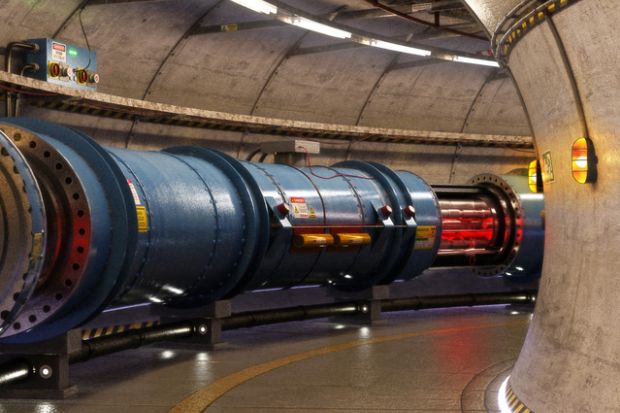
Leading Chinese physicists have condemned UK Research and Innovation’s “irresponsible” decision to withdraw funding from an upgrade to an experiment at Cern, Europe’s world-leading particle physics facility.
UKRI’s decision, revealed in January, to pull funds for an upgrade to a detector on the Large Hadron Collider – called the LHCb – has recently drawn criticism from high-profile UK scientist Brian Cox and the Cern council.
Now, Yifang Wang, director of the Institute of High Energy Physics at the Chinese Academy of Sciences in Beijing, has told colleagues at Cern that “it seems irresponsible to give up the leadership role halfway”. Wang’s statement is understood to have been made with the expectation that it would find its way into the public domain.
UK scientists in July said a three-year pre-construction phase for the LHCb had been completed, building on prior technical design reports, accounting for £5 million of the planned £49.4 million for the upgrade. China is one of many other countries participating in the LHCb upgrade, 40 per cent of whose budget was planned to come from Italy and the UK; now Italy’s contribution also looks uncertain.
Wang said: “The withdrawal of UK support risks limiting the scientific reach of the upgrade project and indeed threatens its very existence. With such consequences, the whole field will suffer a major setback.”
Wang’s condemnation is unusual, Steve Tsang, director of the SOAS China Institute told Times Higher Education. “Scientists don’t generally comment on diplomatic matters – in most, if not all, countries,” he said. He added that in today’s China, under Xi Jinping, all scientists are “subject to the leadership of the Communist Party, so if the party has so indicated, academics, including scientists, will have to speak or not speak as required”.
Another Chinese scientist to express concerns is Yu-Gang Ma, president of East China Normal University. He told Times Higher Education that the UK’s withdrawal from the LHCb upgrade was “really bad news”.
Ma, who, as a nuclear physicist, has been engaged in large-scale international collaborations, said he is “deeply troubled” by what has happened.
“This was not merely a budget cut; it was a unilateral breach of a long-standing commitment, made without meaningful consultation with[in] the collaboration,” he said.
Ma explained that in global big-science projects, “trust and predictability are as vital as funding. A unilateral exit erodes the UK’s credibility and sets a dangerous precedent.
“It also damages early-career researchers and weakens the collective strength of the international particle-physics community. This decision is short-sighted and self-defeating,” he said.
THE understands that the scientists’ comments come amid concern within the Cern council that China will take over the LHCb upgrade leadership.
China is not a paying member state of Cern, whereas the UK pays a roughly £160 million annual membership fee – which does not cover the costs of experiments. There are also high-level worries about China accessing UK IP, following an MI5 alert last week warning UK universities not to work with a specific Chinese research institute.
Despite the diplomatic complexities, the Chinese scientists said they want to see the UK maintain its LHCb leadership. Ma urged UKRI to “reconsider and to uphold the principles of transparency, reciprocity and shared responsibility”.
Wang is the former spokesperson for the Beijing Spectrometer III experiment, located at the Institute of High Energy Physics of the Chinese Academy of Sciences, an experiment that he described as “a competitor of LHCb to some extent”.
“I know very well how important and excellent such an upgrade is. We have both witnessed great advancement in hadron spectroscopy…in recent decades, and we together still have a long list of tasks to accomplish.”
According to Cern’s experiment database, the UK currently has 12 research-performing institutes and 242 participants in the wider LHC experiment, whereas China has 13 institutes and 305 participants.
Register to continue
Why register?
- Registration is free and only takes a moment
- Once registered, you can read 3 articles a month
- Sign up for our newsletter
Subscribe
Or subscribe for unlimited access to:
- Unlimited access to news, views, insights & reviews
- Digital editions
- Digital access to THE’s university and college rankings analysis
Already registered or a current subscriber?