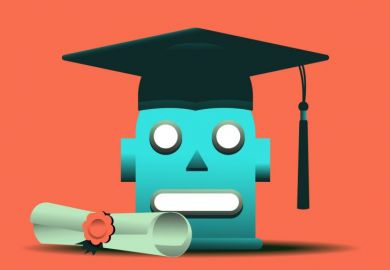
Several universities have begun rolling out artificial intelligence (AI) access to all their staff and students, but critics warn that the “blanket” approach may encourage inappropriate use of the new technology.
Earlier this year the University of Manchester became the first in the world to promise to give its 65,000 students and staff members access to Microsoft’s M365 Copilot after agreeing a deal with the tech giant.
Paul Gregory, Copilot programme director at the university, told Times Higher Education that all staff now have access, with students to follow in the new academic year once “engagement and discovery work” has been compledted. Access to the technology has been accompanied by the creation of a Copilot student advisory group to begin “co-creating communications resources and engagement approaches” for its use.
Approximately 50 “listening sessions” have also been held across the year to understand how its people are interacting with the tool.
Some of the recurrent anxieties around AI – including the environmental impact of the data centres used to process and power the technology – appear to have cropped up as part of those discussions. Gregory said “the most common themes raised have been responsible use, data security, the implications for teaching and learning, and environmental sustainability”.
The University of Leicester is also in the process of sharing M365 Copilot across its entire community, with the hope of completing student and staff access in time for the new academic year to begin this September.
Leicester’s vice-chancellor Nishan Canagarajah has previously described the move as “about future-proofing” the institution, saying “if we want to remain a world-leading and inclusive university it is vital that we become early adopters and embrace the opportunity for change”.
The University of Liverpool, meanwhile, is approaching the technology more cautiously. It is currently in the second phase of a proof-of-concept trial of M365 Copilot, set to run until November this year.
“The university is committed to ensuring our staff and students are equipped for the future workplace and to that end we are currently trialling a number of different AI models across various use cases,” a spokesperson said.
The University of Oxford last year opted not for the Microsoft tool, but to make OpenAI’s ChatGPT Edu available to all of its community in time for 2025-26, part of a five-year partnership between Oxford and OpenAI.
But some are not convinced that giving widespread access to the tools is the right way to go.
Kaśka Porayska-Pomsta, a professor of AI in higher education and director of the UCL Knowledge Lab, told THE she thought universities had both “moved too quickly and at the same time not quickly enough”.
“Some of it is, I think, too fast – because it’s adopting technology that’s not really backed with evidence and best practices,” she said. “The truth is everybody is scrambling to figure out how to use this technology best and at the same time trying to understand the long-term implications.”
Porayska-Pomsta suggested that committing to institution-wide roll-outs created an implication that everyone ought to be using generative AI, which failed to prove how the technology was useful to “specific contexts” and led to “blanket assumptions” it would work for every subject.
She questioned the reliance on specific chatbots over others and the idea that generative AI could be used not in the “service of human development” but to undermine the importance of human learning.
“The anxiety that the whole situation creates, I think, is a direct result of this stance of inevitability which is being propelled by industry, certainly by companies such as Microsoft, because it’s in their interest and it’s understandable,” Porayska-Pomsta said. “But it’s really important for us as educators to have the courage to pause and to think about the practices which will allow for a more considered case.”
Register to continue
Why register?
- Registration is free and only takes a moment
- Once registered, you can read 3 articles a month
- Sign up for our newsletter
Subscribe
Or subscribe for unlimited access to:
- Unlimited access to news, views, insights & reviews
- Digital editions
- Digital access to THE’s university and college rankings analysis
Already registered or a current subscriber?