There are two common models of collaboration between academics and creative artists. One sees the academic acting as an adviser or fact checker, for example on a drama set in Roman Britain. The other involves an academic using an artist to disseminate (or engage the public in) some research they have already completed. But is it possible to develop deeper forms of collaboration that amount to genuine co-creation?
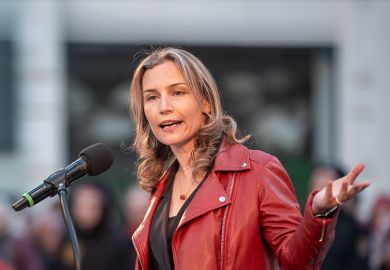
Someone ideally placed to answer that question is Josephine Burton, a playwright and theatre director who has run a company called Dash Arts for 20 years. She was recently appointed practitioner in residence at the University of London’s Institute of Classical Studies, where she will be working on a music-theatre project, Songs of Solidarity, to create a collective epic for our time drawing on both Classical and non-Western models.
Many of the most effective co-creation projects, she said, start with informal, open-ended discussions: “Never go up to someone and say ‘I want to make a project with you’, because that feels forced. Instead, agree to meet for coffee a few times and just talk, be open, listen and see what grows. Understand that the other person is not a channel for your work to travel through.”
A striking example of this was The Great Middlemarch Mystery, developed in 2021, the year that Coventry was UK City of Culture.
Burton had been reflecting on the nature of Englishness in the aftermath of Brexit. Ruth Livesey, professor of 19th-century literature and thought at Royal Holloway, University of London (and now pro vice-chancellor for research and innovation), had a fellowship from the Arts and Humanities Research Council (AHRC) to explore the meaning of provincialism in 19th-century fiction. She had long been fascinated by the way that George Eliot’s 1871 novel Middlemarch felt like an immersive experience.
When a mutual friend introduced them, they started talking. It was thus that they slowly developed plans – and secured AHRC follow-on funding – for an immersive theatrical version of Middlemarch, updated to the 1980s and set across five different locations in Coventry.
Livesey was involved throughout the writing process (although she took a back seat once the production moved into the rehearsal room). She was delighted to have “a rare opportunity to do something a bit more risky or speculative. I found a different voice, after decades of writing academic monographs. It was absolutely liberating and took me to all kinds of places in my work that followed.”
Another major co-creation project arose out of Burton’s chance encounter at a festival with Alan Finlayson, professor of political and social theory at the University of East Anglia.
Together with Henriette van der Blom, professor of ancient history at the University of Birmingham, Finlayson was working on an AHRC-funded project on The Crisis of Rhetoric. He had a theory, Burton explained, that “we all have the ability to be coherent and articulate and write a political speech” so she proposed that the team at Dash Arts “would help them test-drive this theory by asking people to make a speech about what we could do today to change tomorrow, based on their lived experience. We would go round England together, into schools, community centres, prisons, deaf communities, council estates and working clubs to see if Alan was right. We thought it would give us an incredible picture of who we are as a country and who we could be.”
Together, they also secured AHRC follow-on funding for a series of “Speak Out!” public engagement workshops, which were designed to feed into an eventual theatrical production.
“We ran the workshops together, starting with drama games,” recalled Burton. “We helped people with the writing process. Then facilitators helped them deliver their speeches. Alan and I both gave feedback, often drawing attention to slightly different things.”
For the academics, the process enabled them to test their theories about everybody’s innate ability to make powerful speeches. For Dash, the workshops provided vast amounts of raw material that playwright Barney Norris has now woven into a drama set in a pub, said Burton, where “every character is inspired by the people we met”. Our Public House will go on tour from next May.
Burton acknowledged that “academics can find it difficult to share unfinished ideas” and that funders often require “measurable outcomes” yet urged researchers to “show up and feel a bit uncomfortable”, since “a willingness to learn from others is integral to co-creation...the holy grail of these projects is when you come up with something you would never have come up with apart. That’s definitely what happened with Middlemarch and the speech-making initiative. The magic occurred because of the work we did together.”
Register to continue
Why register?
- Registration is free and only takes a moment
- Once registered, you can read 3 articles a month
- Sign up for our newsletter
Subscribe
Or subscribe for unlimited access to:
- Unlimited access to news, views, insights & reviews
- Digital editions
- Digital access to THE’s university and college rankings analysis
Already registered or a current subscriber?