University workers generally do not believe that their jobs will be taken by artificial intelligence in the short term but experts have warned against complacency, saying that automation may still be used as “justification” to cut roles anyway.
While respondents to Times Higher Education’s UK University Redundancy Survey expressed widespread concern about the impact of the tens of thousands of job losses across the UK sector, concerns over the effect of AI remain low.
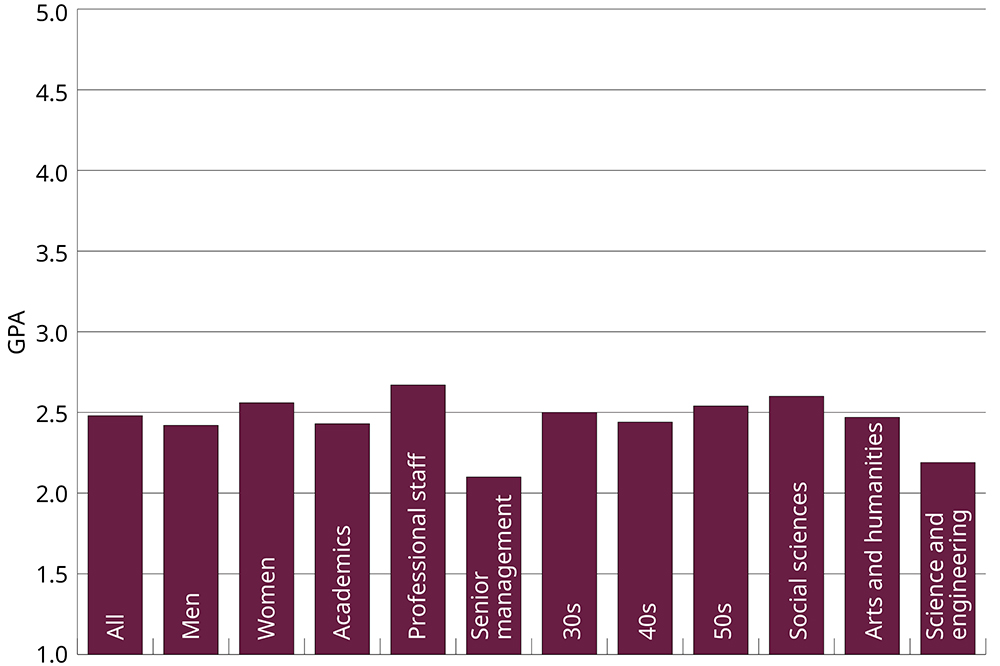
Asked: “Do you fear you will be made redundant within the next three years due to the rise of AI?” more than half (55 per cent) disagreed, with 17 per cent of these strongly disagreeing.
Just under 5 per cent strongly agreed and 14 per cent said they agree, while a fifth (21 per cent) neither agreed or disagreed.
Men were more likely to strongly disagree with the statement compared with women (22 per cent compared with 13 per cent), and a quarter of STEM workers strongly disagreed (25 per cent), compared with 17 per cent of humanities and arts workers and 16 per cent of those in the social sciences.
Academics were more likely than professional services staff to strongly disagree at 19 per cent compared with 12 per cent. While 20 per cent of professional services staff agreed with the statement, just 11 per cent of academics did so. Senior management respondents diverged further, with 31 per cent strongly disagreeing, 16 per cent agreeing with the statement, and none strongly agreeing.
Experts have warned that the findings may show overconfidence, with some respondents flat out rejecting the notion that AI will have any immediate impact on jobs. One outreach worker in their 50s said “my job can’t be done by AI”, and another said, “you need money to implement AI”.
However, many responses revealed a lack of trust from staff towards the intentions of their university management. An English literature academic in their 50s said while “AI can’t do what I can do…there’s no accounting for the short-term thinking of senior management”. Another male academic in their 40s said: “I don’t [think] AI is a threat in what it can do, so much that I think leadership will use it as an excuse to replace staff.”
Professional services respondents were more outwardly pessimistic in their responses. This was captured by a male library worker in their 50s, who said: “how can we not fear that the tasks we do will be carried out by AI?”
To what extent do you fear you will be made redundant within the next three years due to the rise of AI?
Patrice Seuwou, associate professor in learning and teaching at the University of Northampton, said the data mirrors the “complexity of the moment in higher education”.
While he said the results were “no surprise”, he added: “There is a danger of underestimating the indirect impact AI may have on employment structures within universities. The greater problem might not be that AI will simply replace academics, but that universities will use AI as part of broader cost-cutting and restructuring agendas.
“In an already stretched sector, AI could be used as an excuse to make staff cuts, merge posts, automate admin or pile work on to staff, with the rationale that technology will fill the gaps.”
Rose Luckin, emeritus professor of learner centred design at UCL, said much of what is currently described as AI-driven job loss can be seen as “AI washing”, explaining that “cuts driven by funding pressures, overhiring corrections and high interest rates [are] rebadged as automation”.
“The threat is rarely that AI can do the full job of a skilled professional. It is that leadership under financial pressure will use partial automation as justification to cut the role anyway. Several of [the] respondents make exactly this point. The most honest version of ‘AI is taking our jobs’ in UK higher education is closer to ‘financial pressure is taking our jobs, and AI is becoming the cover story’.”
Senior academic roles look relatively protected against AI, she said, whereas junior workers, contractors and many professional services functions “are more exposed”.
“A workforce strategy built only on aggregate numbers will miss what is actually happening. Universities need to think seriously about how junior roles develop into senior ones, because those gateway positions are where the future pipeline of expertise is built. If those posts go, the senior expertise that currently looks safe will not be replaced when this generation retires,” Luckin said.
Register to continue
Why register?
- Registration is free and only takes a moment
- Once registered, you can read 3 articles a month
- Sign up for our newsletter
Subscribe
Or subscribe for unlimited access to:
- Unlimited access to news, views, insights & reviews
- Digital editions
- Digital access to THE’s university and college rankings analysis
Already registered or a current subscriber?