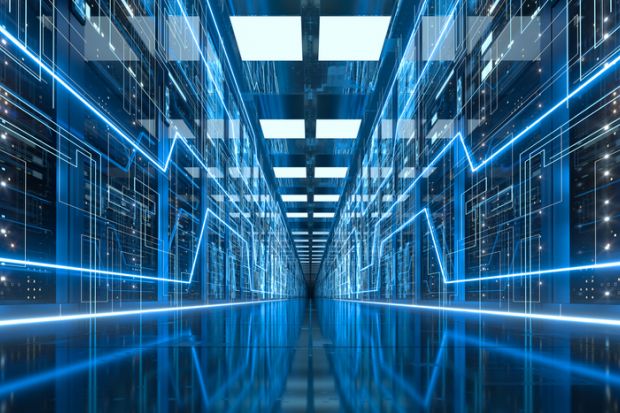
Artificial intelligence (AI) research at universities is intensifying demand for Australia’s already overstretched supercomputers, forcing academics to turn to private facilities that may be unsuited to their needs.
Representative group Science and Technology Australia (STA) says researchers who specialise in machine learning – and can require thousands as much computing power as academics in other fields – are likely to increase competition for use of Australia’s two “tier one” supercomputers: the National Computational Infrastructure in Canberra and the Pawsey Supercomputing Research Centre in Perth.
These two facilities, which are accessed through merit-based applications, are already massively oversubscribed. Applicants this year sought over 2.2 billion “compute” hours, which is almost three times their combined capacity.
The problem appears set to escalate, after an STA survey of more than 1,000 researchers revealed disparate requirements for computing power. While most of the 100-odd respondents who estimated their individual computing needs said they required several thousand compute hours a year each, 21 needed at least 100,000 and nine needed more than a million. One needed 15 million.
Compute hours are equivalent to the capacity of a central processing unit (CPU) operating for an hour. Several respondents also reported huge requirements for graphics processing unit (GPU) capacity. GPUs, which are constructed differently from CPUs, can handle many tasks simultaneously and are well suited to AI applications.
STA chief executive Ryan Winn said over 95 per cent of the estimated need for both types of processing had been concentrated among just 10 respondents. “It shows that the demand is quite complex,” he told Times Higher Education.
Winn said public sector researchers would increasingly turn to private sector computing facilities to undertake their work. But this presented proprietary and privacy problems.
Researchers who developed innovative code on private sector hardware might not own the intellectual rights to the code, and may not be able to transfer it to other systems. “You get provider lock-in, effectively,” Winn said. Researchers could also face legal, ethical and security hurdles if they tried to move sensitive data on to private computing facilities for analysis.
“There are these barriers and complexities,” Winn said. “[It] goes to a general need for standards and transparency about how commercial providers would work.”
The survey asked respondents whether they were prepared to use discounted computing services from commercially operated data centres. Ten per cent said they would, and another 36 per cent said they would consider it if access, cost and technical support hurdles could be overcome.
STA policy chair Kathy Nicholson, who manages the Australian Institute for Machine Learning at Adelaide University, said her staff – machine learning researchers “who use AI every single day” – were looking at using cloud-based and “hyperscale” data centres in “times of absolute need”.
“But if we’re doing anything to do with health or defence, then it has to be our own on-premise facilities,” Nicholson told the Joint Select Committee on Artificial Intelligence, which is examining the opportunities and risks the technology poses.
Pawsey CEO Mark Stickells said there was “definitely a role” for the private sector in providing computing facilities for public good research. But it must be part of a “national framework” that included “sovereign” public capacity, he said.
“It’s an important national critical infrastructure conversation,” Stickells said. “In the same way that we…talk about ports and airports, digital infrastructure and the capability it delivers to scientific discovery is now increasingly part of the core business of our universities.”
Register to continue
Why register?
- Registration is free and only takes a moment
- Once registered, you can read 3 articles a month
- Sign up for our newsletter
Subscribe
Or subscribe for unlimited access to:
- Unlimited access to news, views, insights & reviews
- Digital editions
- Digital access to THE’s university and college rankings analysis
Already registered or a current subscriber?