On the Friday night of the January week when Cardiff University announced plans to axe 400 academic jobs, Wendy Larner was at home, exhausted.
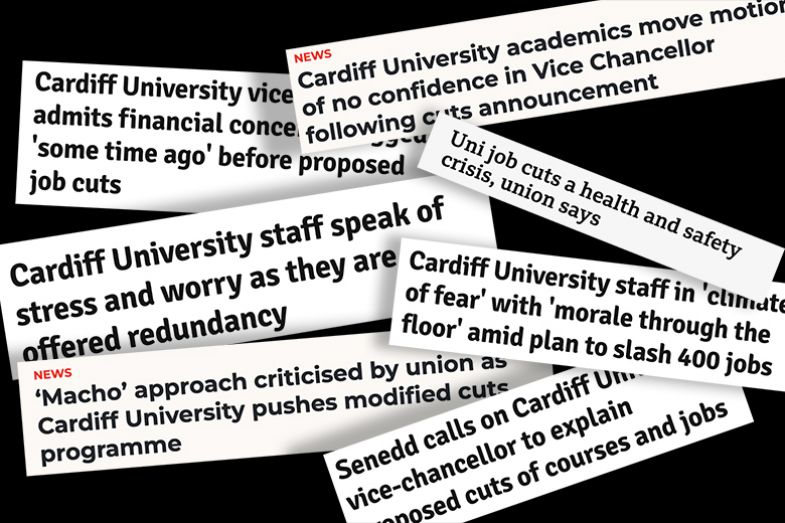
The plan by Wales’ flagship institution to scrap programmes in ancient history, modern languages, music, nursing and theology had been presented as the only way to “adapt to survive” severe financial challenges. Unsurprisingly, however, it had provoked something of a media storm, amid howls of outrage from those affected.
So when Larner’s doorbell rang, she could have been forgiven for thinking twice before answering it. But she did – and was very grateful for having done so.
The caller, as it happened, was a neighbour. “I watched the news with my daughter on Tuesday,” he said. “And my daughter said to me, ‘Daddy, that lady’s really sad. She lives across the street. Do you think we should invite her over to play with my toys?’”
Perhaps mercifully, the neighbour, who introduced himself as a Cardiff graduate, did not insist on Larner taking up his daughter’s invitation. But he had his own token of sympathy to offer.
“I know you’ve had a really hard week,” he said. “Here’s a bottle of wine.”
For Larner, recounting the exchange nearly a year on, that simple gesture was a priceless counterweight to the intense personal scrutiny she had faced all week.
“I’m never going to forget that [conversation]. I almost cried on him,” the social scientist told Times Higher Education.
“But that understanding and sympathy – not for me, but for what we were going through as a university – was something that I heard over and over again.”
The New Zealander had been Cardiff vice-chancellor for little over a year before announcing the restructure – which also included plans to increase student-staff ratios – aimed at addressing a deficit that predated her arrival from the Victoria University of Wellington, where she had been provost.
“Some of the work that had been done in many other universities simply had not been done here and needed to be done,” she said, pointing to programmes with student-staff ratios that were low by sector standards. However, it would “be a mistake to see it as simply a cost-cutting exercise”, she added. It was also an attempt to focus Cardiff’s activities on its strengths, allowing it to support world-leading research and economic growth in Wales.
She dismissed the idea that Cardiff’s course offering should be set in stone. “This university has shifted and changed over time. Schools that didn’t exist historically exist now, and schools that exist now will not exist for the future. Disciplines that existed historically no longer exist; disciplines that exist now will not exist in the future. Universities are living, organic entities. We reinvent ourselves over and over again; we have done since the Middle Ages. I do think we need to get past the idea that we’re these ossified entities that need to continue to look the same, particularly at the current moment,” Larner said.
“I’m really clear, we are at a moment of qualitative change, not just quantitative change. And if we want to do some of those future-facing things that we need to do, we need to be able to think more creatively about who we are and how we organise ourselves.”
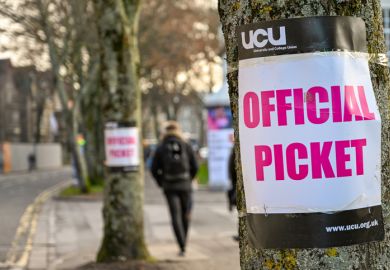
Of course, Cardiff is very far from being alone in making job cuts. According to the University and College Union (UCU), more than 100 UK universities have made redundancies in the past couple of years amid falling real-terms revenues for domestic students and fewer international enrolments. But one thing that was notable in Cardiff’s experience was how much its proposals changed during the consultation process. The target of 400 academic redundancies was later revised down to 138, to be carried out over a number of years. A further 133 staff members left under a voluntary severance scheme. Nursing, music and modern languages were all granted reprieves.
But Larner rejected any suggestion that Cardiff had deliberately gone in hard to make clear to policymakers the scale of the financial challenge that it faces. “I’m a very straightforward person. I don’t do those kinds of politics,” said Larner, a former dean of social sciences and law at the University of Bristol.
Instead, she put the plan’s evolution down to a “genuine process” of listening to staff’s ideas. “People discovered that they could teach programmes more efficiently. They began to think about offerings that leveraged opportunities across the university, not just within individual disciplines or schools. Programmes did discover ways in which they could improve their staff-student ratios, without requiring additional resources,” Larner said.
“And of course, throughout this time, our branch campus in Kazakhstan also came on stream. That was really important for a number of our schools which were in scope [for closure or cuts]. So we ended up where we needed to end up, but the means by which we got there was what changed during the process.”
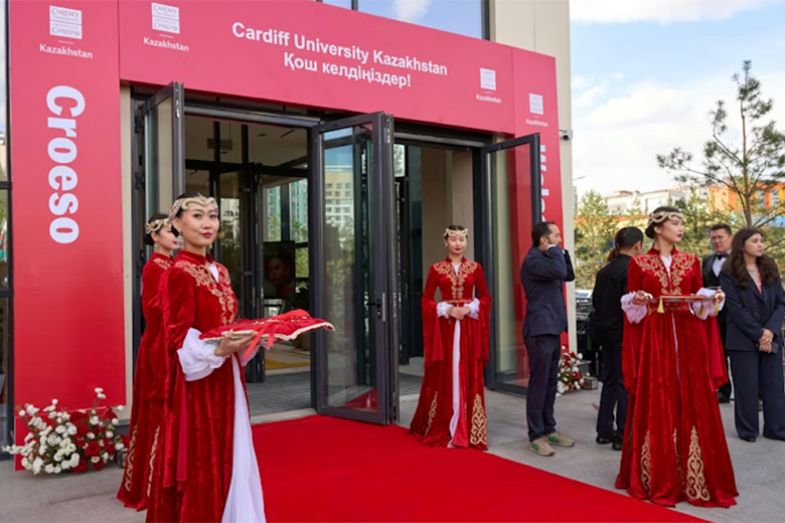
The Kazakhstan campus opened this autumn with 320 students, 300 of whom are being funded via scholarships from the Astana government. Currently, two foundation programmes are on offer, but four undergraduate programmes will be added next year, with more to follow after that.
Larner presented Cardiff’s Kazakhstan campus as a major opportunity for the university, and something that had played an important role in limiting job losses. It will employ a “flying faculty” model, whereby classes will be delivered by Cardiff staff on secondment in Astana for relatively brief periods. This has led some staff to express concern that their jobs will only be safe if they are prepared to travel regularly to central Asia. Larner insisted, by contrast, that no staff will be required to go to Astana if they don’t want to – but those who had already been had “fall[en] in love with the place”.
Some academics have also argued that Cardiff’s focus should remain firmly on its core activities in Wales at a time when its finances and the mood of staff appeared so delicate – rather than jumping into bed with a country that has a history of human rights abuses.
However, “any country that you might think of that is associated with [transnational education] is grappling with those kinds of cultural challenges,” Larner said. “The Kazakh government themselves understand that they’ve got work to do in this space. And in fact, part of the reason why they’re investing so much effort into transnational education…is because they know they need to be different for the future. So this is an enormous success story for us, for Wales, [and] the UK more generally.”
It sounds like Kazakhstan is just the start for Cardiff’s offshore ambitions, with future transnational education projects in China, India, Malaysia, Singapore and the US in the pipeline. This was a clear direction of travel, Larner said: “If international students aren’t coming to us in the same numbers, we do need to go to them.”
Larner hailed the “amazing” students Cardiff has recruited in Kazakhstan, as well as the support it has received from local ministers and an educational foundation – which means that Cardiff is not having to invest any capital in the project.
As for accusations that TNE amounts to neocolonial exploitation, with the Western university always taking the lead and the profits, Larner insisted that “TNE is thought about these days in a very different way. This is not a colonial extractive model. These are deeply reciprocal relationships, whereby we build not just educational partnerships but also new research opportunities and new country-to-country relationships, [such that] we are learning just as much from our partners as our partners are learning from us.”
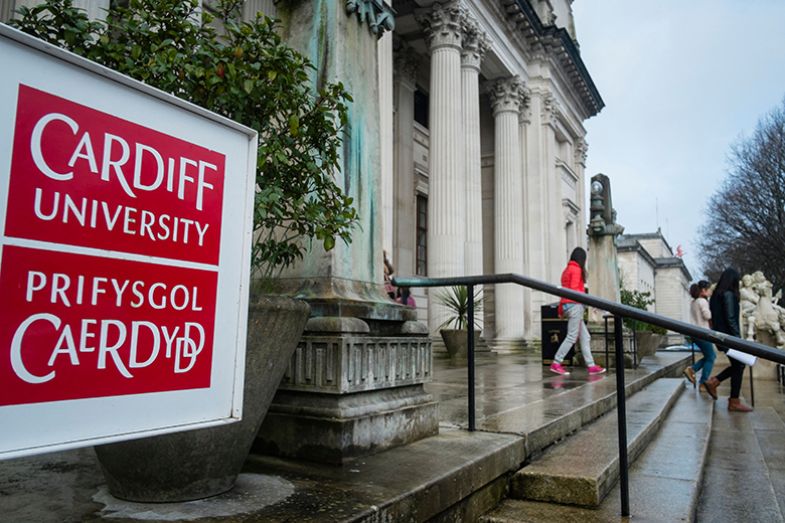
All the debate around Cardiff’s future plans only underlines for Larner how important the university – the principality’s leading research-intensive and only Russell Group member – is to both its city and the wider region. And with that comes a “really strong sense of ownership” among local people and politicians, she said.
“The thing about Wales and the Welsh economy is [that] it’s a public sector economy by and large. Universities genuinely are anchor institutions in an extraordinary kind of way. So it is our success that will drive the success of the city region – and, indeed, of Wales more generally. That’s some of the repositioning that we are trying to do,” she said.
Larner attributes some of the criticism to the fact that the university “went early”, seeking to wrap up its academic reorganisation within 2024-25, and targeted academics first, rather than professional services staff. She remains “absolutely convinced that is the right order in which to do things, because how do you know what you’re going to do with your professional services or your estate if you don’t know what your academic future looks like?”.
Nevertheless, she expressed “deep regret” that many staff and students had learned about the cuts from the media rather than from the university, after details of the proposal were leaked. Hence, Cardiff’s subsequent, ongoing plan to restructure its professional services teams, which affects more than 1,000 staff, was announced to all employees simultaneously, rather than being “cascaded” through the organisation, as the academic changes had been.
While the “adapt to survive” plan might have been drastic and imperfectly announced, none of that seems to explain why the personal criticism of Larner reached quite such vitriolic levels. The nadir was when a transcript of comments she made in 2018 about epigenetics – the study of heritable changes in gene activity separate to alterations in DNA itself – was used to claim that she had suggested poverty may be caused by genetics. Larner took the unusual step of issuing an all-staff email claiming that her words had been “grossly (and wilfully) misinterpreted” and saying that it was “deeply disappointing” that the local UCU branch had chosen to “endorse” the allegation.
“It is not easy to have your personal integrity impugned in the way that my personal integrity was,” she said. “While I was prepared for that, I wasn’t prepared for some of the more outrageous commentary – and I remain appalled by that.”
Nevertheless, recalling her Friday night doorstep conversation, Larner insisted that the hostile media coverage was not reflective of the many more conciliatory conversations she had had about her plans.
“It was quite extraordinary to me: both the opinions that you saw in the media, but [also] the number of people who just came up quietly to me in the street or in the supermarket, let alone on campus, saying, ‘Look, I know what you’re doing is really hard, but I also know that it has to be done because we really need Cardiff University to be successful,’” she said.
“I would not read a few loud voices as being representative of the wider discussion. It was hard; everyone understood it was hard. It was deeply emotional; these are people’s lives. But don’t believe everything you read in the newspapers.”
Register to continue
Why register?
- Registration is free and only takes a moment
- Once registered, you can read 3 articles a month
- Sign up for our newsletter
Subscribe
Or subscribe for unlimited access to:
- Unlimited access to news, views, insights & reviews
- Digital editions
- Digital access to THE’s university and college rankings analysis
Already registered or a current subscriber?