The future of a project that sought to build a new top university from scratch in the desert in Saudi Arabia is shrouded in “mystery” amid reports that the “megacity” in which it was to be located faces being massively scaled back.
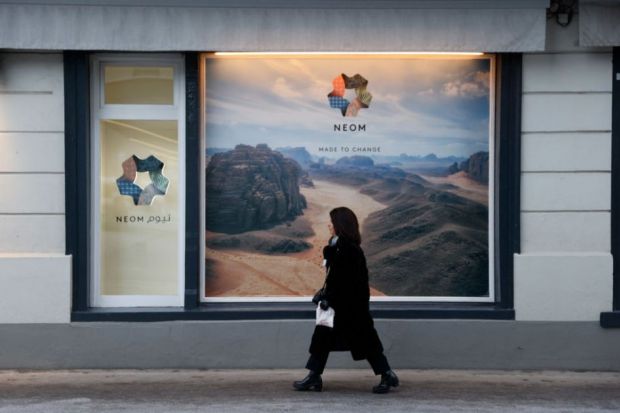
Neom University had been expected to launch its first courses in 2025, but there are now questions over whether it will ever get off the ground, although some scholars believe it can be salvaged as a more specialist institution.
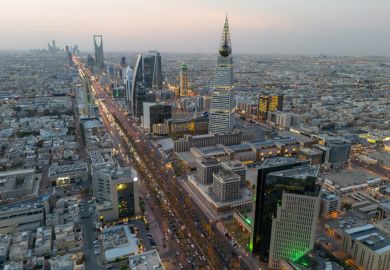
The university was set to be situated within the hugely ambitious Neom project, conceived as a sustainable city in the middle of the desert covering an area the size of Belgium, which has an estimated cost of $500 billion (£411 billion).
Known for its sci-fi-esque architecture, including “the line”, a 177km-long linear city housing 1 million people without conventional cars, and “the chandelier”, a 30-storey glass-and-steel building that would be suspended from a shipping passage, recent reports have suggested the planning for the city has been paused.
Many of these flagship projects now look unlikely to ever happen, or face being scaled back, after Neom encountered problems with funding and technical barriers.
Neom U, which was hailed at time of launch as having the potential to become “Saudi Arabia’s premier and best-resourced research institution” and rival the likes of King Abdullah University of Science and Technology (KAUST), deemed one of the most prestigious universities in the Middle East, is also in doubt.
Online courses that were due to start at the university have failed to materialise and questions hang over when – and if – the institution will open its doors.
“Announcements are one thing, but implementation is something very different,” said Annalisa Pavan, an independent researcher and consultant on Saudi Arabia.
She said that there is “great potential” for Neom U, but the lack of movement in recent years means “many question marks” remain over its future, calling it a “blank canvas” and a “mystery”.
“Am I optimistic at the moment? No, I’m not, because after nearly four years, this is what we have? Just a website and a president? Are they opening an actual campus? Do they have a scholarship programme to attract students from all over the world like KAUST or other Saudi universities? So there are many unanswered questions,” she said.
The Asian Winter Olympics, which will be hosted by Saudi Arabia in 2029, and the Saudi Football World Cup in 2034 mean projects like Neom have been sidelined, she said, adding further delays.
Christopher Davidson, an expert in Middle Eastern politics and fellow at the European Centre for International Affairs, meanwhile argued that Saudi Arabia’s growing interest in artificial intelligence since the publication of its Vision 2030 strategy in 2016, which outlines the country’s plans to diversify away from an oil economy, could be a benefit to Neom U.
“I think the superficial reaction would be to say that Neom U would be downscaled or suffer somehow as a result of the downscaling of the overall Neom giga project,” he said.
“However, the last three years have actually been a great catalyst for Neom U, especially due to Saudi Arabia’s massive interest and investment to essentially turn itself into a West Asian AI hub. Neom University is now far more critical to Saudi Arabia’s future infrastructure than it was three years ago.”
AI wasn’t even something “on the horizon” previously, but the Gulf states have both the capital and the relations with China and the US to become a world player in this area, he said.
Neom won’t be “quite as we envisaged it three or four years ago”, Davidson argued, and instead of trying to compete with the likes of KAUST, it may look to rival the likes of MBZ University of Artificial Intelligence in the United Arab Emirates – “the most successful educational institutions in the past few years in terms of peer-reviewed papers”.
He noted that Neom U has signed various agreements to work with KAUST on projects developing the hydrogen economy, on which he said they “appear to be collaborating in a couple of areas, and I don’t think now they’re going to end up being the same sort of campus”.
“There are already signs that it’s starting to identify its niches – aquaculture, for example, [as it’s] being positioned on the Red Sea, as well as green hydrogen renewables, which Saudi Arabia is also betting very heavily on. So it will perhaps be less of this vision of an all-encompassing multidisciplinary university than may have initially been envisaged, and instead, more of a highly specialised institution.”
Pavan, however, still had doubts. “I’d like to be optimistic, miracles do happen,” she said. “But I’ve never seen one.”
Neom declined to comment.
Register to continue
Why register?
- Registration is free and only takes a moment
- Once registered, you can read 3 articles a month
- Sign up for our newsletter
Subscribe
Or subscribe for unlimited access to:
- Unlimited access to news, views, insights & reviews
- Digital editions
- Digital access to THE’s university and college rankings analysis
Already registered or a current subscriber?