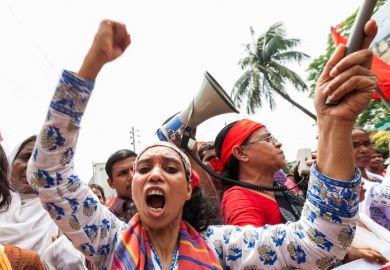
Student protests in Dhaka have been suspended after the education ministry promised progress on long-delayed plans to establish a new institution.
The demonstrations, held outside Shikkha Bhaban, the headquarters of Bangladesh’s secondary and higher education authority, were paused last week after officials said an inter-ministerial meeting would be held by 25 December.
Student representatives warned protests would resume if the promised timeline is not met.
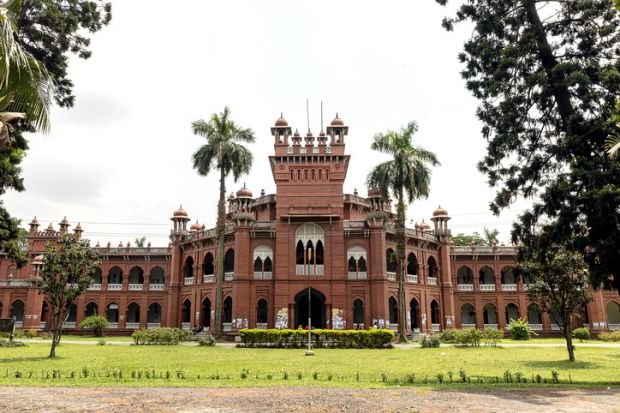
The meeting will review a revised draft of the ordinance that would create Dhaka Central University, a merger of seven large public colleges in the capital that were previously affiliated with the University of Dhaka.
That affiliation model, under which the University of Dhaka oversaw examinations, administration and degree certification, was formally cancelled in January following years of student demands for a separate institution.
Students and officials backing the proposal have said the new university would reduce administrative pressure on the University of Dhaka, address long-standing academic delays and give the colleges greater institutional autonomy.
However, disagreement over the structure of the new institution and uncertainty around legal and administrative arrangements have repeatedly delayed its formal establishment.
According to Tariqul Islam, assistant professor at the School of General Education at BRAC University in Bangladesh, the delays reflect the complexity of the reform rather than a single administrative failure. “The government is seeking extensive stakeholder feedback in revising the ordinance, and this consultation process is taking time,” he told Times Higher Education.
“Existing teachers and staff raised objections about the proposed structure. They are concerned about their job security and the proposed restructuring of the departments,” he said.
Unresolved academic questions also remain central to the dispute.
“The problems of academic operational procedures, such as the admission process, academic programmes, and higher secondary levels, remain unresolved,” Islam said.
Practical and political considerations have further complicated decision-making.
“The proposed ordinance will change the employment terms and conditions of many BCS teachers and other staff,” Islam said.
“From the students’ and alumni’s perspectives, some colleges have a historical reputation and want to protect it. Local political actors also support this demand.”
He added that the government is likely to weigh political consequences carefully before finalising the ordinance.
Official statements indicate that the merger is intended to improve administrative accountability by creating a dedicated governing body, rather than continuing to rely on the University of Dhaka.
The government has also said the new university would help address academic session delays and create a clearer institutional identity for the colleges.
If established under the current draft, Dhaka Central University would reorganise the colleges into four academic schools, changing governance and decision-making structures. “Not all subjects would be taught in every college, allowing departments to focus more on academic quality assurance,” Islam said.
While students could face short-term enrolment barriers due to admission caps, he noted that they would ultimately receive degrees from an autonomous university rather than from affiliated colleges.
Islam said the protests reflect broader challenges in Bangladesh’s higher education governance.
“The demonstrations reflect accumulated student frustrations stemming from DU-affiliation-driven administrative overload and their uncertain identities,” he said, adding that repeated protests point to weak stakeholder engagement and concerns about how policies are implemented.
While the suspension of protests has created space for further negotiations, Islam warned that continued uncertainty carries risks.
“Delays without an accepted timeline must deepen students’ academic losses and reduce trust in policymaking and implementation in Bangladesh’s higher education sector,” he said.
He added that a transparent process, phased implementation and clear protections for staff and students could still allow the reform to address long-standing problems in Bangladesh’s public higher education system.
Register to continue
Why register?
- Registration is free and only takes a moment
- Once registered, you can read 3 articles a month
- Sign up for our newsletter
Subscribe
Or subscribe for unlimited access to:
- Unlimited access to news, views, insights & reviews
- Digital editions
- Digital access to THE’s university and college rankings analysis
Already registered or a current subscriber?