The number of US students coming to the UK is unlikely to keep rising and universities should not pin their hopes on recruitment from a structurally tough market, a vice-chancellor has warned.
Recent figures from the Higher Education Statistics Agency show there were a record 23,565 US students enrolled in UK universities in 2024-25 – up from 22,955 the year before.
The University of St Andrews has consistently had the largest contingent since at least 2014-15 – rising to a record 2,270 in the latest data. With this representing a fifth of the total student body, the institution has been labelled a “mini-Nantucket”.
Sally Mapstone, the principal and vice-chancellor of St Andrews, told Times Higher Education that the university has been able to grow its US contingent steadily through relationships with schools and counsellors, regular in-country visits, and strong alumni advocacy.
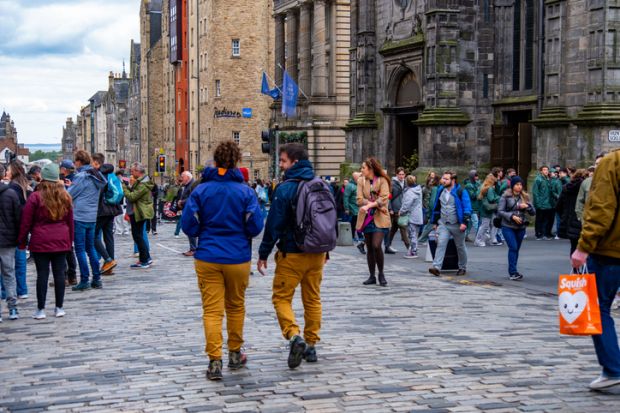
Over a quarter of US students within the UK are based in Scotland. Mapstone said the country has a long-standing reputation in Washington for academic excellence, intellectual independence, and a “distinctive undergraduate experience”.
Stuart Easter, director of international partnerships and student recruitment at Edinburgh Napier University, said Scotland is known for its reputation for safety, quality education, and “beautiful landscapes”.
His university more than doubled its US intake in 2024-25 to 200 – and expects to see further increases in 2025-26.
Along with a new marketing campaign featuring a US student, Easter cited historic connections between Scotland and the US, and “word of mouth” recommendations from students.
“Many [are] able to trace family links and want to experience a bit of their own ancestry,” he added.
Many of the US applicants captured in the Hesa figures would have applied before the Trump administration. More up-to-date data from Ucas suggests undergraduate student numbers, who make up over half of the US contingent in the UK, are rising post-Trump.
A record 6,920 were accepted on to undergraduate courses for 2026 – up from 6,680 in 2025.
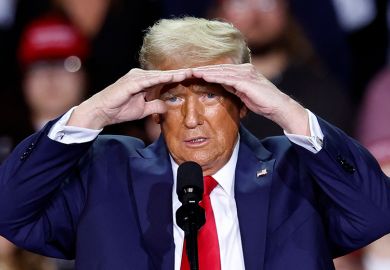
But Phil Deans, president and vice-chancellor of Richmond American University London, warned that any “Trump surge” – if there is one – will not be sustainable.
“Everyone’s looking for US students because the English language skills are there, they’re low risk in terms of visas, most of them are funded in various ways, so it’s an attractive group of people but it’s still a very challenging market to work in.
“It’s not the new China, and it’s not the new India. American students are very useful at plugging some gaps as part of a broad strategy. But there are structural issues in the US student market…which means it’s a very difficult place to operate.”
With federal laws preventing the use of agents to recruit students, administrators must do it themselves – with different conditions in each state. There are also different tax rules across the country, and a strong emphasis on discounting tuition fees.
Deans said there is “confusion and complexity” in recruitment, and there is a structurally profound problem ahead with the number of 18-year-olds soon to start declining.
This demographic cliff is particularly affecting more liberal states, such as California and New York, where many of the visiting students come from, he added.
“Where the population’s still growing is Florida, Texas, those areas which tend to trend red and be more Trumpy – more MAGA [Make America Great Again].”
Deans said there are also regulatory differences which can make it quite confusing for students coming directly from US schools – particularly unease with the UK grading system.
“For British universities, it’s like taking a Mac disk and sticking it in a PC and nothing quite works because the grading systems are different, and the approaches are different.
“While they’re low maintenance in some respects, their parents aren’t. The stereotypical soccer mum really does get involved. They are hard work in a way that British parents and European parents aren’t.”
Some universities may be turning to the US to reduce reliance on countries such as China or India, which are seen as potentially geopolitically risky.
But Deans said the Trump administration is making communication harder by shuttering the Department of Education, and might suddenly introduce restrictions on federal student aid being used abroad.
“That would sink the US market really, really quickly, so anybody involved in the US needs to keep a close eye on that risk, because it could happen on a whim.
“America’s a mess, it’s really difficult right now. I think in some ways where the benefit to the UK will come from is not necessarily more American students, but more international students declining the US because of the uncertainty.”
Register to continue
Why register?
- Registration is free and only takes a moment
- Once registered, you can read 3 articles a month
- Sign up for our newsletter
Subscribe
Or subscribe for unlimited access to:
- Unlimited access to news, views, insights & reviews
- Digital editions
- Digital access to THE’s university and college rankings analysis
Already registered or a current subscriber?