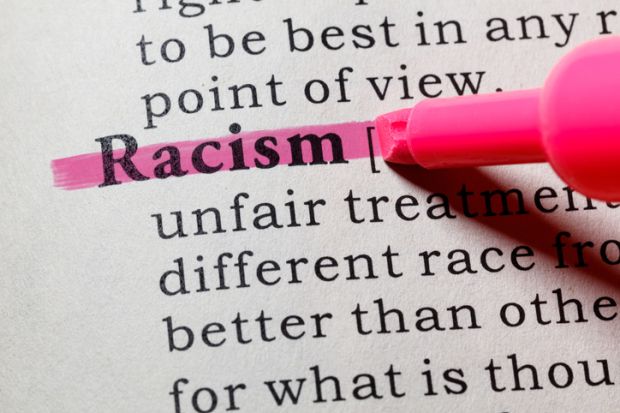
Australian campuses are hotbeds of xenophobia, according to a report from the Australian Human Rights Commission (AHRC), which has found that “pervasive” racism in universities has “a profound impact on people’s lives”.
The 248-page report, produced on the recommendation of the Australian Universities Accord, says racism is “deeply entrenched” in policies and practices that “exclude, dismiss and invalidate – even if no racial slurs are said”.
The “harrowing” racism occurs in “multiple forms”, from interpersonal discrimination – including assault, threats and ridicule – to systemic inequities.
Racism spikes during global events like the coronavirus pandemic, the indigenous voice referendum and the Israel-Hamas war. But the report says it is rooted in historical foundations like the state-sanctioned oppression of indigenous people and the 20th century White Australia policy.
Campus racism also intersects with “marginalisation” over gender, religion, sexuality, socioeconomic status, disability and physical appearance, the AHRC says. “This report provides a clear, evidence-based path forward, with the voices and stories of staff and students who experience racism at its core,” said race discrimination commissioner Giridharan Sivaraman.
“It is an opportunity for government and universities to honour those voices, dismantle racism and create institutions where safety, belonging and respect are lived every day.”
Central to the report’s 49 recommendations are a demand for the government to fully implement and fund the National Anti-Racism Framework unveiled by the AHRC in November 2024. “We cannot wait any longer as racism continues to impact the lives of many in visceral ways,” Sivaraman said.
His report also requests funding to conduct “independent annual reviews” of universities’ progress in battling racism.
Recommendations for universities include whole-of-organisation anti-racism plans, annual public reporting on anti-racism activities, improved complaint procedures, “culturally safe” support services and “comprehensive” anti-racism and cultural competency training.
“Fragmented or reactive measures will not suffice,” the report says. “Systemic change demands coordinated leadership and sustained commitment.”
Education minister Jason Clare said the government would consider the recommendations as part of its broader higher education reform agenda. “Universities aren’t just places where people work and study,” he said. “They are also places where people live, and we need to ensure they are safe and free from racism.
“When we announced this study, we said it would listen to students and staff and shine a light on their experiences. This report delivers that.”
The findings are based on a nationwide survey of 76,131 respondents – around 20 per cent of staff and 3 per cent of students – together with a literature review, an audit of university policies and focus groups with 310 participants.
Around 15 per cent of survey respondents reported experiencing direct interpersonal racism at university over the past two years. Seventy-odd per cent reported “indirect” racism against their racial, ethnic, cultural or religious groups.
Both forms of racism were reported at high rates across the ethnic spectrum and particularly by Palestinians, Jews, indigenous Australians and Middle Eastern people. Up to 6 per cent of respondents did not experience direct or indirect racism, but witnessed it inflicted on others.
Greens education spokeswoman Mehreen Faruqi said the report had exposed the “terrifying truth” that racism in universities was “the rule” rather than the exception. “This report may come as a shock to those who don’t experience racism, but for the rest of us it is business as usual.”
Faruqi said the government must adopt the report’s “systemic whole-of-racism” reforms and “scrap” the “one-sided” antisemitism report cards. “Cherry picking one type of racism over others does nothing to dismantle structural racism embedded in policy and practice,” she said. “It only entrenches the systems of discrimination we should be dismantling.”
The Council of Australian Postgraduate Associations (Capa) said higher degree by research (HDR) students experienced racism at a higher rate than their undergraduate peers – particularly female international PhD students. “Racism from supervisors can manifest as preferential financial or resource support [or] discrimination when it comes to authorship on publications, all of which have huge repercussions on a candidate’s future,” said Capa president Jesse Gardner-Russell.
“When your supervisor controls your funding, research direction and academic future, reporting their racism isn’t just difficult – it can feel impossible,” said CAPA board chair Gemma Smart. “We need independent grievance pathways that protect HDR students from retaliation.”
National Tertiary Education Union president Alison Barnes said the results revealed a “systemic” workplace crisis. “Our colleagues’ careers are being derailed, their mental health is suffering and they’re being driven out of the sector because of racism.”
For staff, racism occurred most frequently in shared workspaces and meeting rooms, while students experienced it particularly in classrooms and other small learning spaces.
Just 6 per cent of victims of direct racism said they had complained about it. Of these, around seven in 10 reported dissatisfaction with the complaints process.
The audit found that just 11 of Australia’s 40-plus universities had “advanced” anti-racism policies and strategies. “Racial literacy” was low, with “minimal” training on systemic racism and racial dynamics.
Workforce diversity strategies focused mainly on indigenous Australians, “with very few structured initiatives for other staff who experience racism”.
The AHRC acknowledged “inevitable” limitations in the research, including possible response bias due to an over-representation of people with “strong views or experiences”. The commission mitigated this risk by taking a “census” approach, “making it clear all were invited”, “prioritising confidentiality” and including open-ended questions.
“Our study had a very strong response rate and the story it tells simply must be acted on. While [it] reflects that racism in universities often mirrors broader societal patterns, and in some cases may be less severe than in other settings, universities should be held to a high standard.”
In a statement, Universities Australia said the report’s findings were deeply troubling. “We recognise that many individuals and groups on our campuses – as in the broader community – experience racism, hate speech and harassment.
“Universities…are required by law to take academic freedom and freedom of speech seriously, and we are committed to these ideas as a matter of principle, but they can never justify harm.”
UA said universities had been “working to address racism in all its forms” but the survey reinforced the need for “coordinated, principled and sector-wide” action. It supported the establishment of a “Racism@Uni” working group to develop a coordinated action plan for the sector, in line with the report’s initial recommendations.
Register to continue
Why register?
- Registration is free and only takes a moment
- Once registered, you can read 3 articles a month
- Sign up for our newsletter
Subscribe
Or subscribe for unlimited access to:
- Unlimited access to news, views, insights & reviews
- Digital editions
- Digital access to THE’s university and college rankings analysis
Already registered or a current subscriber?