Venezuelan academics are pessimistic that a change in leadership will improve the fortunes of the country’s downtrodden universities after the shock ousting of leader Nicolás Maduro.
Delcy Rodríguez has been sworn in as the country’s interim president following the dramatic seizure of Maduro by US forces.
Despite Rodríguez’s past as a professor at the Central University of Venezuela, academics are doubtful that her ascension will be beneficial to the country’s higher education system and have warned that “profound” political change is needed if universities are to recover from years of attacks.
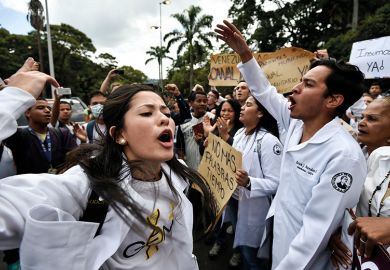
Venezuelan universities suffered under Maduro’s reign, with economic decline leading to severe budget cuts. Hyperinflation means salaries have dipped to meagre amounts, with reports suggesting that pay for professors averaged $15 (£12) per month in 2020, while student numbers have fallen dramatically.
Meanwhile, the deposed leader’s administration was known for jailing scholars it saw as critical of the government and has been accused of installing those with pro-Maduro views in leadership positions at universities.
These attacks, combined with the economic crisis, have driven many scientists and academics out of the country. A 2020 study found that Venezuela has lost 16 per cent of its scientific research workforce as a result of emigration.
Benjamin Scharifker, emeritus professor at Simón Bolívar University in the capital Caracas, said the country’s university system and scientific institutions “absolutely collapsed” under Maduro, with attacks on universities seen as a way to maintain power.
“If you collapse the universities, then you also collapse the possibility of students going to the street and protesting against the government,” he said.
While they might not be grieving Maduro’s departure, academics said Rodríguez, who has been vice-president since 2018, was not seen as any better. “We are only changing a face,” said Scharifker, with many of those who ruled under Maduro remaining in power despite his departure.
Jorge Rodríguez, for example, was reappointed president of Venezuela's National Assembly days after the US attack. Rodríguez, the interim leader’s brother, previously held academic posts at universities in the country and was a prominent student leader.
But, despite its links with the higher education sector, the Rodríguez family is not thought to be interested in helping universities recover from years of damage.
“I don’t think that somebody that in 25 years has done [nothing] for the university will start doing it now,” said Jaime Requena, member of the Academy of Physical, Mathematical and Natural Sciences of Venezuela and a researcher on brain drain. “I would be extremely surprised.”
“It is a tremendous task to rebuild,” he added.
Although the US might influence the country’s future policy direction, academics were doubtful that president Donald Trump would be interested in prioritising the university sector. In the US, Trump’s second presidency has been characterised by a crackdown on higher education, including funding cuts.
And, while new ties with the US could make travel into and out of the country easier after a period of international isolation, many academics are unlikely to return without economic and political reform, Requena said. “You cannot have a research system working in a place where there is no freedom.”
He added that international cooperation and partnerships, including loans, will be crucial to the future recovery of the sector.
“If you don’t have political freedoms, then you cannot really be a university professor,” Scharifker agreed.
“If we really want science to recover to…the level that we once had many years back, we need a profound political change in Venezuela – not only the change of who is sitting in the presidential palace, but really what are the policies, and that I think that is not going on in Venezuela at the moment.”
Register to continue
Why register?
- Registration is free and only takes a moment
- Once registered, you can read 3 articles a month
- Sign up for our newsletter
Subscribe
Or subscribe for unlimited access to:
- Unlimited access to news, views, insights & reviews
- Digital editions
- Digital access to THE’s university and college rankings analysis
Already registered or a current subscriber?