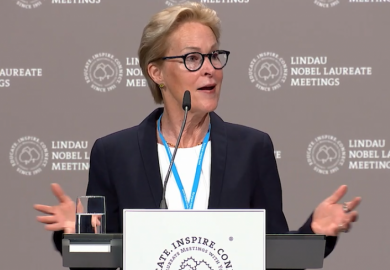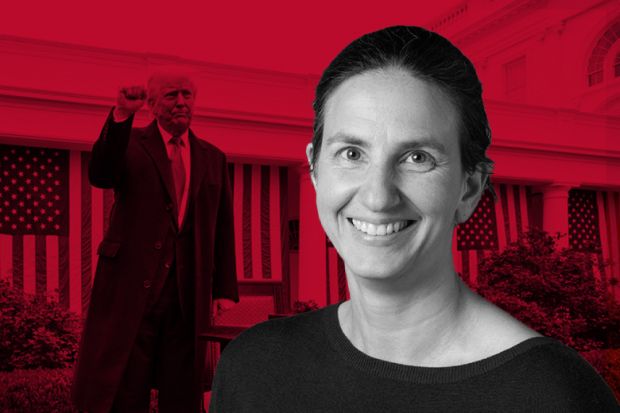
During the dark days of the Covid pandemic, as a handful of scientists became vital to the public for analysis of latest trends, Christina Pagel stood out for her cool-headed analysis of what was happening.
Unlike many other scientists who made their name at that time, Pagel did not initially train in public health, instead taking a PhD in space physics, before later becoming a professor of operational research at UCL, with a focus on healthcare.
In more recent years, Pagel has pivoted again, using her skills in data-tracking and public communication to lift the lid on what is behind Donald Trump’s most egregious policy decisions.
Pagel is behind the Trump Action Tracker – the world’s only comprehensive dashboard of the actions, statements, and plans of the Trump administration.
Along with her small team of volunteers, she has manually logged almost 2,500 examples that may “pose a threat to American democracy” since January 2025.
Pagel said her “slow slide” from public health research came from trying to make sense of the sheer volume of actions taken by the White House in those first few months – it quickly became apparent that there was a pattern to what seemed like a “scattergun” approach.
“In most cases, you cannot just see the escalation in activity, you can see the growth of the legal underpinning of the way that people are trying to prepare the ground,” she told Times Higher Education.
The data allows readers to see how rules around what Immigration and Customs Enforcement (ICE) can do were changed early on – leading to their significant role in the administration’s immigration crackdown now.
“I guarantee you that you’ll be able to track whatever happens at the midterms back to the beginning of his term, in terms of the attacks on voting and undermining public confidence,” Pagel added.
The White House has largely adopted right-wing mogul Steve Bannon’s tactics of “flooding the zone” to disorientate opponents. For Pagel, the tracker is a method of fighting back against that – and a “way to sift through the shit” – because such attacks become normalised very quickly, she said.
She said the tracker, which is provided largely free from commentary, is a contemporaneous record of what happened that will be useful for both historians in the future, and journalists now.
Her background in statistics allows her to be able to take a step back from the media’s approach of writing stories every day to try and keep up with the administration’s actions, she said.
“There isn’t a lot of technical expertise in it. I’m finding things and I’m listing them and I’m categorising but I do think that coming from my background means that I could see the value in doing that quite early on.”
Pagel, a member of the independent Scientific Advisory Group for Emergencies (Sage), said she also hopes that data can be used by people around the world to think about what checks and balances are needed in their own countries.
Of the actions recorded in the data so far, 404 relate to Trump’s attempts to control science and health to align with state ideology, and 185 to attacks on universities, schools, museums and culture.
Pagel said universities are attacked because that is where resistance to authoritarian regimes often starts.
“What you need in a populist regime is you want to have control of the narrative, and science goes directly against that, it’s not about controlling a narrative, it’s about evidence and critical thinking.
“It’s about trying to make sure that all of the benefits of the elite are with people in the government, and so there is always this concerted attack on independent sources of evidence.”
For Pagel, part of her motivation for stepping into a new area stems from her dual German-British identity – with her parents both born in Nazi Germany.
“I’m not kidding myself that I’m doing anything particularly impactful, but I feel like I have to do something, and this is what I think I can do.
“Maybe I wouldn’t be the person you would pick automatically to do this, but I’m the one that happens to be doing it, and there isn’t anyone else.
“And I guess that’s kind of how I see it with Covid as well, that’s what I ended up doing, and I tried to do as good and an honest job as I could and it’s what I’m trying to do now.”
Register to continue
Why register?
- Registration is free and only takes a moment
- Once registered, you can read 3 articles a month
- Sign up for our newsletter
Subscribe
Or subscribe for unlimited access to:
- Unlimited access to news, views, insights & reviews
- Digital editions
- Digital access to THE’s university and college rankings analysis
Already registered or a current subscriber?