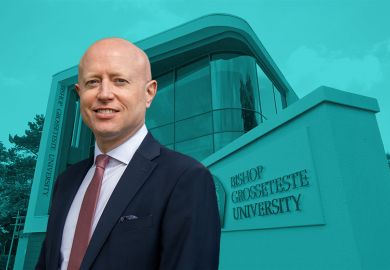
Questions have been raised over how much influence a private education group has over a UK university after it provided it with a crucial loan to cover cash flow, with critics labelling the move an “institutional takeover by stealth”.
Earlier this year, accounts revealed that, facing “significant financial risk”, Lincoln Bishop University (LBU) turned to the company Global University Systems (GUS) to form a “strategic alliance”.
The agreement involved a loan – suggested by one source to be worth £5 million – to cover points in the cycle where the university had low cash levels but sources with knowledge of the negotiations said this came with strings attached.
It has since emerged that figures with ties to GUS have been appointed to the university council in recent months.
Alfred Morris, chairman of Higher Education Associates and a non-executive director at GUS, is one of those taking a seat, as is Mary Bishop, former director of learning at the Royal Society of Medicine who is currently deputy chair of the board at Arden University, which is part-owned by GUS.
Douglas Blackstock, former chief executive of the Quality Assurance Agency for Higher Education and adviser to the University of Law and FutureLearn – which GUS owns – has also joined the council.
The university stressed that it those appointed were “independent” and were brought in for their expertise in strategy, quality and finance to “further strengthen institutional governance”.
But the GUS influence also appeared to extend to other areas of the university’s operations.
LBU recently advertised for a founding dean of a new business school on its campus, aligning it closely with a key specialism of GUS, which runs several business education providers in the UK and abroad.
Sources also said that the University of Law was looking to establish a base on LBU’s campus.
Although this would not be usual for the institution – which already works with several universities across the country – the pivot to law and business has left some to question whether LBU, a small university that has traditionally specialised in teacher training, is being pulled away from its roots.
“I guess for people who’ve always worked in public universities, any suggestion that the private sector is taking over is always going to be concerning…and LBU have been quite coy about it,” said one source, who added that little had been said publicly about the changes in provision.
“Presumably if they thought that they could have invested in those [law and business], they would have done that for themselves. Maybe getting this loan is a way to do things that they couldn’t do otherwise, that they think will rescue them, but we don’t know any of those things if they don’t tell us.”
Another source said that LBU was at real risk of becoming “the first institutional collapse” before GUS “came charging over the hill on a white steed with a £5 million line of credit”, adding that the board appointments and GUS-backed operations setting up on campus “feels a little bit like an institutional takeover by stealth”.
They said academics would be relieved that the university has survived but could quickly “have their noses out of joint” once they understand how the institution is set to change under the partnership.
Dennis Hayes, emeritus professor of education at the University of Derby and director of the campaign group Academics for Academic Freedom, said it was a complex issue and not simply one about privatisation.
“The issues at LBU are yet another example of the severe financial problems facing UK universities. GUS has a network of institutions with a focus on the industrial or commercial application of knowledge. LBU have a reputation for teacher training and they offer apprenticeships.
“There may be some basis here for a successful collaboration. Fears about privatisation may be misplaced. But we may be seeing the beginning of a breakup of the traditional state-funded university.”
A spokesperson for LBU said that the university has “begun a new chapter focused on renewal, sustainable growth and deepening its civic impact” – with its plans demonstrating a “commitment to social purpose, widening participation and service”.
“Our strategic alliance with Global University Systems builds on three years of collaboration and supports these ambitions, particularly in areas such as international recruitment and online delivery,” they added.
“Academic direction, standards and governance remain firmly under the authority of University Council and Senate who have, as part of a planned refresh of Council membership appointed additional independent members with expertise in strategy, quality and finance to further strengthen institutional governance.”
GUS was approached for comment.
Register to continue
Why register?
- Registration is free and only takes a moment
- Once registered, you can read 3 articles a month
- Sign up for our newsletter
Subscribe
Or subscribe for unlimited access to:
- Unlimited access to news, views, insights & reviews
- Digital editions
- Digital access to THE’s university and college rankings analysis
Already registered or a current subscriber?