Artificial intelligence is a “great equaliser” that can hand countries such as Kazakhstan a “competitive advantage” in research, according to a minister.
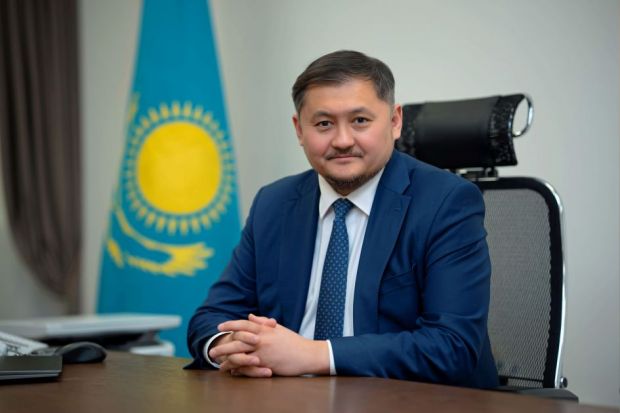
Sayasat Nurbek, Kazakh minister of science and higher education, said the next stages of his country’s development will depend on partnerships with foreign universities in science and technology, having attracted a raft of international branch campuses in recent years.
While new overseas sites continue to open, such as a second Coventry University campus announced earlier this month, Nurbek said the government wants universities to be places where research happens, not just where overseas degrees are delivered.
Speaking to Times Higher Education, he said: “We have 40 branch campuses at the moment, which is very huge progress. It’s gaining a lot more momentum than we ever hoped for.”
Now, the emphasis is on what these campuses can add to the national research ecosystem. Nurbek pointed to joint research teams, co-funded projects and patents as evidence of a more selective approach.
One example is a collaboration with the University of Arizona on polymers made from sulphur, a by-product of Kazakhstan’s oil industry.
The project involves 11 joint patents, with funding from the national oil and gas company alongside government research grants, and is intended to lead to large-scale production.
“We chip in some research grant money,” Nurbek said, adding that large-scale polymer production could begin within the next year.
Alongside research, AI has become the centrepiece of Kazakhstan’s higher education strategy, framed not just as a teaching reform but as a national economic project.
“AI is becoming a world obsession,” Nurbek said. “But for countries like Kazakhstan it is a great equaliser.”
“AI can give our country a competitive advantage, boost productivity, optimise resources and ensure digital sovereignty,” he added.
Kazakhstan has adopted a national AI strategy, purchased two Nvidia GPU-backed national supercomputers and made AI compulsory across the national curriculum. According to Nurbek, almost 95 per cent of students have already completed AI training, with 686,000 certificates issued.
Universities have been given free access to a quota of national supercomputing power, while students completing advanced training are learning how to build AI agents.
The most successful projects are eligible for seed funding through a new venture fund. In less than a year, students designed 229 AI agents through the programme, Nurbek said.
The ambition now extends to academic staff. Kazakhstan has been selected as one of the participants in a global OpenAI pilot, alongside Estonia, Greece, Italy’s Conference of University Rectors, Jordan, Slovakia, Trinidad & Tobago and the United Arab Emirates.
Under the scheme, “every faculty member, every professor and every teacher in Kazakhstan will be given their own ChatGPT for education,” Nurbek said. “We’re going to train 100 per cent of faculty and research institutions.”
Yet the pace of change has generated resistance within universities. “Education is one of the most conservative spheres out there,” he said, acknowledging pushback from academics asked to overhaul long-established curricula.
“Imagine telling a professor who spent half his life designing a curriculum that it’s now obsolete – there will be huge resistance,” he said.
Nurbek argued that universities must move away from static course content towards adaptability and ongoing education. “Hard skills and soft skills are not enough any more,” he said. “The core has to be adaptability, resilience and lifelong learning.”
He also raised concerns about burnout and information overload among students. “We have brilliant, talented young people, and they burn out, because they can’t match the speed of change,” he said, adding that attention deficit and information overload are becoming widespread problems.
In response, some institutions have introduced student-led “digital detox days” initiated by students themselves, Nurbek said.
Register to continue
Why register?
- Registration is free and only takes a moment
- Once registered, you can read 3 articles a month
- Sign up for our newsletter
Subscribe
Or subscribe for unlimited access to:
- Unlimited access to news, views, insights & reviews
- Digital editions
- Digital access to THE’s university and college rankings analysis
Already registered or a current subscriber?