Why critical visual literacy matters in a complex information landscape



Created in partnership with

Created in partnership with
You may also like
Our world is one of “multimodal” communication; that is, meaning relies less on written language alone and is instead conveyed through images, layout, colour, spatial arrangement, sound and movement alongside words. In our information-saturated environment, visuals circulate rapidly, often out of context and at scale. Beyond fake news, AI slop, misleading advertisements and online scams, images are frequently used to trigger strong emotions, urgency or trust before critical thinking has time to intervene.
Even in authoritative online journals, textbooks or news sources, visuals convey viewpoints and perspectives that readers should review – and not merely accept uncritically as “truth”.
Similarly, the seminar slides, infographics, diagrams, charts and scientific models used in lectures and tutorials are not merely self-evident illustrations but also persuade viewers through the careful framing of arguments and perspectives.
All students, therefore, need to develop the critical eye to “read” images as strategic tools for meaning-making. And it is not just language or linguistics faculty who have a responsibility to develop this essential literacy. It extends to all disciplines, including STEM; think of engineers who interpret schematics and scientists analysing complex graphs.
- Anatomy of a term paper: using information literacy skills with AI
- If AI were a DJ…
- ‘We must replace critical thinking with intuitive critical thinking’
My students are teachers, or future teachers, in primary and secondary schools. They’ll go on to design learning materials, select texts, curate visuals and shape how young people engage with information. If they’re not equipped to read images critically, it will be difficult for them to help their learners to navigate an increasingly complex visual world.
In such a world, literacy cannot stop at surface comprehension. Learners need to be able to delve deeper, to ask questions such as:
- Who created this text, and for what purpose?
- What perspectives are being foregrounded or marginalised?
- How do visual and design choices influence how I feel or think?
In a multimodal world, critical literacy must extend beyond written language to images, design and visual metaphor.
Reading visuals critically: a classroom example
One multimodal text that I use to model critical visual literacy is the National Geographic poster “Planet or plastic”?
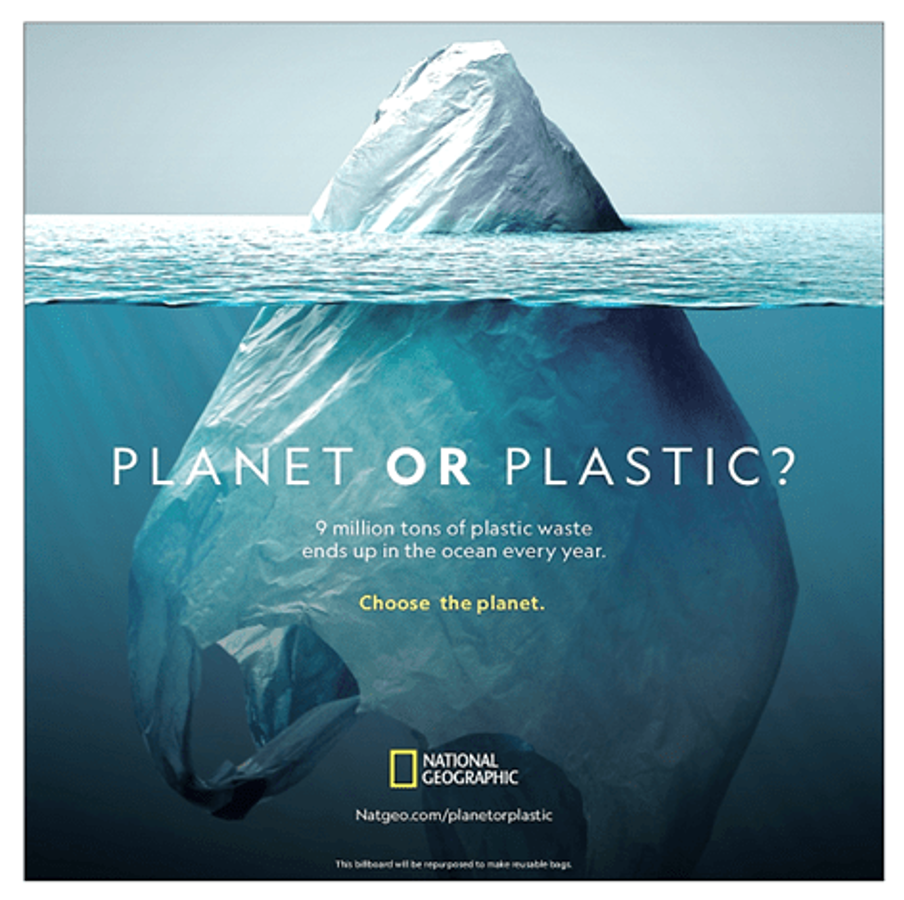
At first glance, the image appears to be an iceberg floating in the ocean. A closer look, however, reveals it to be a plastic bag. Many students quickly identify that the image is “about pollution”. Critical visual literacy pushes them further.
I begin with simple questions:
- What do you see?
- What specific visual features lead you to that interpretation?
These questions slow down the reading process. They encourage learners to attend carefully to shape, colour, scale and composition rather than jumping immediately to judgement.
As the discussion develops, the questions become more probing:
- How does the iceberg metaphor shape how we think about plastic pollution?
- What does the portion of the plastic bag extending below the waterline suggest?
- Is the title a genuine question or does it function as a statement?
At this point, students begin to recognise that the image is not simply showing a problem; it is framing it. The metaphor highlights the scale of hidden plastic pollution but it also simplifies a complex environmental issue into a stark binary. This could open up conversations about what images emphasise, what they leave out and how visuals can both illuminate and obscure.
Crucially, these are the same interpretive skills needed to navigate misleading visuals elsewhere – from sensationalised news thumbnails to scam advertisements that rely on visual credibility rather than factual accuracy.
Designing for critical viewing: adapting the four resources model
My approach to critical visual literacy is informed by Peter Freebody and Allan Luke’s four resources model. Originally proposed as a framework for understanding how readers engage with written texts, the model has since been widely taken up and adapted across literacy contexts.
In my teaching, I extend this model to support the critical reading of multimodal and visual texts. It serves as a practical lens for designing questions that guide learners from noticing to making meaning to critique.
In practice, this means attending to four interrelated roles:
- code breaker: noticing visual elements, conventions and design features
- text participant: drawing on prior knowledge, experience and inference
- text user: considering purpose, audience and context
- text analyst: questioning perspective, power and intent.
Rather than treating critical analysis as a single step at the end of a lesson, the model helps scaffold it throughout the learning process. Over time, many students begin to ask such questions independently.
Why visual literacy matters beyond language classrooms
Although critical visual literacy is often associated with language education, its relevance extends far beyond it. Across disciplines, students encounter visual representations of information that shape understanding, decision-making and belief. Teaching learners how to interrogate images – to ask how meaning is constructed, whose interests are served and what alternatives are possible – equips them for a multimodal, high-information world.
Critical visual literacy is not about teaching students to distrust images. It is about empowering them to read visuals with discernment. In doing so, we help prepare graduates who are not only skilled in their respective fields but also thoughtful, critical and ethically aware participants in a visually saturated world.
Alexius Chia is principal lecturer in the department of English language and literature at the National Institute of Education at Nanyang Technological University (NTU).
This is an edited version of "Reading beyond the surface: why critical visual literacy matters in higher education”, which was first published on the blog of NTU’s Institute for Pedagogical Innovation, Research and Excellence.
If you would like advice and insight from academics and university staff delivered direct to your inbox each week, sign up for the Campus newsletter.
