

Why AI paraphrasing no longer works — and how StrikePlagiarism.com exposes rewritten AI text


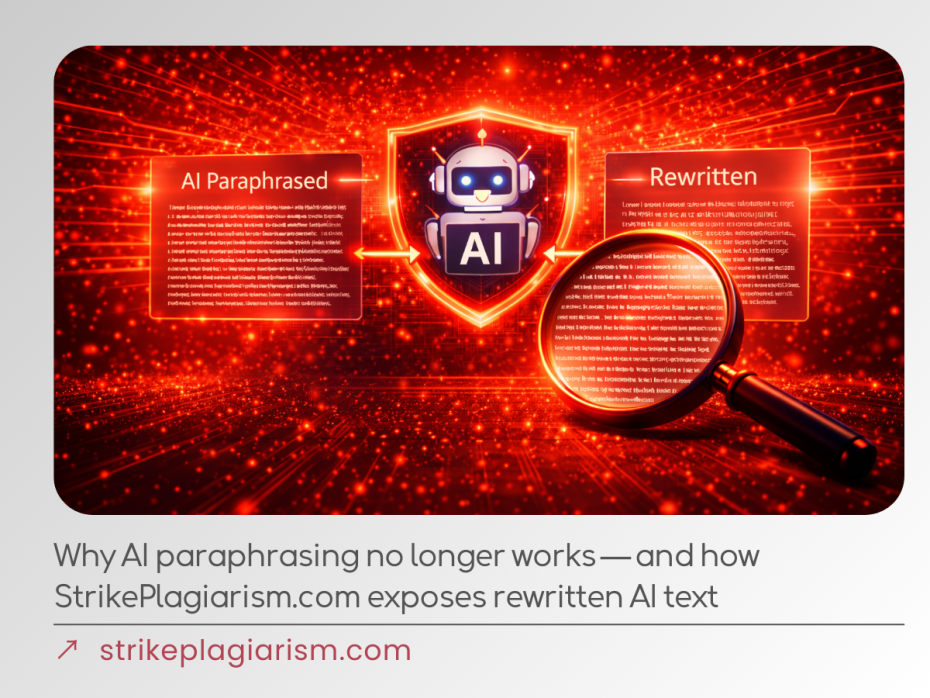

This belief is no longer accurate.
Paraphrasing has become the most common method used to mask AI-generated content, but it is also one of the most misunderstood. While wording may change, the behavioural patterns of AI writing often remain. Paraphrased AI content is not neutralised — it is transformed in ways that modern integrity systems can still identify.
The problem: paraphrasing creates a false sense of security
In academic practice today, paraphrasing is frequently treated as a defence strategy:
AI generates a draft → a human rewrites it → the final version is submitted as original work.
Traditional similarity checks may show low overlap, reinforcing the assumption of human authorship. Yet underlying semantic structure, argument flow and stylistic consistency often continue to reflect machine-generated patterns.
This gap exposes institutions to undetected AI-assisted submissions, inconsistent assessment standards and weakened trust in academic integrity. Paraphrasing does not remove AI influence — it pushes it below the surface.
Why similarity scores fail
Similarity-based detection was designed to identify copied text, not rewritten behaviour. When AI-generated content is paraphrased, lexical overlap disappears and percentages lose explanatory value.
A low similarity score does not confirm independent authorship. In many cases, it simply means the wrong signal is being measured.
The solution: detecting behaviour, not rewritten words
StrikePlagiarism, as a company focused on academic integrity, addresses this challenge by shifting the analytical focus. StrikePlagiarism.com, as a system, is designed to detect writing behaviour, even after paraphrasing or human editing.
Instead of relying on surface overlap, the system analyses:
- semantic structure and logical progression,
stylistic consistency, - patterns that persist across rewriting.
Because these elements are difficult to disguise intentionally, AI-generated writing remains identifiable even in hybrid AI–human texts.
Why this matters
When paraphrased AI content goes undetected, institutions risk applying integrity standards unevenly and losing the ability to defend academic decisions.
By focusing on behavioural evidence rather than wording, StrikePlagiarism.com enables transparent, consistent and defensible assessment. Paraphrasing ceases to be a loophole and becomes a visible part of integrity analysis.
Clarity in the age of AI-assisted writing
AI tools and paraphrasing techniques will continue to evolve. But authorship is defined by behaviour, not vocabulary.
StrikePlagiarism responds to this reality with a system built for modern academic writing. StrikePlagiarism.com analyses how content is produced — even when words are changed.
StrikePlagiarism.com → Real detection. Real integrity.
