
How to start reimagining assessments authentically



Created in partnership with

Created in partnership with
You may also like
Too often, we educators revert to the type of assessments we encountered as students: high-stakes exams. Students, too, are familiar with this type of assessment from primary and secondary education. But when numerous factors can cause students to underperform on exam day, high-stakes exams do not measure learning well. They also increase students’ stress and anxiety.
Authentic assessments, on the other hand, allow students to “see themselves as not just recipients of content, but as knowledge producers, as architects of their own learning”, as Kevin M. Gannon from Queens University of Charlotte wrote in his 2020 book, Radical Hope: A Teaching Manifesto. In other words, authentic assessment provides a more meaningful measure of learning and gives students agency in their own learning.
- A practical tool for valid assessments in the GenAI-enabled university
- Spotlight guide: reframe assessment as part of learning
- Is authentic assessment leaving some students behind?
What is authentic assessment?
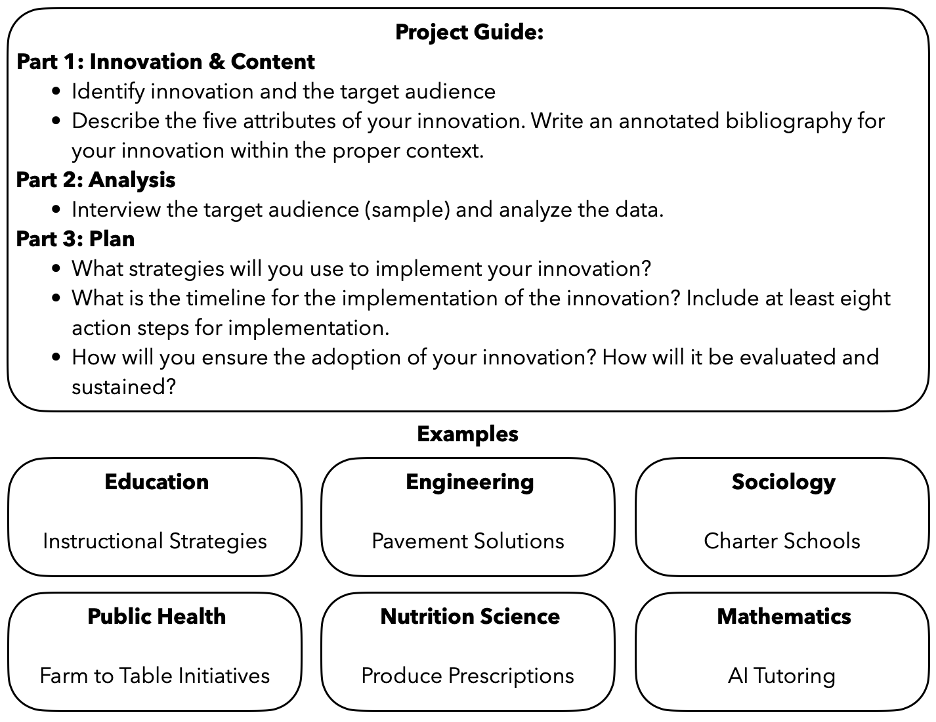
Authentic assessment has three key characteristics: real-world tasks, meaningful application, and core knowledge and skills. We want students to apply the core principles of our course within a real-world context. For example, if you are teaching a diffusion of innovation theory course, you could have students work with a community partner to identify an innovation that would improve their processes. Through an authentic project, students could identify the innovation, describe its attributes, interview the community partners and develop an action and evaluation plan for the innovation.
What are examples of authentic assessment?
Here are examples of authentic assessments:
- low-stakes quizzes
- student-written quiz questions (they can work individually or in groups)
- conceptual or applied tests conducted as open-book or take-home exams
- creative presentations or demonstrations of course content
- student-selected works for an annotated anthology or bibliography
- a one-page fact sheet or infographic
- reflection (or connection) journal for self-reflection
- a digital portfolio that scaffolds to a final version of the assessment
- real-world projects such as digital stories, podcasts, concept maps or interactive videos/presentations
- group projects that include a peer-evaluation component in the overall grade.
How do I get started with authentic assessment?
To get started with authentic assessment, ask yourself these questions – to help frame concepts, tasks and what success looks like – and then fit those aims with an assessment type.
What are the core concepts in your course? Consider drafting a concept map to help you frame the core concepts.
What tools can help me consider assessment in a multi-dimensional way? I like to use Bloom’s Taxonomy and the taxonomy of significant learning. For example, students do a short activity to practise foundational concepts, then work to analyse, evaluate or create within a real-world context.
How can I help students succeed with this assessment task? Be clear and transparent with your students about the assessment; the transparency in learning and teaching (Tilt) framework is helpful here. Ensure your assessment is aligned with your learning goals. Share models or examples with students of successful assessments. Build in practice opportunities, feedback and revision. Remember, we learn from our mistakes.
Finally, review the types of authentic assessments and consider which ones could measure the core concepts well.
How do I grade authentic assessments?
To grade authentic assessments, we want to focus on a few key areas that challenge traditional ways of thinking about grading, while also considering alternative grading options. Here are three key considerations:
- Shift language: Shift from a focus on letter grades or scores to focusing on what the student has learned. Use phrases like: “What did you learn?” Or “Try another way.”
- Be transparent: The focus is on learning, so consider options that allow students to revise and resubmit work after receiving feedback from you or their peers.
- Type of feedback: If we only score a rubric, will they understand what they are doing well or did they just check off the requirements in a box? Think of the best way to provide meaningful feedback on key components of the assessment.
Going back to the diffusion of innovation theory example from earlier, here is how the project could be structured and what it might look like in a few different fields.
In Creating Wicked Students: Designing Courses for a Complex World, Paul Hanstedt, quoting Georgetown University vice-president of strategic education initiatives Randall Bass, notes that high-impact practices, such as authentic assessments, “succeed because they ‘offer the opportunity to integrate, synthesize, and make meaning’, pushing students to ‘make decisions in the midst of uncertainty’”. Authentic assessments promote students’ agency and creativity and so open new opportunities for them to showcase their learning.
So, let your students wow you.
Karen Bunch Franklin is a teaching and learning specialist at the Georgia Institute of Technology.
If you would like advice and insight from academics and university staff delivered direct to your inbox each week, sign up for the Campus newsletter.
