How to get students talking in seminar courses



You may also like
As educators, we’re all too familiar with awkward silences, the sound of crickets, answering our own questions, the same two student voices. Motivating students to participate in class discussions can be challenging, even more so in a seminar course.
My primary goal when teaching a seminar course is to prevent my students from feeling the anxiety I felt during my first one as an undergraduate. Here are strategies that have increased student participation in my classes.
Pre-semester: lay the groundwork
Introduce the expectation that your course will focus on collaborative learning before it starts to set students up for success. For seminar courses, it can be helpful to add a mind map to the course syllabus to highlight connections between course topics. This primes students to look for connections throughout the semester.
The design of a seminar course and its assessments can also help you maximise student participation. Take the focus off yourself and on to the students by limiting your contributions to providing a high-level overview at the beginning of the class and closing remarks at the end. Students are responsible for the rest. For example, each class could include a graded student-led discussion. This makes participation more concrete and structured, which can be useful for students taking a seminar course for the first time.
Pre-class reflection papers are another assessment method that can encourage student participation. Before each class, students collect their thoughts, opinions and questions about the week’s readings in a brief, low-stakes written assignment. This holds students accountable for class preparation, gives them space to contemplate their contributions, and counts as another mode of class participation that some students may feel more comfortable with.
The first day of class: set expectations
Students may not understand how a seminar course differs from other course or class formats, so set participation expectations from the first day.
Clarify that a seminar course requires students to take on the role of scholars. It takes a change in mindset to understand that these classes require students to engage in collaborative learning, peer ideas exchange and scholarly enquiry. This includes sitting with ambiguity, debating ideas and tolerating opposing views.
Explain to students that a seminar course requires a different skill set. Identify transferable skills from other classes that they can employ to analyse course materials. For instance, they can use concepts from a research methods course like generalisability, confounding variables and bias.
Get students talking and building community from day one. This can reduce anxiety and prevent the establishment of conversational patterns that leave some students behind.
If students will be leading discussions throughout the semester, model good facilitation skills, such as being patient with silence. You can lead a discussion and then ask students to comment on strategies you used to keep everyone engaged and the conversation going.
- Spotlight guide: How to motivate students and staff in higher education
- Seven strategies to fuel students’ motivation
- What is student engagement?
Pre-class: help students prepare
Students new to the seminar course format need to learn how to best prepare for class. In addition to emphasising the importance of completing readings before class, you can provide students with a choice of reflection questions to prepare, such as:
- Is there anything you need clarification on?
- What do you agree or disagree with?
- What questions did the readings raise but not resolve?
- How do the readings connect to other course readings and themes?
- How do the readings relate to your own lived experiences?
From spectator to scholar
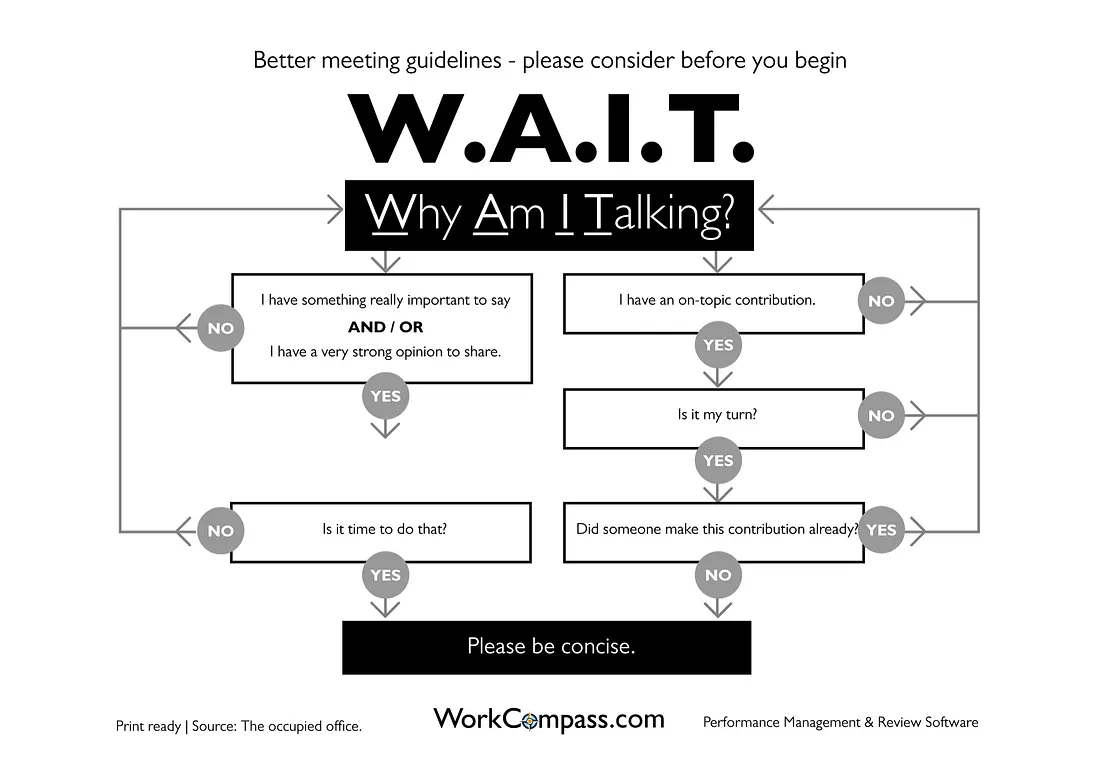
I find the Why am I talking? (WAIT) principle and the Interactive Participation Model are particularly helpful in engaging student seminar course participation. The WAIT principle uses a flowchart to help students determine if they have a meaningful contribution to make to a discussion, or if they should pause and reformulate their ideas. This principle encourages active listening, prevents speakers from dominating and filters out comments that don’t move the conversation along.
The Interactive Participation Model highlights three methods of participation – enabling, challenging and speculating – each with a multitude of examples. It helps broaden our understanding of what counts as participation (for example, asking for clarification on an ambiguous comment or suggesting a subpoint for the class to explore).
Other strategies that can encourage students to participate in seminar courses include:
• Encourage your students to think of these classes like a book club. We aren’t searching for correct answers, we’re sharing interpretations, opinions and ideas.
• Act as a referee. You provide coaching, but your students are the ones in the field making the moves.
• Be an observer rather than a facilitator or participant. Trust your students and refrain from frequently jumping in with your own comments. It may be helpful to physically take a backseat, by sitting somewhere other than at the head of the classroom.
• Scaffold participation and facilitation skills. For example, you can begin the semester with a couple of brief discussions led by you, working your way up to peer-facilitated discussions or an end-of-term class debate or roundtable. Another approach is to have students give a presentation on a topic they are familiar with to warm them up for facilitating a discussion on it.
• Assign roles or viewpoints to promote collaboration. For instance, students could be assigned a different theory or perspective to frame their discussion contributions.
• Take a break or switch to a different reading or topic once discussion falters. Signs to look out for include students having sidebar (separate from the main discussion) conversations, not listening to each other, trying to force ideas on to others, arguing, identifying insignificant points or comments have come to a halt.
• Include midterm participation assessments, either assessed through self-reflection, peers or by you. This provides students with concrete goals for the remainder of the semester and makes them aware of how they are contributing to the class’ intellectual ecosystem.
• Have students collaboratively build a conversational artefact such as an annotated bibliography, glossary or mind map that each contributes to throughout the semester. This reinforces the continuity of ideas and course themes.
By thoughtfully implementing any of these strategies throughout the semester, your chirping crickets will be replaced with students expressing rich, enlightening and thought-provoking academic discourse.
Daniella Sieukaran is the senior educational developer (program development) at Dalhousie University and currently teaches in the department of psychology at Mount Saint Vincent University.
If you would like advice and insight from academics and university staff delivered direct to your inbox each week, sign up for the Campus newsletter.