
Designing humanitarian technology to create lasting impact
Universities in Asia are evolving to address real-world problems through new research approaches, deeper partnerships and expanding students’ skills outside of their discipline

Sponsored by Lingnan University

Sponsored by
Sponsored by
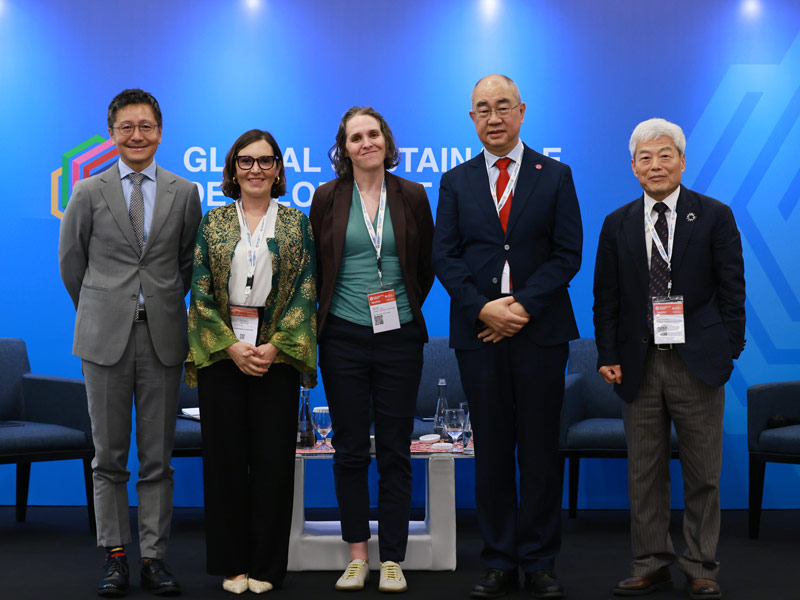
The traditional role of universities centred on producing knowledge and advancing research. However, there is a growing shift within higher education institutions towards creating lasting and meaningful impact using their extensive research expertise and academic excellence. As a bridge between governments, policymakers and industry, universities are uniquely placed to translate knowledge into practical solutions that improve lives. A panel discussion – held in partnership with Lingnan University – at the 2026 Global Sustainable Development Congress, explored how institutions are using innovative and interdisciplinary approaches to meet global challenges.
Amy Bilton, director and associate professor at the Centre for Global Engineering at the University of Toronto, argued that the rapid rise of AI means that disciplinary knowledge can be accessed quickly, so working on real-world problems is crucial for students’ skills development. “We want to ensure that our students have the core competencies to be efficient leaders, regardless of their field,” said Bilton. “We want them to be resilient and creative.”
Youmin Xi, executive president of Xi'an Jiaotong-Liverpool University in China, spoke about his institution’s integrative education model. “In the last 20 years, we have been trying to explore new education for the future,” said Xi. The university’s digital platform brings together resources and learners from different parts of the world with the intention of creating a global learning community. Having attracted more than 100 industry partners so far, the university is helping other institutions in the region to embrace a similar model.
Raymond Chan, provost and vice-president of academics at Lingnan University, spoke about how all education is undergoing changes prompted by AI. Lingnan University has evolved from a traditional liberal arts university into a research-orientated institution. It has introduced interdisciplinary courses that bring together subjects such as philosophy, data science and AI. All first-year students must complete a course on generative AI to understand its risks as well as benefits to humanity.
Lingnan University encourages faculty members to undertake research with international partners not only to enhance its research excellence, but also to create more experiential learning for its students. He shared examples of innovative projects such as developing a portable ultrasound device for detecting cardiovascular diseases and using satellite imaging and hyperspectral data to detect illegal mining in Peru.
Georgina Curto Rex, senior researcher and team lead at United Nations University Institute in Macau, agreed that institutions must leverage research to solve real-world problems. She argued that research evaluation should shift away from publication volume and visibility to how solutions are applied in communities.
The panel agreed that partnerships are crucial to achieving impact, but they need to evolve from traditional models of on-campus laboratories and lecture halls. “We’re starting to realise an engineering school alone is not enough to train the next generation of engineers, and a liberal arts school or technology institution alone is not going to cut the deal to train the next generation of problem solvers,” said Albert Ko, director of the United Nations University Hub at Lingnan University. “The goal is to break down the boundaries between countries, regions and majors.”
The panel:
- Amy Bilton, director and associate professor, Centre for Global Engineering, University of Toronto
- Raymond Chan, provost and vice-president of academics, Lingnan University
- Albert Ko, director, United Nations University Hub, Lingnan University (chair)
- Georgina Curto Rex, senior researcher and team lead, United Nations University Institute in Macau
- Youmin Xi, executive president, Xi'an Jiaotong-Liverpool University