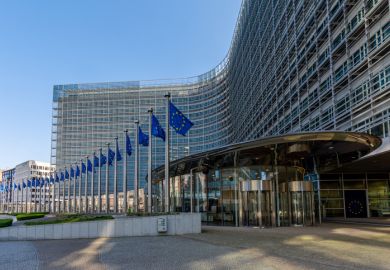
The European Parliament has just taken a decisive step towards finding a common negotiating position on the next European Framework Programme for Research and Innovation, Horizon Europe (FP10) – and the results are impressive.
Christian Ehler, the parliament’s leading voice on research and innovation (R&I) for the past two decades, published his amendments to the European Commission’s draft regulation of FP10. In lockstep, René Repasi, a new member of the European Parliament (MEP) with rich R&I experience as professor of law at Erasmus University Rotterdam, published his proposed amendments on the Commission’s proposal for FP10’s specific programme, which addresses Horizon Europe’s implementation.
Both MEPs’ amendments provide important solutions to ensure applications and project implementation will become simpler. Ehler’s insistence on a €200 billion (£173 million) budget over seven years (compared with just under €100 billion for the current period) would also significantly improve success rates.
Repasi and Ehler defend the “crown jewels” of Horizon Europe – an autonomous European Research Council (ERC), the principle of bottom-up research for the ERC and the Marie Skłodowska-Curie Actions (MSCAs), and a more agile European Innovation Council (EIC). Accordingly, decisions in the EIC would be guided by programme managers sitting within the Commission, senior experts whose autonomy would be strengthened. In contrast to the commission’s proposal to reduce the term of the ERC presidency to 2+2 years, the MEPs would retain the current 4+4 mandate and expand the president’s remit to explicitly include communication with policymakers and the wider academic sector. These amendments defend the right of the ERC president to speak up.
But perhaps the MEPs’ most important intervention is in relation to how the next Horizon Europe programme will relate to the European Competitiveness Fund, designed to scale up innovation and bring it to European and global markets. Against the Commission’s proposal for a common steering mechanism, Ehler and Repasi have heeded the sector’s calls to separate governance of the two programmes.
This is crucial because R&I functions very differently from what is required for scale-up. Moreover, in any industrial programme at European Union level there will be a bias towards supporting existing technologies and companies, which have the political power. FP10 must free itself from this to ensure it pushes radical and original ideas that have no lobby except for their promise.
Ehler and Repasi agree that challenge-based research should be guided by the thematic priorities of the ECF. But for FP10 they want experts, appointed for five years, to operationalise these priorities into call texts, to ensure these are guided by the frontiers of research and innovation. The experts would be overseen by two councils, one for European competitiveness research and one for global societal challenges research. With its expert members appointed for five years (renewable for another six-year term), this structure would ensure the quality of the calls.
It would also simplify the process of developing call texts, which currently go through a lengthy process of comment by member states, even on matters of wording. Political bodies would retain the possibility of intervening but their capacity to influence minute details would be contained. Meanwhile, applicants would find significantly improved call texts that would motivate Europe’s best to engage with the programme.
Yet a few questions around the MEPs’ proposals remain. The first relates to how we ensure the experts serving in the councils and writing call texts will be neutral and sufficiently qualified to relate broad policy priorities to research and innovation frontiers covering a wide disciplinary spectrum. These experts must be of sufficient standing in their communities, and they must be incentivised to leave their work in research or innovation to take up these new posts. But this is the bread and butter of any leading funding body so it will not be beyond the wit of the Commission to implement.
The second question relates to Ehler’s proposed “Fast Track to Excellence” instrument for the ERC, to support bottom-up collaborative research for two years with up to €2 million. It is an interesting proposal that merits serious consideration: it might dovetail nicely with the ERC synergy grants (awarded for teams of up to four principal investigators to address a self-defined specific problem) and bring together bottom-up collaboration and excellence. However, we don’t yet know the budget envelope for the ERC, and it will be important in the new budget period to apply financial uplifts for existing grant streams that have never been adjusted for inflation. For this reason, it will be critical to model the impact of this new instrument on the budget and success rates of existing ERC instruments.
Third, Repasi proposes that the ERC Scientific Council invite research organisations to develop a “sectoral plan” for six years, which would include focus themes. Upon positive evaluation by the Scientific Council, these research organisations would then develop a list of proposals that would be evaluated by experts through peer review. The purpose would be to strengthen Europe’s science system as a whole.
The proposal has taken inspiration from the Netherlands, where in 2022-23 the Dutch science ministry encouraged its universities to develop sectoral plans among themselves in the major research domains (social sciences and humanities, engineering and technology, health sciences, and sciences). Universities were incentivised by an extra €200 million budget, with the government fostering specialisation and concentration of resource. The big question is how this can be translated to the EU, and how participating institutions would be selected. It is not clear how much of the ERC’s budget would be required. Nor is it clear what structuring effect the ERC could have since universities receive so much more of their funding at national level.
But could this initiative be anchored in the second, challenge-led pillar, where we already have broad research priority areas articulated? To be sure, these have already been defined top-down, but few universities would object to focusing on “global societal challenges”, “digital leadership” or “resilience”. Finding a way for them to collaborate in a structured way on these key thematic areas, based on excellence (including with non-university actors), could add institutional heft to these policy windows and go beyond project funding.
Finally, an important amendment relates to MSCA. The MEPs accept the Commission’s proposal that particular subject areas might be prioritised for bottom-up research. But they add that this can only be done through additional funding – this is a crucial addition and the very minimum that we must expect.
The MSCA budget is already under intense pressure, with a success rate of under 10 per cent. The key goal for this successful instrument must be to improve those rates among excellent proposals across the entire subject range. Hence, any concentration in certain areas must be supported by genuinely new money, additional to the MSCA’s seven-year budget envelope as well as the funds contributed by associated countries.
The quality of Ehler and Repasi’s proposals will force the European Council and Commission to take them extremely seriously, and if MEPs of all parties now coalesce around these proposals, the parliament will be in a very strong negotiating position for the final shape of FP10.
It’s early days in the battle for FP10. But we should feel encouraged.
Jan Palmowski is secretary general of the Guild of European Research-Intensive Universities.
Register to continue
Why register?
- Registration is free and only takes a moment
- Once registered, you can read 3 articles a month
- Sign up for our newsletter
Subscribe
Or subscribe for unlimited access to:
- Unlimited access to news, views, insights & reviews
- Digital editions
- Digital access to THE’s university and college rankings analysis
Already registered or a current subscriber?