ADVERTISEMENT
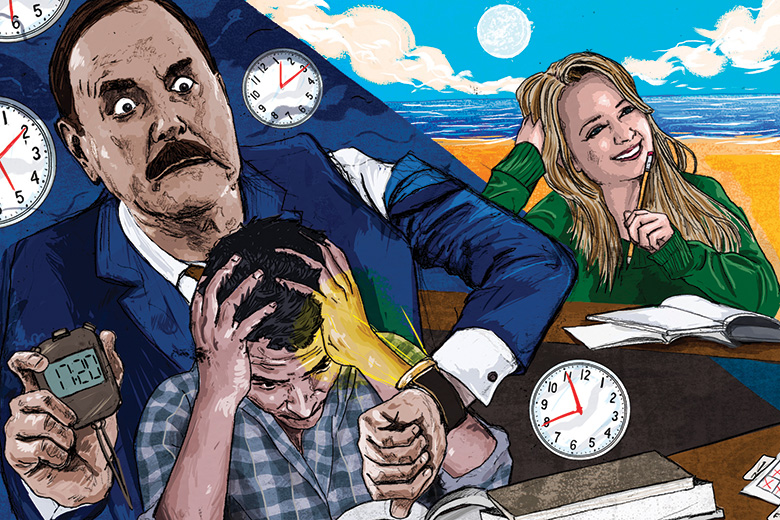
John Cleese’s headmaster is no role model for academics
While learning to work quickly is a useful life skill, a greater gift to students is permitting unhurried excursions and digressions, says Shahidha Bari
Source: Matthew Brazier
“The first step to knowing who we are,” begins John Cleese’s punctilious headmaster, Brian Stimpson, in the 1986 British comedy Clockwise, “is knowing where we are and when we are”. He looms sceptically over Stephen Moore’s hapless music teacher, who has clearly never had a clue who, where or when he ought to be in his life.
One of the delights of Christopher Morahan’s film is the pitch of Cleese’s performance: the barely contained panic and escalating mania with which he determines to arrive at the annual headmasters’ conference at the fictitious “University of Norwich” in time to deliver his speech at 5pm. Cue a detour on a train heading to Plymouth, a run-in with a truculent sixth-form student, a prang with a police car and an enraged encounter with a Morris 1100 in a sodden field. Sure, he’s mud splattered, his sleeve is torn and he’s wearing somebody else’s shoes, but it is a moment of absolute triumph as the digital clock hits 17:00 and Stimpson staggers into the Norwich lecture hall. Brian Stimpson is a hero – of the sort that record appointments in their Filofaxes as though it were their religion.
Clockwise, one hopes, is a fiction, rather than a docudrama about the teaching profession. But the education industry certainly has a peculiar sense of timekeeping. Seminars, lectures and marking are completed to strict deadlines. On the other hand, essay hand-in times are more flexible – as are academics’ own self-imposed deadlines for submitting our research papers to journals. Outsiders tease us over our extended holidays, but many of us work weekends as a matter of course and are run ragged juggling teaching, research and administration.
Those three parts of our profession each seem to set their own pace. Teaching week in and week out can feel like a treadmill – until the summer arrives with its sunny vista stretching infinitely ahead of us. Admin comes in waves, with upsurges that overwhelm, and then recede. And research so often demands – but is so rarely permitted – a pause to pull ideas together, to review and reassess.
Recently, I was reminded of Brian Stimpson when Jo Johnson, the UK’s minister for universities and science, announced the government’s plan to roll out two-year degree programmes at English universities. The basic logic of the proposal seems to be that doing a degree is a case of the quicker, the better: if we can fast-track students through their studies, we might hasten their routes into paid work and save them an additional year’s worth of tuition fees and living costs.
ADVERTISEMENT
Universities may be tasked with preparing students for the rat race, but one of the most important things that we can do is to press the pause button.
ADVERTISEMENT
Shahidha Bari is senior lecturer in Romanticism at Queen Mary University of London.
Print headline: Pause for thought
Read more about


Featured jobs
ADVERTISEMENT