Science gives us a mantra grammar for life: control the variables, minimise noise, stay composed. For most of my career, I followed these rules faithfully. Then grief made me the variable.
I am a postdoctoral researcher at McGill University, working at the intersection of chemical and synthetic biology to decode and reimagine nature’s design principles for health and environmental challenges. Over the years, I have learned to adapt to uncertainty, to carry personal and professional pressures calmly, and to keep working. But recent global conflicts have affected me in a way I was not prepared for.
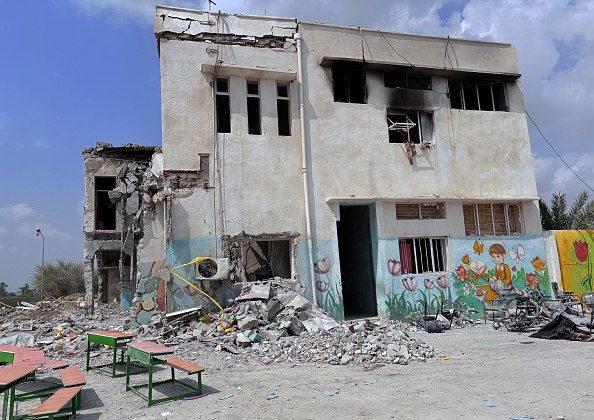
In particular, when more than 100 children were killed at a girls’ school in Minab in my native Iran, something in me quietly broke. They were the kind of children you recognise instantly. They were like the kids in the celebrated Iranian film Children of Heaven, which was nominated in 1998 for the best foreign language film Oscar: worn shoes, shy determination, enormous hearts, wanting nothing more than time to grow.
Still, I kept coming to the lab. I pipetted solutions. I attended meetings. I wrote the paper. I responded to emails. I performed the composed, stable scientist I had been trained to be. What I did not expect was what the lab gave back.
My colleagues and PI began grieving – openly, genuinely – for a place they had never been, for the premature ending of stories that they have never been part of. I found myself handing out tissues, consoling the people who had come to console me. I filed these moments privately under unexplained results.
A woman who cleans our office’s floor has known me for a while: long enough to know I am Iranian, long enough to exchange a few words about Molana Rumi, whose borderless poetry she loves. One afternoon she looked at me, just looked, and her face changed. Her eyes filled. She quietly cried. She did not know the names or the details, but she knew that it was in my country, and that was enough to transmit the full frequency of grief across the every difference of language, history and origin between us. I stood there, the supposed subject of all this sorrow, and found myself gently saying it’s OK, it’s OK to someone who had just proven, without a single word of explanation, that it was not.
As scientists, we trust patterns that persist across repeated observations, and that seemed to be what I was witnessing. I did not yet have a formal way to describe it, but I began paying attention.
A university-wide message soon transpired, acknowledging global suffering and expressing solidarity. Such gestures mattered, too. Yet it was in the moments between individuals that I began to understand that the stability of research is shaped not only by technical conditions but also by the quality of attention people offer one another. When internal variables become difficult to control, attentiveness can provide some ground for intellectual engagement to persist.
This recognition has not made me suddenly comfortable with speaking openly about struggle. After all, academia does not always respond well to visible vulnerability. Early-career and international researchers learn quickly that being perceived as struggling can reshape how others read your competence.
What has changed is not my caution, but my awareness. Silence is not always strength. Sometimes it is simply accumulated strain, invisible in any performance metric but slowly stunting careers. I have watched qualified researchers quietly leave academia just because the environment lacked attentiveness – or maybe didn’t want to attend. Now I will try to notice subtle shifts around me – a colleague’s unexpected withdrawal, a labmate’s sudden loss of energy – and treat these not as interruptions to research flow but as signals worth pausing for a brief check-in, a moment of genuine listening. Such gestures require time, yet I have now seen how effectively they can protect scientific continuity.
Institutions have real means to support struggling individuals and a genuine responsibility to try. Much of academic research is sustained by public funding, entrusted to institutions not only to generate discoveries but to develop the people who carry knowledge forward. That trust carries an obligation. Enabling researchers from diverse cultural, economic and geographic backgrounds to remain in science is how the scientific imagination stays broad and connected to the societies that support it.
This means deliberate design of attentiveness. Mentorship, for instance, can normalise conversations not driven by output. Leadership can model the legitimacy of pausing, thereby signalling that a researcher’s humanity is not separate from their scientific value.
Evaluation frameworks can acknowledge that sustained intellectual contribution depends on relational conditions that do not fit neatly into formal metrics but can be reflected through context-sensitive attention to personal circumstances, including when care, flexibility or time away becomes necessary. When humane environments depend on individual goodwill rather than institutional intention, their benefits remain unevenly distributed and always fragile.
I am grateful that my laboratory treated my humanity as part of my scientific life. But no researcher’s ability to endure hardship should depend on such good fortune. Science advances through deliberate design of experiments, instruments and collaborations. The human conditions in which discovery unfolds deserve the same care.
Hamideh Rezvani Alanagh is postdoctoral researcher at McGill University.
Register to continue
Why register?
- Registration is free and only takes a moment
- Once registered, you can read 3 articles a month
- Sign up for our newsletter
Subscribe
Or subscribe for unlimited access to:
- Unlimited access to news, views, insights & reviews
- Digital editions
- Digital access to THE’s university and college rankings analysis
Already registered or a current subscriber?