Imposing viewpoint diversity is the wrong cure for academia’s ills

We need greater openness among scholars on both the left and right to revise their views in light of counter-argument, says Martyn Hammersley 

Published on
March 17, 2026
Last updated
March 17, 2026
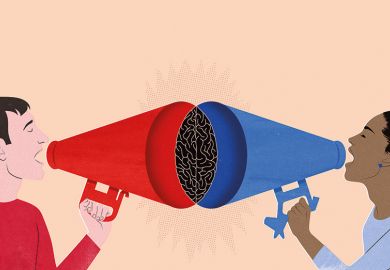
Figures in red and blue shout at each other through megaphones
Source: CreativaImages/iStock

The US federal government has for some time been pressuring universities to increase the “viewpoint diversity” of faculty, and much the same is true of some state governments in the US. Arguments for “intellectual diversity” have also been put forward in the UK, for instance by Matt Goodwin in his book Bad Education and by the University of Buckingham’s Heterodox Academy.

What is often demanded is that a wide range of political views are represented within each subject department, and specifically that right-wing academics must be recruited to correct an imbalance. This builds on longstanding complaints that the humanities and social sciences are dominated by “liberals”, “progressives” or “socialists” and that, as a result, research is biased and students are being indoctrinated.

The principle of viewpoint diversity appears to be modelled on the very policies designed to increase gender, ethnic and racial diversity that are rejected by the right. Indeed, there is a parallel with claims by postcolonial and decolonial theorists about epistemic injustice: that ideas, beliefs and knowledge from outside the West are not given adequate representation within the Western academy, despite its claim to offer what is universally true and valuable.

A variety of grounds have been put forward for enforcing viewpoint diversity. One is that it is essential for the pursuit and dissemination of academic knowledge. A quite different justification is that no cogent determination of the truth of conflicting views is possible, so that they all deserve equal representation. Yet another is that encouraging diverse views will result in “the survival of the fittest” in the “academic marketplace”.

ADVERTISEMENT

Generally speaking, those on the right argue that intellectual diversity is required for the pursuit of truth, although it should be said that the US president has a loose relationship with facts. Here, I will take it for granted that gaining academic knowledge is possible, desirable and important. But, while intellectual diversity in the political views of academics can be helpful for this, it is neither necessary nor sufficient.

Calls for intellectual diversity are sometimes linked with the more practical idea that genuine dialogue across political and other divides should be encouraged. This is certainly needed, and it also points towards what is an indispensable requirement for academic research and teaching: discussion devoted to producing factual knowledge and conceptual understanding rather than to advancing particular viewpoints.

ADVERTISEMENT

Furthermore, there must be a willingness to consider a wide range of ideas, to suspend existing beliefs if this seems necessary for the task of enquiry, and to reject them when they conflict with cogent counter-argument. Advocates of intellectual diversity are correct that for some academics in the humanities and social sciences pursuit of the goal of producing knowledge and understanding is distorted by commitment to political critique and activism.

Also frequently linked with championing viewpoint diversity is vigorous support for academic freedom and free speech. However, while these are required, they are subject to restrictions. Academic freedom allows publication, via teaching or research, of what is taken to be established knowledge in the relevant field, and the expression of individual views about the validity and implications of this. However, it does not warrant academics expressing opinions outside of their fields, whatever their politics.

This can only be justified under free speech provision, which, of course, is not restricted to academics. Moreover, it, too, involves limits, notably concerning incitement to violence. Nor does it require that others take no action against a person expressing views with which they disagree, only that any response be legal. Within the academy, toleration does not rule out robust criticism of what colleagues or students say, even if this is found upsetting or distressing – provided it does not descend into personal abuse, harassment or suppression. However, whatever some on the right might insist, “the exchange of opinions” is not the main academic function.

A further complication is that not all positions ought to be tolerated, even within academia: those for which there is currently little supporting evidence, or against which there is cogent counter-evidence, should be excluded. There is, to take extreme examples, no justification for tolerating denials that millions of Jews were killed in extermination camps under the Nazis or assertions that the world was created only 6,000 years ago – let alone any obligation to hire academics who make such claims. At the same time, there must not be exclusion of views simply because they are found politically offensive, immoral or distressing, whether by a majority or a minority.

ADVERTISEMENT

Unjustifiable intolerance certainly operates within some academic fields. Yet, where this occurs, the main problem is not intellectual uniformity but lack of sufficient commitment to objective assessment of ideas and evidence. This stems from the influence of self-undermining relativistic and sceptical arguments and from the increasing prevalence of activist conceptions of academic work which demand that it be designed to have practical “impact”. Increasing intellectual diversity is no remedy for this. Indeed, it will worsen the problem because it places primary emphasis on background beliefs rather than on commitment to the academic task.

Whether coming from the right or the left, attempts to impose viewpoint diversity, far from enhancing the pursuit of academic enquiry, are yet another threat to it.

Martyn Hammersley is emeritus professor of educational and social research at the Open University.

Register to continue

Why register?

  • Registration is free and only takes a moment
  • Once registered, you can read 3 articles a month
  • Sign up for our newsletter
Please
or
to read this article.

Related articles

Reader's comments (11)

Why doesn't this author understand that "viewpoint diversity" has nothing to do with genuine diversity and respect for difference? Elementary, to anyone who looks and listens!
A very good piece in my view. I often think that positions are now held on all sides almost as matters of faith rather than rational argument. Scepticism and rational doubt of our own assumptions and positions seems to have been entirely abandoned in favour of evangelical commitment to particular causes, activism etc. The tropes and language of religious belief ("denial" is a good example) are deployed in political, historical, and secular contexts. As Donne wrote "Doubt wisely, in strange way/, to stand enquiring right is not to stray/ To sleep or run wrong is"
"There is, to take extreme examples, no justification for tolerating denials that millions of Jews were killed in extermination camps under the Nazis". There are however, putative justifications - the apparent quality of the 50+ volumes of Holocaust Handbooks and the related Encyclopedia compared to Hilberg's famous book for example.
An interesting article. Thank you. Of course, viewpoint diversity has its problems. But sensibly introduced, it is infinitely preferable to its ugly cousin: ethnic, class, gender and/or other quotas. No one who works in academia - and, in particular, in the social sciences - can doubt that there is a left-liberal bias. Is this good for the pursuit of knowledge? I think not. It is certainly not good for the young people who should be at the heart of it.
An important article Martyn - raising some interesting discussion/opinion as is clear from the comments. Diversity in intellectual terms can take on many forms. What matters is that the nature of the diversity is engaged with rationally and openly. Thus I have seen plenty of arguments and theorists in the social sciences from the 'right' - maybe the predominance of 'left-liberal' view(point)s is a consequence of rational thinking and evidenced outcomes - not inherent 'biases'?
Are 'left-liberals' more rational than their right-leaning colleagues? Are their conclusions more evidence-based - and thus, I suppose, more useful to the rest of us? Both interesting questions ... The main thing is that academics love and support their subjects - by refusing to make them tools of any particular ideology. In an ideal world, academia would move to its own beat, one separate as far as possible from personal political convictions.
Difficult... especially in the sciences where my opinion on, say politics, has absolutely nothing to do with computer science and I'd probably take offense if asked at a job interview what my opinions on some completely irrelevant topic happened to be. I'd probably fall back on my father's epic response to a pollster asking him how he intended to vote at an upcoming election. "In a secret ballot," he said firmly.
1. "Diversity" cannot be "imposed." 2. There is not, and cannot be, "a left-liberal bias," because liberals are not "left." Nor are conservatives right-wing
Isn’t the question really about where politics comes in? I’ve worked at unis for many years, in business schools, and political diversity is pretty common if we are talking about discussing who is in government and what policies might work. But, it’s rare this hits the classroom in a ‘this is the best way’ view and when it does it doesn’t go down well and can impede learning. Or is being in a business school simply assumed to be leaning right? Big assumption if you know anything about business schools. I teach a class on brand purpose, or the idea that brands should align with a social cause. I do it because it’s topical in industry and among researchers. I make it clear that purpose is agnostic politically - there is a left wing bias to cause but there are examples of more right wing brand also engaging in the strategy and this should be forgotten. My overall take is purpose or activism is not great for brand or cause. Similarly when I discuss representation in ads, I can offer different perspectives to stimulate debate and understand the challenges from different views but I don’t say, you must do X. Why would I? I’d only caution against projecting your ideals onto your prospective customers.
Point taken about business schools. Teaching business is compatible with any political belief, whether in schools, colleges or, yes, universities. The issue again is imposition - imposing or rather not imposing one's political beliefs on students. As regards ethics, that is where things get a little trickier. As a teacher, you believe - or should believe - in certain values: open-mindedness, fairness, always privileging the empirical over the ideological - quintessentially English values, in other words (Yes, that last bit is designed to be provocative). Is this compatible with the study of brand purpose in the way that you teach it? I can't see why not. As a rule, I'm sure that most teachers know when they're imposing their politics on students. As for those who don't, they probably shouldn't be in teaching in the first place. Unfortunately, we're now in a situation where, in some universities, the expression of left-liberal political beliefs are actively encouraged - which is why viewpoint diversity is important.
new
Thanks for the comments, an interesting discussion, and I can’t possibly respond to all the points made. Unfortunately, I don’t think that the current predominance of broadly Leftist views among humanities and social sciences scholars is simply a product of intellectual progress; but nor are all of those promoting intellectual diversity genuinely interested in this. Of course, dichotomies like Left-Right and Conservative-Progressive are far too crude to capture differences in political views anyway. And this also makes any imposition of intellectual diversity through recruitment problematic (what positions are and are not to be represented?). As I indicated, for me the problem is not diversity in background views but the tendency on the part of some to see the academic task as serving a political cause (of whatever kind).

Sponsored

Featured jobs

See all jobs
ADVERTISEMENT