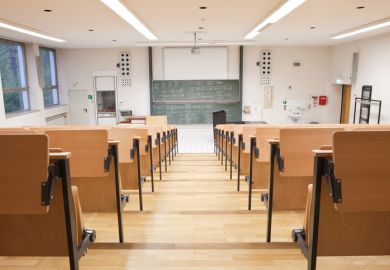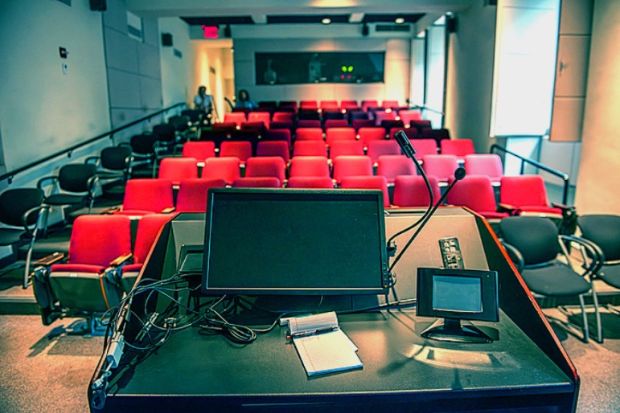
In one of our seminars in Madrid this year, five students stood out. They came every week, prepared, asked questions and did the work. In a group where most seats were empty, they were impossible to ignore. They were all the children of Chinese immigrants, raised in Spain but educated in the values their parents brought with them.
Every one of their classmates had the same access to the internet, the same AI tools, the same lecture slides. The conditions were identical. The behaviour was not.
That contrast is, we would argue, the most instructive thing happening in European universities right now, and it points directly at what we are getting wrong in the current debate about student absenteeism.
Last week Ucas chief executive Jo Saxton raised eyebrows by suggesting that some students are “intimidated” by sharing lecture theatres with large number of strangers. The more familiar explanation is that generative artificial intelligence (AI) has given students a substitute for lectures and professors, so they have stopped coming. The solution, on this reading, is to redesign teaching for the AI age. But Saxton’s explanation is actually closer to the truth that the issue is not so much pedagogical as cultural and generational.
The timing of the AI explanation alone should give us pause. Absenteeism and disengagement surged in 2020, during the pandemic and the forced shift to online learning. ChatGPT did not arrive until November 2022, two years later. A cause cannot follow its effect.
The RAND Corporation’s 2025 report on chronic absenteeism in US school districts confirms the trajectory: chronic absence rates jumped to 28.5 per cent in 2021-22 and, despite some recovery, remain well above pre-pandemic levels today. The OECD’s 2024 review of post-pandemic education policy finds the same pattern across all its member systems, with the pandemic as the universal inflection point.
The observed behaviour of students undermines the AI thesis further. If students were staying away because ChatGPT was doing their learning for them, you would expect them to arrive at practicals having at least used it to prepare. They do not. In our experience, students who skip lectures also arrive at seminars having read nothing, prepared nothing, and with no questions to ask.
The AI is not replacing the effort. The effort is simply not happening. And the correlation between attendance and grades has not weakened, which it would if AI were providing an effective substitute. Students who come do better; students who do not come do worse. That relationship, across institutions and disciplines, remains intact.
A third explanation for absenteeism points to economics. Saxton herself cited scheduling conflicts with paid jobs as a reason students give for missing lectures, and the Unite Students report finds nearly nine in 10 incoming UK students expect to work during term time. But notice what Saxton added: students stay away because “if lectures are available to catch up online, they know that they can do that”. The problem is not the job. It is the institution’s decision to make absence consequence-free. And at private universities, where financial hardship is rarely the issue, absenteeism is just as visible: students there are more likely to be choosing an internship than covering rent. That is a prioritisation, not a constraint. Our Chinese immigrant students, in all likelihood funded by their parents, as most students in Spain are, came anyway. The economic variable was held constant. The cultural one was not.
Fan and colleagues’ 2024 research in the British Journal of Educational Technology identifies what they call “metacognitive laziness”: students who use AI tools show short-term performance improvements but no gain in real understanding, motivation or ability to use that knowledge independently in new contexts. AI does not replace attendance; it makes the cost of absence feel smaller – until the exam makes it feel very large indeed.
And yet universities tolerate it. Why? Because non-attendance is part of a pattern over the past two decades whereby, in the name of making learning more accessible, institutions have systematically removed friction from the educational process. Slides replaced note-taking, recordings replaced attendance, group work reduced individual accountability. Each of these changes was reasonable in isolation. But, collectively, they eliminated the mechanisms through which learning actually happened.
Research published in BMC Medical Education this year confirms that students who take notes by hand show significantly higher cognitive performance than those using digital methods, precisely because the effort of paraphrasing in real time is the learning. When that effort disappears, so does much of the benefit of attending.
There is also a systemic incentive problem. In many institutions, academics who maintain high standards receive lower student evaluations and face implicit institutional pressure to lower the bar. The system, without intending to, penalises rigour and rewards accommodation.
Yet the uncomfortable truth is that the crisis of attendance and engagement in universities is not ultimately a pedagogical problem with a pedagogical solution. It is the expression, in lecture halls, of a much wider cultural rupture.
The pandemic did not merely disrupt education. For a generation of young people who spent formative years in lockdown – at least, those in the West – it broke something more fundamental: the intergenerational transmission of a belief that sustained effort has value in itself. Jean Twenge’s 2023 analysis of the University of Michigan’s long-running Monitoring the Future study is striking here. The proportion of 18-year-olds willing to work extra hours fell from 54 per cent at the start of 2020 to 36 per cent in 2022, the lowest point in the study’s 46-year history. This was not the continuation of a gradual decline. It was an abrupt rupture, coinciding exactly with the pandemic years.
Research on mortality salience helps explain the mechanism. Studies published in PLoS One and the Journal of Cross-Cultural Psychology confirm that younger generations experienced significantly higher levels of existential threat during the pandemic than older adults, despite being less physically vulnerable to the virus. The psychological literature suggests that vivid awareness of death reorients people toward the present and devalues long-term investments. For a 16-year-old watching the world stop, the logic of four years of degree study may have come to feel particularly abstract.
But not so for our Chinese students. Why? Because the cultural framework transmitted within their families sees effort is a moral obligation rather than a personal choice. Research on Confucian heritage cultures, including Kaity Kao’s 2022 doctoral work at Harvard, confirms that the intrinsic value placed on effort is the strongest predictor of academic performance in these contexts. When that framework is present, external disruptions do not fundamentally alter behaviour.
So what can universities do?
Redesigning assessment for the AI age will help at the margins. Rebuilding a generation’s relationship with effort is a different order of challenge entirely, but academics can at least resist the institutional logic of infinite accommodation.
Maintaining genuine standards is not a reactionary position. Neither is refusing to make absence consequence-free nor insisting that learning requires effort. They are, right now, quietly countercultural ones.
Mario Senovilla is a professor at Universidad Carlos III de Madrid. Elena Liquete is a researcher at the University of Bath School of Management and a senior consultant at CarringtonCrisp.
Register to continue
Why register?
- Registration is free and only takes a moment
- Once registered, you can read 3 articles a month
- Sign up for our newsletter
Subscribe
Or subscribe for unlimited access to:
- Unlimited access to news, views, insights & reviews
- Digital editions
- Digital access to THE’s university and college rankings analysis
Already registered or a current subscriber?