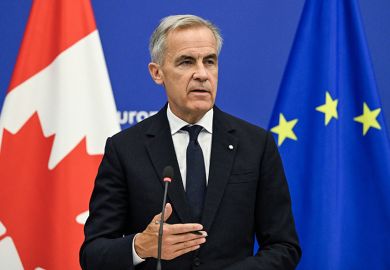
When Canadian prime minister Mark Carney addressed the European Parliament in September, he spoke extensively about the “current geopolitical rupture” to make the case for a much closer relationship between his country and Europe.
Among his proposals on energy, defence and artificial intelligence, there were two with potentially significant implications for universities: Canadian membership of the Erasmus+ mobility scheme and greater involvement in the next iteration of the European Union’s flagship research programme, Horizon Europe.
“Canadian membership of Erasmus+ can give your students and ours more opportunity to learn at some of the world’s top universities, to broaden their horizons and to build lasting ties that will sustain our alliance for the future,” he told MEPs in Strasbourg. “Canadian membership of the next generation of Horizon would allow us to pool resources, cooperate on frontier technologies and leverage our world-class research institutes and universities.”
He gave the speech shortly after European Commission president Ursula von der Leyen suggested that Canada could become the EU’s first “associate member” – a status that does not currently exist in EU law. The suggestion did not meet with universal enthusiasm among existing member states, and Carney himself stressed that the substance of the relationship mattered more than its name. At an EU-Canada summit in Montreal at the end of October, the phrase was dropped in favour of a commitment to define an “ever-closer association” by next year.
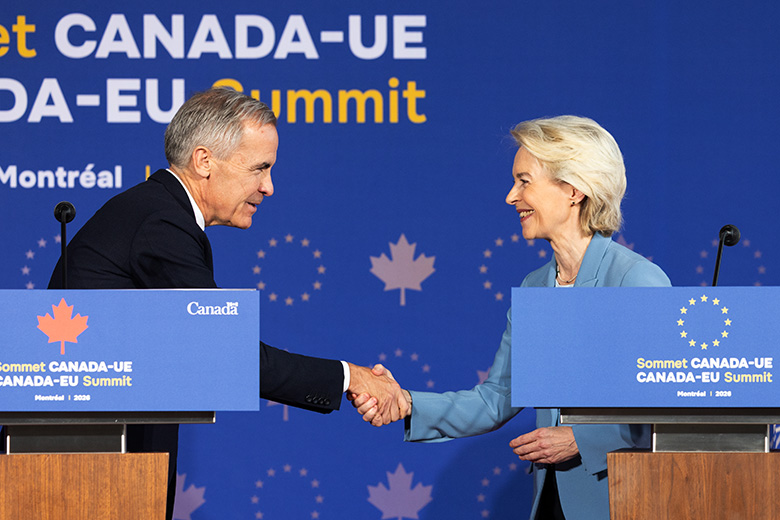
Although diplomacy is often marked by breezy declarations that fail to translate into concrete changes on the ground, there is a sense that Canada’s intent is very serious. Its overtures to the EU come at a time of tense relations with the US – which seem likely to endure at least until the end of Trump’s presidential term in 2028, despite the popular repudiation of his policies that the Republicans’ disastrous performance in last week's mid-term elections has been interpreted as. Trade disputes and Donald Trump’s ambition to annex Canada have shaken Canada’s relationship with its closest neighbour while, on the research front, drastic cuts to cross-border funding from US science agencies have disrupted joint research projects, shattering decades-long trust and fuelling a new sense of Canada’s separateness from the US.
Previously, “In conversations about international higher education in Canada, we often didn’t even talk about the US because it is such a close neighbour. We don’t see the US as international,” said Glen Jones, professor of higher education at the University of Toronto. “There are so many structural similarities. Canadians are members of American scholarly associations. North-south flights are very frequent. So the sudden shift in the US, from the broader tariff issues to the silliness of the ‘51st state’ comments…all had implications for US-Canada relations, including [in] higher education. The question that has emerged…is what is the future of those relationships?”
Robert Asselin, chief executive of U15 Canada, which represents the country’s leading research-intensive universities, said although Canadian research does not rely on US funding, American agencies including the National Institutes of Health (NIH), National Science Foundation, the Defense Advanced Research Projects Agency and Nasa have historically played an important role in Canadian science. According to the annual report of Canada’s chief science adviser for 2024-2025, 43 per cent of the country’s internationally co-authored research papers involved US researchers.
“The question is, will the US be a reliable partner going forward? Trump will eventually go but the reputation of the US as a reliable partner for research for Canada has been deeply damaged,” he said. “The US historically has been a huge leader in research funding. In health, in fundamental research, in space, these collaborations have been really significant. If the US is disengaging, that is a concern not only for Canadian researchers but for researchers around the world.”

US-Canadian ties are particularly strong in biomedical research. Canadian scientists often take part in projects supported by the NIH but several changes by the Trump administration to the agency’s rules have put that in jeopardy. More than 1,800 NIH grants were cancelled between February and June 2025 following an administration directive targeting areas including diversity, equity and inclusion and gender-related research. Moreover, in the same year, the agency announced that it was ending American institutions’ ability to pass on part of their NIH grants to foreign collaborators. In 2025, the agency announced that it would end that structure for new or continuing awards, saying that it required greater oversight of US taxpayer money spent overseas. Foreign researchers can still take part through a replacement system of directly linked awards but existing collaborations built around subawards were thrown into a state of uncertainty.
According to an analysis by Evidence for Democracy, a Canadian not-for-profit organisation that advocates for science-based public policy, 31 Canadian institutions received NIH funding in 2024. By 2025, seven of those institutions were receiving no NIH funding, while another 14 had suffered double-digit percentage declines. It calculated that total NIH funding to Canadian institutions fell from US$40.6 million (£30.2 million) in 2024 to US$19.1 million in 2025.
Artem Babaian, assistant professor of molecular genetics at the University of Toronto, was among those caught in the crossfire. Babaian was part of the NIH’s Human Virome Program, working via a subaward from the main grant holder, a New York-based institution, on a five-year project developing cloud computing tools to search genetic databases for viruses that could play a role in diseases such as Alzheimer’s and cancer. They were one year into the project when the NIH ended subwards, abruptly cutting off his support.
“This was a major setback,” he said. “I had already passed peer review and the work we proposed had been judged as valuable. If I write a grant proposal and it doesn’t have the merit to be funded, fine, I can accept that. But if it does have merit and then for an administrative or political reason, you lose that money, that hits in a very different way.”
The University of Toronto provided emergency funding to support his lab for a year. But the money could not replace his place in the wider NIH programme. “While the university funded my lab, that was not funding to be integrated into that programme, which was really about trying to build a consortium and work together with all these researchers,” Babaian said.
The change to foreign subawards, combined with the wider messaging coming from Washington about international research, has had a “chilling effect” on his willingness to pursue US federal funding, he added, noting that in another grant review, feedback from one reviewer identified the involvement of Canadian researchers as a potential risk for US projects. Babaian stressed that this was anecdotal rather than evidence of an NIH-wide policy but said it suggested that the political environment was beginning to filter down into the culture surrounding research funding.
That is why Canadian scholars are also contemplating the risk of sustaining relationships with US colleagues, according to Jones, “in the context of a government in the US that’s not pro-science and is raising questions about kinds of research activities [and has overseen] a dramatic loss in academic freedom”.
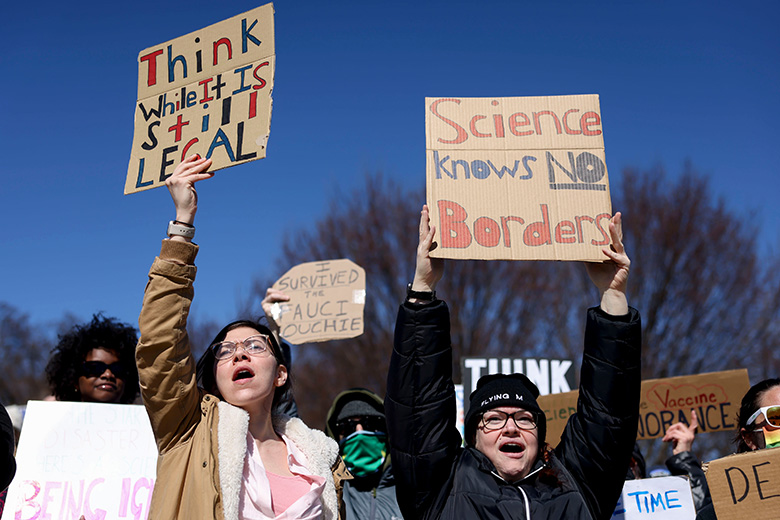
Babaian’s recent NIH experience has changed where he intends to look for funding. Before the drastic cuts, securing an NIH R01, one of the agency’s main research grants, was an important part of growing his laboratory. Babaian said he was now preparing a Horizon Europe application with a French colleague instead.
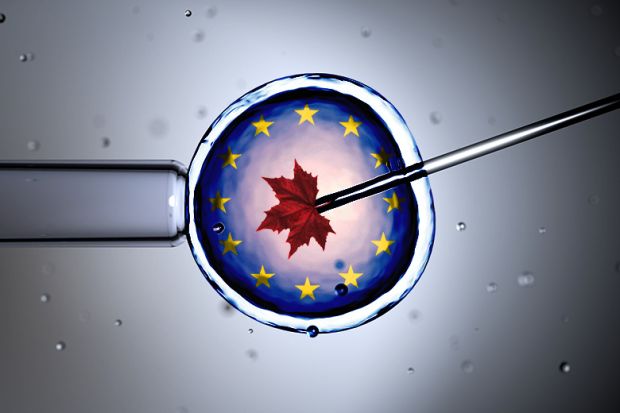
Canada is already formally associated with Pillar II of Horizon Europe in 2024. This pillar, titled “global challenges and European industrial competitiveness”, funds large multinational collaborations in areas including health, climate, digital technologies, industry and space. Association means Canadian researchers can receive European funding directly and lead consortia in these areas.
Ottawa has allocated about C$147 million to support its current participation, which is a separate federal allocation, rather than being deducted from the budgets of Canada’s main domestic research councils: all the more reason for Canadian academics to support continued and potentially expanded association to the next iteration of Horizon Europe, which runs from 2028 to 2034 and whose exact make-up is currently being negotiated within the EU.
“Even if things were perfectly fine with the US, Horizon is an extremely attractive research programme for Canada, Asselin said. “But because of what has happened with the US, the renewal of the programme and Canada’s place in the next framework has become incredibly important. The fact that the prime minister is mentioning it is great news because it has elevated this to a key pillar of the Canada-EU collaboration.”
Apart from additional funding streams, what Horizon offers Canadian science is critical mass, he added: “Canada is not big enough to build all these strategic capabilities on its own. In areas like space research, if we work closely with Europeans, we can achieve more scale. That is the promise of the next phase of Horizon. These key sectors, like AI, quantum and space research, are really exciting.”
Canada is not currently a member of Horizon’s Pillar I, which mainly funds projects proposed by individuals, and Pillar III, which is focused on growing innovative businesses. But U15 would like that to change next time around, Asselin said: “The more access we have, the better it will be.”
According to Tatiana Fumasoli, professor of higher education studies at UCL, that is something Canada is lobbying for. And if its proposal to join Erasmus+ is also accepted, the country could become much more closely embedded in Europe’s academic networks.
“While Erasmus+ is often seen as an exchange scheme, it has developed into a well-resourced broader scheme for cooperation, turning individual contacts into institutional relationships,” she said, adding that this could include joint master’s programmes, staff mobility schemes and capacity-building projects.
“To access [Erasmus] funding, universities design curricula together, align procedures and quality standards, and build trust over several years. That is how you develop sustainable links over the longer term,” she said.
But not every Canadian university would benefit equally, Fumasoli conceded. “Building consortia, writing competitive bids and managing EU projects require experience, expertise, networks and dedicated support staff,” she said. “Those are not equally distributed across universities, even in an advanced higher education system like Canada’s. Without attention to that, the benefits tend to concentrate in a small number of research-intensive institutions that already have the know-how, risking further stratification of the system.”

At the same time as Canada looks to Europe for new opportunities, it is trying to make the best of the turmoil in the US. At the end of last year, Ottawa launched its C$1.7 billion (£905 million) Global Impact + Research Talent initiative, designed to bring more than 1,000 “world-leading” researchers to Canada, with an unspoken emphasis on tempting top US talent across the border. Its flagship scheme, the Eddie Goldenberg Research Chairs of Canada programme, offers senior academics packages worth up to C$8 million over eight years.
Historically, the prevailing flow of talent in North America has tended to be southwards. But Canada appears to be having some success in changing that. Of 64 research chairs announced in August, 48 were moving from American institutions, according to Nature.
The government has framed the programme in terms of strengthening Canadian capacity in strategic fields such as artificial intelligence. But some have questioned the wisdom of providing multimillion-dollar packages for so-called stars while researchers already working in Canada face precarious conditions and low grant success rates. The Canadian Association for Neuroscience, for instance, warned that the announcement brings into “sharp focus” a “central gap in Canada’s research strategy”: namely, that the same 2025 budget that confirmed the Global Impact + Research Talent initiative also set ongoing 2 per cent budget cuts for Canada’s three research councils from 2026/27.
Those cuts reverse a sharp previous rise of nearly 15 per cent in the amount spent on research by Canadian universities between 2022/23 and 2024-25, amounting to a real-terms rise of 10 per cent. It also comes on top of a substantial real-terms decline in the value of the councils’ existing spending over the previous decade, according to the 2023 Boucher Review of the federal research support system. Canada also spends modestly on R&D overall. Expenditure stood at about 1.8 per cent of GDP in 2024, compared with an OECD average of about 2.7 per cent and 3.4 per cent in the US.
“The overall story is that research funding has stagnated,” Babaian said. “Inflation has devalued the money and the number of applications has increased because there is a larger base of researchers. So there has been a squeeze, and research funding is becoming increasingly competitive.”
Yet he also believes that the opportunity to recruit scientists from the US is too unusual to pass up: “I think this is a huge win for Canada and Canadian science in the long term…I don’t think we will have another opportunity like this in my lifetime.”
But Canada isn’t merely intent on picking the bones of US science before turning to a new Euro-focused future. Canadian researchers have “a lot of empathy” for what their US colleagues are currently up against and are unsure how to feel about the unravelling of US-Canadian connections.
“These are people you have worked with, gone to conferences with and respected for years,” he said. “So it’s a mixed response...you’re hearing the American government talk about annexing Canada but at the same time you know the people who are there. Suddenly, you’re not entirely sure how to deal with that relationship.”
Fumasoli warned that those relationships are unlikely ever to be fully replaced by European connections, either: “Europe is unlikely to replace the US as Canada’s main partner, given geography, language and the history and density of the existing links. But Europe offers a complementary partnership with a different model of cooperation, based on multilateral consortia and long-term programmes rather than mainly bilateral or individual ties. Canada has shown in other sectors that, in a period of greater uncertainty, it values building or strengthening alternative strong anchors.”
Asselin agreed that Europe still has “a long way to go” before approaching the scale of the American relationship but, “directionally, it could become a much more prominent funding mechanism. It has the potential to become very significant.”
And, for Babaian, “Horizon Europe really is a beacon now…the most prominent and advanced labs in Canada can now look to Europe for collaborations on high-capital, high-impact research. I’m cautiously optimistic…and I’m looking forward to working more closely with Europeans.”
Register to continue
Why register?
- Registration is free and only takes a moment
- Once registered, you can read 3 articles a month
- Sign up for our newsletter
Subscribe
Or subscribe for unlimited access to:
- Unlimited access to news, views, insights & reviews
- Digital editions
- Digital access to THE’s university and college rankings analysis
Already registered or a current subscriber?