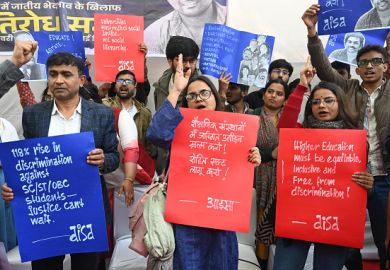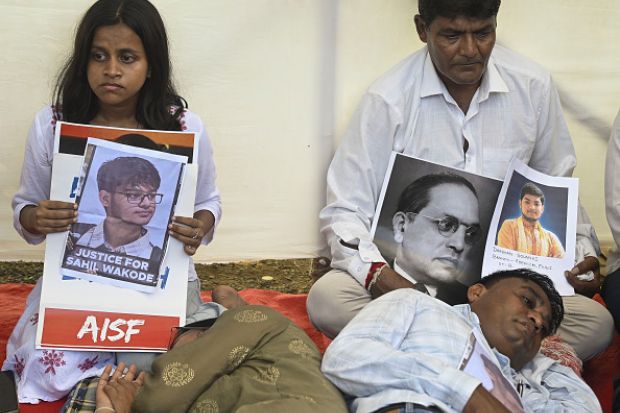
When a Scheduled Caste student, Sahil Wakode, died by suicide at the Indian Institute of Technology Bombay last month, the reaction to his death laid bare precisely what such disadvantaged Indian students are up against at elite institutions.
Wakode had reportedly been accused of using ChatGPT during an examination. A video circulating online appears to show him leaving the classroom after a faculty member confronted him. He then apparently went to his hostel, described the incident to his partner over the phone and then took his own life.
In the police’s first information report, his parents alleged that he had experienced caste-based discrimination, and they embarked on a hunger strike. Although the mainstream media pointed its many cameras at them and continuously interrogated them about their son’s apparent attempt to cheat, Wakode’s father stood holding a picture of him and crying copiously, while his wife demanded justice for what many see as yet another example of caste-based discrimination in Indian higher education.
The professor who confronted him was reportedly charged under the Scheduled Castes and Scheduled Tribes Act, 1989, which addresses discrimination against members of historically oppressed communities, the former “untouchables”. But that only prompted further pushback.
IIT Bombay faculty members issued a notice expressing solidarity with the professor and warning that charging him could discourage them from carrying out their institutional responsibilities. Some mainstream media outlets also invited IIT Bombay students to praise him. And online commentary ranged from mocking the system of reservation – which requires centrally funded higher education institutions such as IITs to reserve 22.5 per cent of their available seats for Scheduled Caste and Scheduled Tribe students – to sarcastic suggestions that marginalised students should be handed certificates of excellence without having to pass any exams – or perhaps even be made immune from prosecution for crimes.
It is absolutely no coincidence that most who successfully enter and thrive in elite institutions such as IITs are backed by political connections and generational privilege. And these patterns of hate against marginalised identities are symptoms of two interlinked forces: Brahmanical morality and neoliberal meritocracy.
During my few years of teaching in what were widely considered premier institutions, I learned two fundamental things. Professors at every level use artificial intelligence to write their papers and carry out the administration around teaching, including feedback on assessments, preparing PowerPoint presentations and devising brochures and timetables for conferences and seminars. Perhaps such shortcuts are excusable, but other practices are not.
AI is also widely used to help write theses: in India, PhD candidates often receive inadequate scholarships, and those who take (low-paid) teaching positions may face workloads that leave little time to do the required research, so they reach for whatever shortcuts are available. The use of AI is further normalised by the pressure institutions impose on PhD candidates to produce papers (to which eminent professors often add their names even if they had no meaningful involvement – even if the paper is in an entirely different field from theirs). This makes the scrutiny directed at a student’s alleged use of ChatGPT especially selective.
So why did it occur? Part of the answer lies in Brahmanical morality’s asymmetrical concept of punishment. Religious texts such as the Hindu Vedas and Upanishads have enumerated more punishments for the lower castes than for the higher – to ensure the subjugation of the former to the latter. Hence, marginalised students are digitally surveilled and targeted in the name of academic integrity while those in positions of power – such as faculty members close to the dean or the director, but also students from the upper echelons of the society – are exempted from extensive scrutiny and accountability.
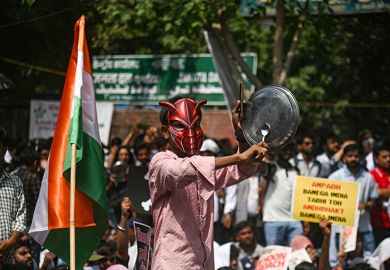
Another example is the recent mass student protests over the cancellation of the National Eligibility cum Entrance Test for medical aspirants, which reportedly led to the suicides of 21 students. The protests sparked the wider “cockroach protests”, named after the Chief Justice of India’s description of certain unemployed young people as cockroaches. The pressure eventually forced the resignation of the education minister Dharmendra Pradhan. Yet, even after his resignation, he continued to be garlanded and celebrated.
It is worth noting that the lowest rung in the Brahmanical higher education hierarchy also includes sanitation workers, who are hired on contracts by intermediary companies and can be laid off at any time. In one private institution I am aware of, they earn 11,000 rupees (£87) a month and receive no casual or medical leave.
Most of the workers are women from Scheduled Castes, and they face discriminatory remarks from faculty members and administrators suggesting that cleaning should come naturally to them because they have been doing it for centuries. At times, it is difficult to separate caste-based abuse from sexist slurs. And it is a widespread practice to dismiss complaints concerning women and caste discrimination as false or advanced by ulterior motives.
All this prejudice dovetails with a neoliberal impulse to protect institutions, such that elite universities are never held accountable for pushing students and faculty to produce more papers through unscrupulous means or for forging data for international ranking.
It also chimes with a view borne of neoliberal meritocracy that students marginalised by caste – who typically enter with lower grades – are incompetent compared with those higher in the caste ladder, discounting their experience of social stigma and lack of the safety net that comes with generational wealth, consciousness and social networks. It is inhumane to require such students – who may have to undertake paid work to survive – to take 12 courses per semester, complete exams and presentations, as well as undertake unpaid and potentially exploitative internships.
The typical response to Dalit student suicides is to employ a counsellor for other such students to talk to. But such small-scale adjustments do precious little to address the flawed hierarchical system that makes such counsellors necessary, again and again.
We need instead a complete overhaul of that system, with collective accountability for when things go wrong.
Ankita Chatterjee is an independent researcher with a PhD in sociology from Jawaharlal Nehru University. She is a member of the Indian Sociological Society’s visual studies group and has taught at Christ University, Delhi NCR and Symbiosis University, Pune.
Register to continue
Why register?
- Registration is free and only takes a moment
- Once registered, you can read 3 articles a month
- Sign up for our newsletter
Subscribe
Or subscribe for unlimited access to:
- Unlimited access to news, views, insights & reviews
- Digital editions
- Digital access to THE’s university and college rankings analysis
Already registered or a current subscriber?