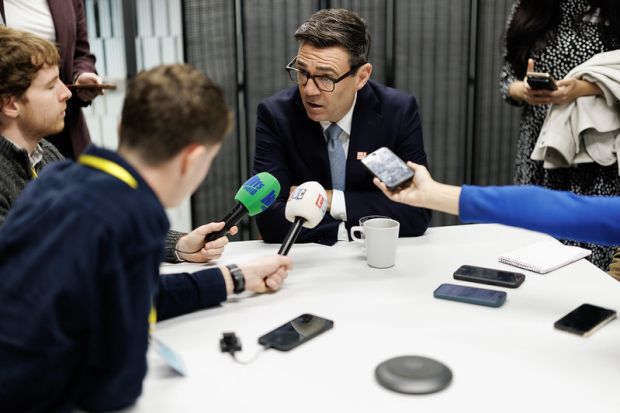
Andy Burnham has been urged to “put his money where his mouth is” and provide more funding for his devolved research agenda, rather than putting further pressure on already stretched UK Research and Innovation budgets.
Universities have welcomed the chance to play a central role in the prime minister’s “innovation nation” plans revealed last week – but some fear that the £1 billion allocated as part of the announcement will threaten other research projects as it will need to be found from within the agency’s existing budget.
Speaking to Times Higher Education, Richard Jones, emeritus professor of materials physics and innovation policy at the University of Manchester, said the money should come from “buckets 2 and 3” of the system devised by former science minister Patrick Vallance and UKRI chief Ian Chapman.
These cover government priorities and infrastructure – and together have about £12 billion allocated for industrial strategy growth sectors – and would allow “bucket 1”, which supports curiosity-driven research, to be protected.
Burnham wants the money to be channelled into regional “clusters” as part of a more “place-based approach to innovation” modelled on his time spent as mayor of Manchester.
A UKRI staff member, speaking to THE anonymously, said: “While we fully support the prime minister’s ambitions to see growth in every postcode, the majority of UKRI’s staff, funding and activity already happens outside the greater south east and the organisation already does more than almost any other branch of government to support economic activity throughout the UK.”
They added that the announcement comes as key research and innovation facilities such as Jodrell Bank, the ISIS Neutron and Muon Source, and the UK Astronomy Technology Centre – and their partners across UK universities – are already under threat owing to real-terms funding cuts.
“The prime minister either needs to decide what else he’d like UKRI to cut or put his money where his mouth is and provide funding for his own announcement,” they said.
Andy Westwood, professor of politics and public policy at the University of Birmingham, was more optimistic. He said he expected the amounts – “depending on the exact nature of the clusters and the R&D expertise in places” could come from any “bucket”.
Stretched over four years it “should be relatively easy to absorb into existing UKRI budgets and plans because of this – and isn’t necessarily an amount that will be directly devolved”, Westwood said.
He questioned whether the investment will be coordinated top-down by UKRI or distributed to regional administrations like the previously announced Local Innovation Partnerships Fund.
Jones cautioned that, to achieve Burnham’s goal of ensuring the £1 billion commitment “builds clusters in the industrial strategy priority areas” – such as artificial intelligence and life sciences – the plans “will need to build on existing data…together with insights gathered by a closer engagement of UKRI with regional leaders and businesses”.
“I think it’s fair to say this is still work in progress,” he said.
George Freeman, former science minister and Conservative MP for Norfolk, agreed that, to be successful, the money would need to be “ring-fenced” and “allocated in clear criteria, rewarding local leaders who can crowd in private inward investment”.
Register to continue
Why register?
- Registration is free and only takes a moment
- Once registered, you can read 3 articles a month
- Sign up for our newsletter
Subscribe
Or subscribe for unlimited access to:
- Unlimited access to news, views, insights & reviews
- Digital editions
- Digital access to THE’s university and college rankings analysis
Already registered or a current subscriber?