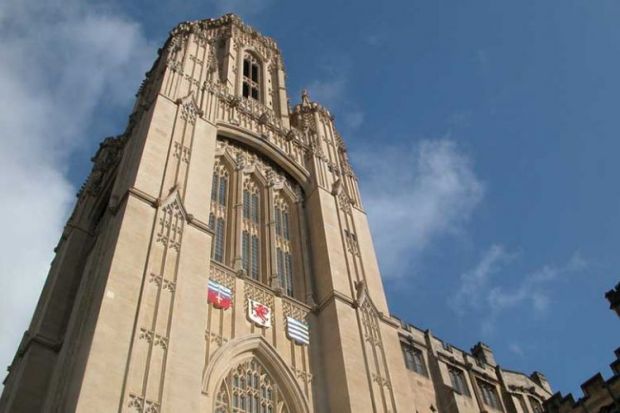
Universities must use their “intellectual firepower” to tackle the social problems of gentrification caused by their own regeneration of run-down urban areas, the former mayor of Bristol has said.
Marvin Rees, who served as Bristol’s mayor from 2016 to 2024, told Times Higher Education’s World Academic Summit in Cape Town that the University of Bristol’s new £500 million Temple Quarter Enterprise Campus represented an important civic engagement by the Russell Group university, which has been largely based in the upmarket hillside neighbourhood of Clifton over its 150-year history.
With its new base near the city’s railway station and the creation of so-called microcampuses in less wealthy areas such as Lawrence Hill and Hartcliffe, the Russell Group university is less likely to be seen by city residents as an “elite” institution “on top of a hill”, explained Rees, who was speaking in a session with Cape Town’s current executive mayor Geordin Hill-Lewis and Bristol’s vice-chancellor Evelyn Welch.
Bristol co-organised the summit with the University of Cape Town.
“It’s difficult to just quantify the value of the cultural shift that happens – or the [changed] nature of a relationship between the university and the city – when a university reaches out like this,” said Rees of the new “down in the valley” campus.
“Bristol is a city that presents incredibly well to the outside world. We’re the home of [the street artist] Banksy, with our own music genre in triphop, fantastic cultural institutions and it’s always been wealthy. And yet we have incredible inequalities,” explained Rees, now a Labour peer in the House of Lords.
“Clifton, where the university is historically based, sees 100 per cent of teenagers go on to higher education. In Hartcliffe, which is a post-war housing estate, white, poor, multi-generational, around 11 per cent of children go into higher education,” he added.
With many areas of Bristol acutely aware of how the university’s growth had led to “gentrification”, which priced out families from certain areas, it was important for Bristol to be seen to actively contribute to the community, said Rees.
He said that before he became mayor there “was something called the Bristol Partnership, which was about a partnership of local institutions. We had council officers running this partnership, and not very well to be perfectly frank. The University of Bristol had a professor called Leroy White, whose expertise was in partnership working. Yet none of Leroy’s work was being put at play within the city,” he said. “We had all this intellectual firepower in the university and we were not drawing on it for those wicked challenges like gentrification, like intergenerational inequality. We made use of Leroy. It was excellent and it gave some real insights into how organisations collaborate.
“More recently, we had a spate of murder stabbings in Bristol and again, I came to university and said ‘Can we draw on your intellectual firepower to better understand knife crime, the threats, where the vulnerabilities are?’
“That actually turned into pieces of work that were presented in Parliament just a few weeks ago. So that capacity is there and [we] don’t have to sit in a political room with government officials just trying to work this out. We have phenomenal research, you know, insights at our fingertips,” he said.
That type of civic engagement challenged the research-intensive university to consider what type of research it undertook and “what does it mean to be the best”, said Welch.
“Ten years ago, there was a sort of sense that investment [should follow] fundamental research or global warming…only the big stuff, [a sense that] that you don’t sweat the ‘small stuff’ if you’re a professor at a major elite university.
“I’d say the small stuff and the big stuff are now so interconnected that actually we need to sweat both, and we cannot do that without partnering not just with fellow universities but also with local communities,” said Welch.
That was why Welch had welcomed engagement with Rees earlier in her time in office, she said.
“Moving between the global, the national, the regional, the local is something that we are all just developing muscles to deal with,” she said on the challenge of greater civic engagement.
“The value of having somebody who politely reminds you that you belong to something that is bigger than your own research interest is incredibly valuable, and that’s why we are building more city [engagement] into our new plans.”
Register to continue
Why register?
- Registration is free and only takes a moment
- Once registered, you can read 3 articles a month
- Sign up for our newsletter
Subscribe
Or subscribe for unlimited access to:
- Unlimited access to news, views, insights & reviews
- Digital editions
- Digital access to THE’s university and college rankings analysis
Already registered or a current subscriber?