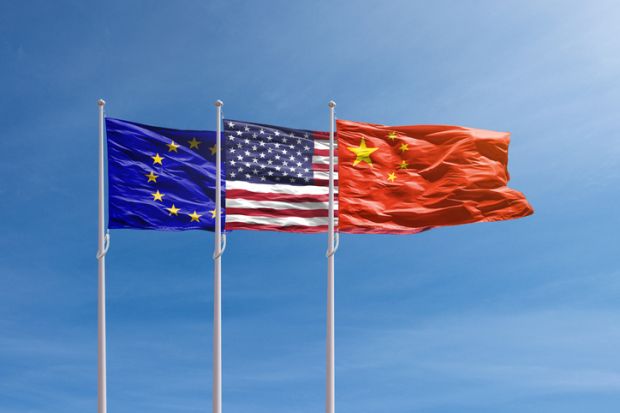
Researcher mobility between the European Union and its two biggest global research rivals, the US and China, has fallen sharply in recent years, but more Chinese researchers are choosing European destinations over the US for the first time, a major report by the bloc shows.
The European Commission’s biennial Science, Research and Innovation Performance of the EU report found that the number of researchers moving from the EU to the US fell by 45 per cent between 2023 and 2025, while movement in the opposite direction dropped by a third. The years cover the later stages of Joe Biden’s presidency and the first nine months of Donald Trump’s second term in office.
The report identified a similar trend between EU researchers and China. Flows from the EU to China fell by 41 per cent over the same period, compared with a 24 per cent fall in the opposite direction. But despite the slowdown, the report pointed out that a growing share of Chinese researchers prefer the EU over the US. For the first time, the EU became “the preferred destination for outgoing Chinese researchers”, overtaking the US, with 53 per cent of those who left China choosing European destinations in 2025 compared with 35 per cent two years prior.
The report points to changes in the US research landscape, including reductions in federal science funding since Trump returned to the presidency in 2025, China’s growing scientific influence and geopolitical tensions as factors influencing international researcher mobility.
Most of the findings in the report predate the 2025 launch of the EU’s ambitious Choose Europe for Science strategy, aimed at attracting and retaining talented researchers from around the world, particularly the US. The report highlights that, as part of the programme, the commission and member states have launched 101 European, national and regional finding calls, up from 65 in 2025, while the allocated budget has more than doubled to €900 million (£768 million).
But the report also says that Europe’s gains are unevenly distributed across career stages.
Since 2023, the EU has attracted increasing numbers of established researchers, defined as those whose first publication appeared before 2015, giving them at least 10 years of research experience. Inflows of such researchers now exceed outflows overall, which the report describes as a sign of a European “brain gain”.
But the bloc is struggling to retain and attract younger researchers, “presumably due to an unstable geopolitical context”, it adds.
Insecure employment is also singled out as a major long-standing issue facing younger researchers. About 20 per cent of researchers working in EU higher education were on “precarious” contracts in 2022, according to figures cited in the report, with insecure employment particularly pervasive at the postdoctoral stage. Rates varied considerably between countries, peaking at about half of researchers in Cyprus, nearly 40 per cent in Finland and about 40 per cent in Germany.
Register to continue
Why register?
- Registration is free and only takes a moment
- Once registered, you can read 3 articles a month
- Sign up for our newsletter
Subscribe
Or subscribe for unlimited access to:
- Unlimited access to news, views, insights & reviews
- Digital editions
- Digital access to THE’s university and college rankings analysis
Already registered or a current subscriber?