Last year, a group of frustrated academics decided they had spent long enough diagnosing the problems facing France’s universities. Instead of just calling for more funding or another short-term fix, they wanted to explore ideas to “overhaul” the higher education model.
Just 50 professors and researchers showed up to their first event. “It was a failure,” admitted Bruno Andreotti, professor of physics at Université Paris Cité and one of the organisers.
A year later, the initiative has returned on a much larger scale, however. The Assises pour l’Université et pour la Recherche (Conference on Higher Education and Research), a national consultation on the future of universities and research, is backed by about 30 academic and scientific societies, with the academic network Agora Sciences Université Recherche (Agora Science University Research) operating as its main organiser.
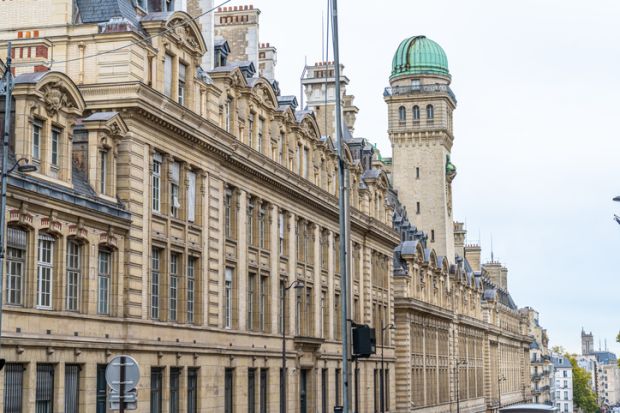
Its launch conference at Sorbonne University earlier this month drew about 500 academics in person and another 500 online. Overall, 6,000 people have shown support for the initiative. Kristel Chanard, a research scientist at the Paris Institute of Earth Physics and one of the organisers of the conference, said it grew out of frustration with years of debate about universities and the research sector.
“It was really about trying to move beyond the diagnosis of the problem of higher education and research in France and start thinking about an alternative,” she said.
The conference itself mirrored the way academics ordinarily present their research at scientific meetings, “where people submit abstracts and are selected to give oral presentations” – only this time the academics were “presenting ideas on possible ways to change the system”, Andreotti explained.
He said meetings about the future of higher education have typically been organised by the government over the past 20 years, with little involvement from professors and students. But the Assises project was a “novelty” because of its grassroots nature.
The September conference was only the beginning. Discussions are now moving to a local level. Meetings (local Assises) are taking place around France before proposals are brought together nationally. Organisers will produce a white paper setting out ideas for the future of higher education and research.
The movement comes ahead of presidential elections in France next April. With other issues such as cost of living and immigration set to dominate, organisers hope the white paper will help put universities and research into the debate ahead of the vote.
“People are ready to start speaking about research and have a voice because of the elections,” Chanard said. And they have lots to talk about. All of France’s 75 universities are expected to end the year in deficit. France has also lost ground in terms of its share of global scientific publications. It fell from sixth to 13th place globally between 2010 and 2022, according to the Observatory of Science and Technology at the High Council for Evaluation of Research and Higher Education.
“It’s really an amazing academic, economic, scientific and technological decline,” Andreotti said. “There have now been something like 10 successive reports from parliament saying what was done in the last 20 years was a disaster.”
For Chanard, one big issue is that French researchers “act more as managers” and have less time to carry out research because of the time it takes to write proposals and take on administrative tasks.
At Université Paris Cité, Andreotti said, the student services office closed down several years ago and professors were expected to take on administrative duties on top of their research and teaching. “When people are burned out, they leave the office and they are not replaced,” he said. “We still teach at a very high level, but we have little time to do the rest of these tasks.
“German staff come to our labs and ask, ‘Where are the [admin staff]?’ We laugh. We’re doing the admin,” he added.
Looking ahead to the election, Andreotti said French academics were dissatisfied with the approaches of different political parties.
There are concerns about the far-right party National Rally, who Andreotti described as being “against science” and pushing “de-academisation”. He argued that the political centre focused heavily on innovation but did not recognise the relationship between fundamental science and technological advances. On the political left, he said fragmentation had generated “more noise” than clear proposals for universities.
That absence of a compelling plan, he said, is what brought professors, researchers and students together in the first place. “We want to produce ideas that political parties don’t any more,” he said.
Register to continue
Why register?
- Registration is free and only takes a moment
- Once registered, you can read 3 articles a month
- Sign up for our newsletter
Subscribe
Or subscribe for unlimited access to:
- Unlimited access to news, views, insights & reviews
- Digital editions
- Digital access to THE’s university and college rankings analysis
Already registered or a current subscriber?