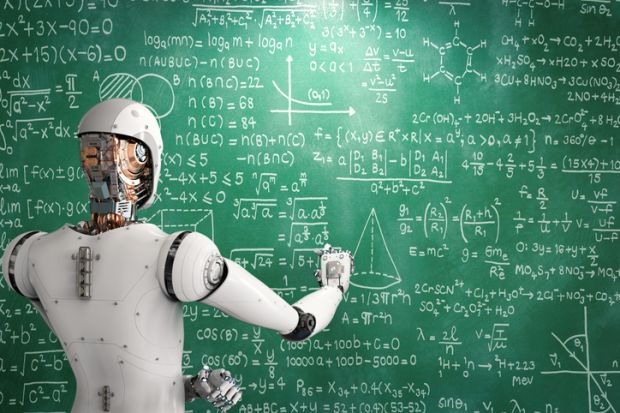
Mythology is replete with stories of people who are killed by their own children. Does mathematics now risk this same fate, at the hands of the technology it helped create and nurture: artificial intelligence?
Fundamental change is already upon us. The field of mathematics, a subject thousands of years old and rarely noted for drama, is in turmoil. It is a cataclysm unlike anything we have seen previously.
As students start courses or return from their summer break, they are walking into mathematics departments wrestling not just with what to teach but also with what they are for. How should we educate undergraduates or advise postgraduate students now that AI is already better than we are at solving the most important research problems?
In only a very short time, AI has emerged and proved itself able to solve some of the most important problems in the subject, the kinds that have been central to the field’s collective sense of self for centuries. Most notably, OpenAI has put forward a solution to a famous problem relating to the equation that governs fluid flow, the Navier-Stokes equation. If that claim stands up, the firm will have cracked one of the seven Millennium Prize Problems defined by the Clay Mathematics Institute at the turn of the millennium and can lay claim to a million-dollar reward.
Although OpenAI appears not to be in it for the prize money, it does seem to be using these iconic mathematical challenges to flex its technological muscles, and quite possibly as a way of drumming up its value and attracting further investment. Whatever the motivation, the AI companies are moving ahead at great pace, using enormous resources, seemingly without regard for the impact they are having on the field.
This all raises profound questions.
First, who should get the credit? Does it belong solely to the AI companies, or should it be shared with the generations of mathematicians whose research the companies have used to train their models? In the case of the Navier-Stokes problem, OpenAI’s inability to rule out that its results leaned on the groundbreaking work of Tristan Buckmaster and Levent Alpöge has raised eyebrows and questions. It has been reported that the firm offered co-authorship to Buckmaster but not to Alpöge, who works for a competitor company. If that is correct, it goes against scholarly ethical norms.
A further question raised relates to what is truly important in mathematics. Is it solving famous challenges, or is it introducing new concepts, ideas and problems? It now seems likely that AI will be better at solving problems, but it remains to be seen whether it will be able to conceptualise and build theories as we do, or whether it will be able to abstract and simplify real-world problems by making judicious assumptions or approximations.
Third, if we have an avalanche of problems being solved, will the AI companies publish the solutions in a way that we can learn from and teach to students? Or will the traditional care with which mathematics has been communicated since the time of Euclid be jettisoned? Often, mathematicians spend long periods polishing their explanations to make them as easy as possible to understand. Referees then often make suggestions for further clarifications. But the AI companies appear to have rushed out papers that are extremely difficult for humans to understand. There seems to have been little effort put in to convey the key ideas. And I do not know whether they have submitted them to peer-reviewed journals.
These questions go right to the core of how mathematicians view their subject, and what they consider important about it. But currently there is not a clear consensus on what the right answers are.
Some mathematicians are rapidly taking up the use of AI themselves, fearing being left behind; others are declaring that they will not use it. Young mathematicians in particular have expressed considerable uncertainty about what careers in the subject will look like in the future.
These issues are being discussed feverishly across the mathematical world. It is important that this is done carefully. If we ignore the threats, we put at risk a tradition that humankind has nurtured for thousands of years. If we ignore the opportunities, we risk missing out on important new ideas and discoveries.
I’m alert to the cautionary tale of Gerald Ratner in all this. He nearly destroyed his own jewellery company by talking down the products it sold in an ill-judged speech to the Institute of Directors. Mathematics may face its own Gerald Ratner moment if we do not choose our words and our path carefully in this moment.
We need calm and rational hands on the tiller. The learned societies will surely play a pivotal part, as will groups such as the Campaign for Mathematical Sciences. I’d like to see them, and the universities, stepping forward to play a key role in navigating the community through the storm.
And, of course, the issues go far beyond mathematics. As several prominent mathematicians wrote to the Royal Society last week, we need urgently to assess whether AI poses a wider threat to society, and perhaps even to humanity. I agree with them.
My own view is that radical change is coming – in mathematics as much as in wider society. But, after all, photography didn’t airbrush painting. Television didn’t close the book on reading. And video didn’t kill the radio star. If we adapt, we can work with AI to enter a new age of mathematical discovery and progress.
Jon Keating is Sedleian professor of natural philosophy at the University of Oxford.
Register to continue
Why register?
- Registration is free and only takes a moment
- Once registered, you can read 3 articles a month
- Sign up for our newsletter
Subscribe
Or subscribe for unlimited access to:
- Unlimited access to news, views, insights & reviews
- Digital editions
- Digital access to THE’s university and college rankings analysis
Already registered or a current subscriber?