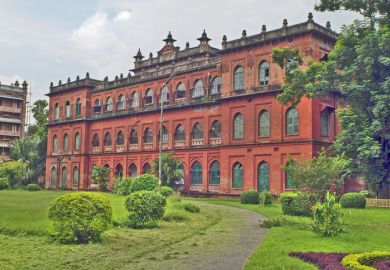
The recent decision by the Dhaka University Syndicate, the university’s highest decision-making body, to formally investigate 231 faculty members accused of alignment with the deposed Awami League (AL) regime exposes a deeply entrenched, recurring crisis in Bangladesh’s higher education system.
Driven by a memorandum submitted to the vice-chancellor by a group of more than 100 university teachers calling themselves the “Anti-Fascist Teachers of Dhaka University”, this administrative purge is not isolated. Rajshahi University, Jahangirnagar University and other public institutions have also instigated mass suspensions, forced leaves and public demonisation of academics associated with former prime minister Sheikh Hasina’s now banned, nominally left-of-centre political party. Other left-leaning academics have also been targeted.
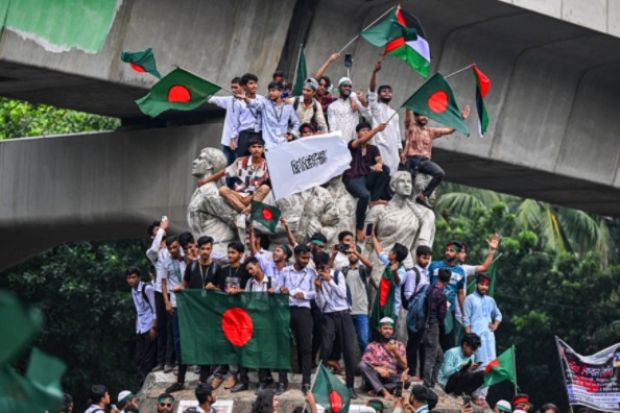
Those leading the charge, of course, see their actions as vital to removing all trace of an authoritarian regime that the United Nations concluded had systematically committed serious human-rights violations during the protests against its government, some of which may have amounted to crimes against humanity. Academics loyal to the AL were very influential in the then university administration under the previous regime, while those who were not had to face challenges on campus and professional harassment. Some were temporarily suspended or dismissed.
However, by reducing campus governance to ideological compliance, the syndicate is reproducing the exact same structural vices the protesters claimed to want to dismantle – illustrating that without fundamental legal transformation, Bangladesh’s higher education institutions will remain trapped in an endless cycle of retribution.
To understand this crisis, we must look at how universities function as an ideological state apparatus (ISA) – a term coined by French theorist Louis Althusser. Rather than serving as an independent arena for free thought, the campus ecosystem is routinely captured by whichever political regime controls the state machinery. Universities are critical instruments used by the ruling class to secure ideological conformity and reproduce state power.
Under Sheikh Hasina, dissenting academics faced relentless institutional harassment, arbitrary transfers and online character assassinations if they dared to challenge state narratives or public policies. Dissidents were monitored, sidelined and systematically intimidated by partisan administrators and state-backed student wings.
Today, the new administration, led by Tarique Rahman’s centre-right Bangladesh Nationalist Party, is using the very same political apparatus. While the ideological banner has shifted from secular nationalism to anti-fascism, the underlying structural logic remains identical: the university is deployed to enforce uncritical political allegiance, rendering intellectual servitude the prerequisite for professional survival. Academic appointments, research grants and promotions remain contingent on propagating state-sanctioned narratives, rather than any sense of academic merit. Affiliation with the former regime, or even an insufficiently enthusiastic interpretation of the recent mass uprising, is instantly treated as grounds for professional exclusion and disciplinary action.
Indeed, across every political regime in Bangladesh’s history, independent scholars who refuse to align with ruling factions have been systematically marginalised, while partisan sycophants have monopolised positions of power. For decades, dominant faculty alliances – such as Dhaka’s AL-leaning Blue Panel (dubbed Nil Dal) – have functioned as self-serving cartels, capturing administrative offices, monopolising promotions and controlling university resources to reward regime loyalty.
Banning these platforms or purging their members en masse might superficially appeal as a solution, but it does not dismantle the underlying machinery of capture. It simply transfers the monopoly of institutional control to a new group of political opportunists.
Partisan sycophants are the last people you want to be in charge of institutions that are supposed to encourage critical thinking and incubate new ideas. When public university teachers are nakedly exposed to hyper-partisan politics, the entire higher education ecosystem is fundamentally jeopardised. Intellectual freedom cannot exist in an environment of collective retribution, where faculty members must constantly self-censor in anticipation of the next inevitable regime change.
To break this destructive cycle, a clear boundary must be drawn between ideological persecution and legitimate judicial accountability. Academics who were directly involved in criminal activities must absolutely be brought to justice. So should those who issued verbal or written orders that led to the confinement, harassment and torture of university students during the July mass uprising. However, this reckoning cannot take the form of vigilante justice, administrative overreach or sweeping ideological lists.
The entire process must be transparent, legally sound and strictly executed according to the university ordinances and the law of the state. Holding individual wrongdoers accountable through transparent legal frameworks is a necessity, but enacting a mass ideological purge is an institutional failure.
A good example for Bangladesh to follow is South Africa, whose 1997 Higher Education Act dismantled the racial and ideological apparatus used by the apartheid state to police thoughts, replacing regime-dictated appointments with independent governance structures and transparent quality assurance frameworks. This historical shift legally decoupled faculty career advancement from state-sanctioned ideology, reclaiming the university campus as a place for critical social critique rather than an enforcement arm of the ruling party.
Ultimately, the root of Bangladesh’s institutional vulnerability lies in the outdated Public University Acts of 1973, under which only the four major public universities – Dhaka, Rajshahi, Chittagong and Jahangirnagar – are run. While originally intended to protect academic freedom and administrative autonomy, allowing academics to elect their deans, the acts inadvertently legalised the partisan polarisation of campus elections for positions such as faculty deans and head of teachers’ association.
Nor are Bangladesh’s other public universities, established from 1980 onwards, in a better position: the legislation under which they were established allows the ministry and the University Grants Commission to intervene directly in academic or administrative matters.
To resolve the problem, the legislation must be amended urgently to completely sever public universities from state patronage. In the case of the 1973 acts, faculty members must maintain their right to express critical opinions on politics, but they must be statutorily prohibited from adopting partisan political affiliations on campuses, which amount to intellectual servitude and destroy academic freedom. Faction-based academic elections must be replaced with neutral, independent search committees tasked with appointing university leadership purely on academic merit and scholarly activities.
Only by replacing partisan retribution with a structural rule of law can Bangladesh transform its universities into genuine centres of academic excellence.
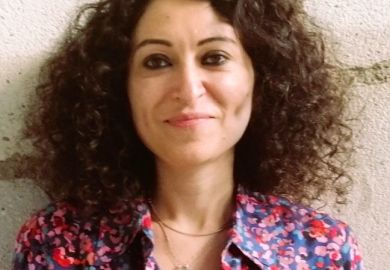
Sheikh Nahid Neazy is associate professor of the department of English at Stamford University Bangladesh, in Dhaka. He can be contacted at nahidneazy@yahoo.com.
Register to continue
Why register?
- Registration is free and only takes a moment
- Once registered, you can read 3 articles a month
- Sign up for our newsletter
Subscribe
Or subscribe for unlimited access to:
- Unlimited access to news, views, insights & reviews
- Digital editions
- Digital access to THE’s university and college rankings analysis
Already registered or a current subscriber?