“Citizens’ assemblies” can be used to tackle some of higher education’s biggest problems, according to staff and students who have helped devise climate policy for the University of Westminster.
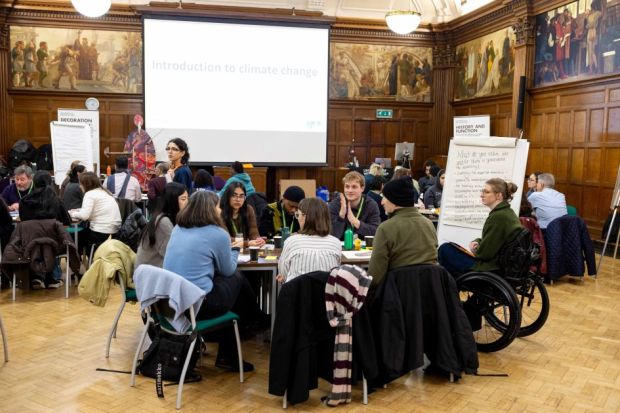
In what is thought to be a first for a UK university, a 45-strong group recently submitted 51 recommendations for how to make Westminster more sustainable, and are now keen to share what they learned with others.
Ro Spankie, a principal lecturer in architecture at the university and one of the original proponents of the initiative, said it was inspired by watching similar processes unfold at French universities in Paris.
Spankie said she’d heard interest in replicating the model from colleagues at the likes of King’s College London and Kingston University, adding that while “every university will do it a little bit differently”, the model could stimulate discussion and problem-solving in a sector grappling with multiple crises.
“We have to bring change into higher education,” Spankie said. “We just can’t keep going on thinking the only solution is to put the cost of a degree up…[Assemblies like this] give us another way of doing things, because having a genuine deliberation where everyone is talking from an equal footing [creates] a really interesting space, rather than the pyramid structures of committees that the traditional university is built on.”
More than 300 people from the university community of academics, professional services staff, students, and alumni applied to take part in the inaugural climate assembly, with members eventually selected by a lottery.
Stuart Farrell, a head chef at the university and one of the participants, admitted he was “quite sceptical” about the scheme initially, but said his perspective changed once in the room. “Hearing everyone’s different point of view – because I thought I had a little bit to offer from the catering point of view…I found it really interesting and a good way forward.”
Over a series of six sessions, and with the help of trained student facilitators, the group discussed what the university could do on sustainability, producing a series of recommendations since put to the institution’s senior leaders for approval.
Vice-chancellor and president Peter Bonfield has said he looks forward to “working with all to implement the assembly’s recommendations”, with proposals including that academics be given additional hours to create interdisciplinary content around sustainability.
Another recommendation calls for the creation of a website or digital hub dedicated to the issue, featuring opportunities, events, and staff and student work on climate action.
But a particular focus is the university’s use of artificial intelligence (AI). One recommendation demands the institution pursue policy and practices with a “strong focus on building AI literacy”, including around the technology’s environmental impact.
Another asks the University of Westminster to “provide much clearer guidance on when not to use AI”, to mitigate its knock-on effects.
Dibyesh Anand, deputy vice-chancellor of global engagement and employability, said the university was committed to making sure the recommendations of the climate assembly were enacted.
“There’s always a risk that there are good recommendations but nothing happens after that,” said Anand. “There’s sometimes a lack of accountability, not because of absence of intention, but because of how universities function, that every year things will change. Partly, my role is to make sure that we as a university are accountable for what we said we will do.”
Anand declined to say how much the university had provided monetarily for the assembly but said it was “one of the largest funded projects” of the last year, with the initiative welcoming “generous” funding from the Quintin Hogg Trust.
Yasmin Kulasi, associate head of Westminster Business School and another participant, said bringing “all these people together from across the university body”, ranging from security staff and chefs to students and graduates, left her gripped by “all the possibilities”.
“We’ve begun to discuss what’s next,” Kulasi said. “Isn’t this a brilliant way of bringing our university community together?”
Register to continue
Why register?
- Registration is free and only takes a moment
- Once registered, you can read 3 articles a month
- Sign up for our newsletter
Subscribe
Or subscribe for unlimited access to:
- Unlimited access to news, views, insights & reviews
- Digital editions
- Digital access to THE’s university and college rankings analysis
Already registered or a current subscriber?