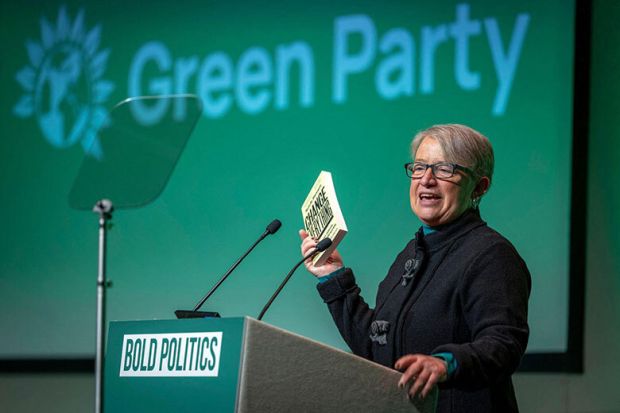
Politicians from nearly all parties are increasingly questioning the value of a degree. While Reform and the Conservatives continually bash so-called Mickey Mouse courses, Labour recently warned prospective students to “choose carefully” when considering a degree programme. Amid this noise, one party stands apart: the Greens.
“Our philosophical position is that education is a public good,” Natalie Bennett, former leader of the party, told Times Higher Education.
Challenging the view that a degree is only worthwhile if it leads to a high-paying job, she described the “utter downplaying” of the humanities and social sciences, while STEM subjects are put on a “golden pillar”, as “horrifying”.
Similarly, “the Green Party is not of the view that…fewer people should go to university,” Bennett said. “We need an educated, skilled population.”
But this opinion does not equate to a free pass for universities. Bennett, now a member of the House of Lords, has written passionately about the problems caused by the marketisation of the university sector.
“This is a model that’s done an enormous amount of damage to education, to students, to academics,” she said, accusing the sector of drawing students in to try to “get the maximum amount of money out of them” and describing universities as “places of fear” given ongoing job cuts.
“It’s a model that very clearly is coming to the end of its life. And the question we have to ask is: what comes next?”
For the Green Party, the answer appears to be a complete rethinking of the system. Speaking at the University and College Union (UCU) conference in May, party leader Zack Polanski reportedly told academics that universities “have been forced to turn students into customers and focus on making money above all else, just to survive”.
He continued: “We all lose out when learning is treated as a commodity.”
As the left-wing party experiences a surge in popularity – membership numbers have more than tripled since Polanski became leader in 2025, with the party surpassing Labour in some polls – leaders appear to be looking closely at their policies and offer to voters.
One policy that may appeal to some amid the growing frustration at high graduate debt levels is the longstanding promise to scrap university tuition fees altogether. “Absolutely that’s still the direction of travel,” said Bennett. “[Education] should be paid for from public taxation, progressive taxation – far more progressive than it is now.”
Hinting at future policy positions, Bennett added that the party would “look at” the Office for Students following the successful legal action against the regulator by the University of Sussex. “The way it’s been set up as a market regulator of a market-driven system – that’s really a problem.”
At the same time, any future government will also have to contend with the financial crisis gripping universities.
“The Green Party don’t have all the answers to that,” Bennett said, “but I think it has to be going back to the idea of: this is something at the heart of the community that’s serving the community, that’s part of the community, that answers the community’s problems.
“That means a lot less focus on shiny glass-fronted buildings, and much more on ensuring that academics have a decent career path, have full-time employment [and] are treated decently.”
She added that the “fat cat” vice-chancellor set-up “has to go”, while acknowledging that reducing senior salaries alone won’t solve universities’ financial problems.
As universities look to cuts and mergers to shore up their finances, Bennett argued that further centralisation is the wrong path, describing the closure of the Southend campus of the University of Essex as “an absolute disaster”.
“That’s one of my concerns about Andy Burnham…I know people on the fringes of Greater Manchester who feel like the creation of the Greater Manchester mayoralty has just sucked things out of their communities,” she said.
Universities “have to be protected and kept in their communities, not sucked away”, Bennett continued. “Ideally what we need to do is see universities going out into smaller parts of their regions.”
From the financial crisis may come opportunities, she added. “If you started with an institution that’s gone down, a small amount of government money could be the seed to establish something much more cooperative, much more community-based, rather than just selling everything off at a fraction of…what it cost to build it.”
Register to continue
Why register?
- Registration is free and only takes a moment
- Once registered, you can read 3 articles a month
- Sign up for our newsletter
Subscribe
Or subscribe for unlimited access to:
- Unlimited access to news, views, insights & reviews
- Digital editions
- Digital access to THE’s university and college rankings analysis
Already registered or a current subscriber?