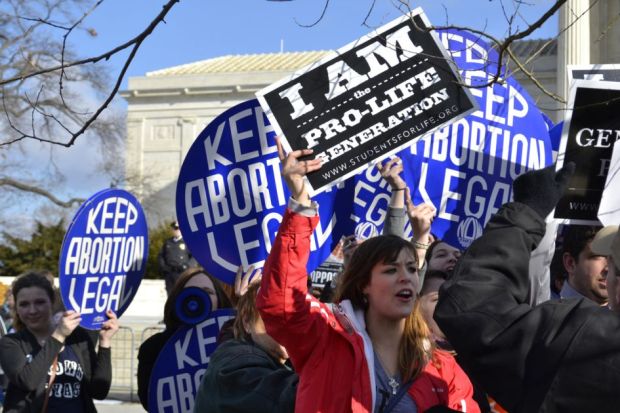
The number of applications for medical school from women in the US has grown more slowly in states that have introduced restrictions on abortion, according to a new study that warns political decisions can “meaningfully reshape who practices medicine, and where”.
After the Supreme Court overturned the constitutional right to terminate a pregnancy in 2022, there was an “overall increase” in the proportion of women applying to study medicine, rising nationally by 4.07 percentage points or an additional 498 candidates a year, research published on 3 June in the journal PLOS Global Public Health found.
But that growth was “significantly attenuated” in areas with more restrictive approaches to abortion, resulting in approximately 71 fewer female applicants each year than the trend would otherwise suggest.
Researchers Jade Gilchrist, of Western University in London, Ontario; Alexandra C. Istl of the Medical College of Wisconsin; and Amrit Kirpalani, of the London Health Sciences Centre, also in Ontario, analysed the gender composition of applicants and those who formally enrolled in medical school in the US between 2018 and 2025, using figures from the Association of American Medical Colleges.
The scholars sought to assess the impact of the repeal of Roe v Wade, a landmark decision by the Supreme Court that had, for nearly 50 years, upheld the right to an abortion as a constitutional guarantee. Its repeal returned the authority to write abortion laws to each individual state.
The study looked at 45 US jurisdictions, of which 17 had expanded abortion rights or maintained protections for access, and 28 had enacted legislation hostile to abortion or failed to implement any kind of legal protection for it.
The results revealed that the proportion of female applicants in restrictive states grew at a slower rate than within jurisdictions with expanded or protected abortion access.
This had not been the case prior to the Supreme Court ruling, supporting the view that differences were “due to policy shifts”.
However, no “statistically significant” change was observed in the number of women accepted to or entering medical schools nationwide.
Although the divergence between more and less restrictive states was “modest”, the researchers said even “seemingly small shifts” in applicant numbers can have “outsized long-term effects”.
Even a slight dip in the number of women applying to become doctors, the study claims, could lead to a “more substantial shortage”, and deficits in specialisms where women predominate, such as obstetrics and gynaecology.
The researchers point to other recent analysis suggesting that the disparity is not exclusive to medical schools, but that “many students do not want to train in abortion-ban or abortion-restrictive states”.
“From a higher education perspective,” the article says, “this study highlights the need to understand how policy environments shape who feels able or willing to pursue professional degrees.
“Admissions offices and policymakers alike should be attentive to these dynamics, as they influence both access and diversity in education and in the workforce.”
Register to continue
Why register?
- Registration is free and only takes a moment
- Once registered, you can read 3 articles a month
- Sign up for our newsletter
Subscribe
Or subscribe for unlimited access to:
- Unlimited access to news, views, insights & reviews
- Digital editions
- Digital access to THE’s university and college rankings analysis
Already registered or a current subscriber?