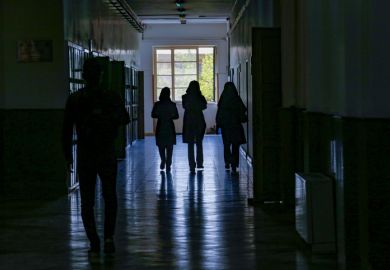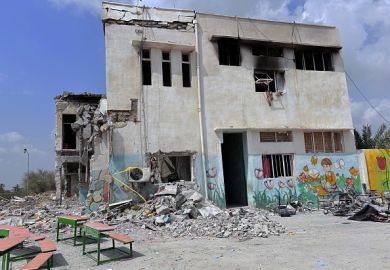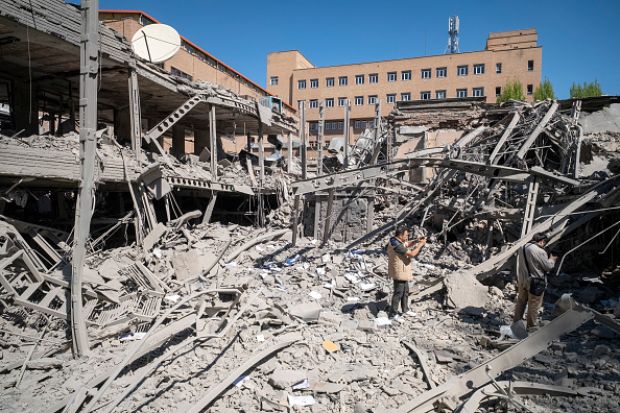
As they rebuild after the recent strikes by US and Israeli forces, should Iranian universities distance themselves from research areas that could attract future military targeting?
This question was raised in a recent article in Times Higher Education, in recognition of the fact that Iranian universities, research centres and scientists had been targeted because of their alleged relevance to Iran’s nuclear programme.
But the idea that the burden of avoiding attack lies with universities is deeply troubling. This is precisely the wrong starting point. Under international humanitarian law, universities – in Iran as much as anywhere else – are civilian institutions. Their protection does not depend on how powerful actors choose to label their research. It depends on one question only: whether they are directly participating in military operations. And this is a deliberately high legal threshold.
Dual-use research does not count. And that is just as well because it is it is far from an exceptional undertaking confined to Iran. Degrees of academic autonomy vary, and in some countries researchers face greater political and security pressures than in others. But the structural entanglement of universities with state interests is universal.
In the US and across the developed world, military-related agencies have long funded basic university research in physics, mathematics, computer science, materials science, engineering, biology and even the social sciences. No university system operates in complete isolation from state and military priorities. In that sense, vast swathes of university research are potentially relevant to the military.
Fields such as artificial intelligence, quantum technologies, aerospace engineering, biotechnology and network science all carry dual-use potential. If such potential were sufficient to weaken civilian protection, the vast majority of the world’s research universities would be permanently vulnerable. But when universities in the Global North pursue research with potential military applications, it is often framed as a pursuit of industrial competitiveness or strategic leadership; similar research in parts of the Global South is more readily interpreted through a security lens.
Equally, dual-use potential is policed more or less rigorously depending on who might have access to the technology. In Europe, export restrictions and security reviews can be triggered by a researcher’s nationality, institutional background and access to standard laboratory equipment, aluminium alloys, electron microscopes or data expertise.
A tighter definition of “dual use” applies to technologies that have obvious, direct military applications, alongside civilian ones. But precisely because the world is becoming more dangerous, the volume of such research is only likely to increase. The European Union, for instance, has responded to the perceived threat from Russia by proposing to remove restrictions on funding dual-use technology during the next Horizon Europe research funding programme, beginning in 2028.
If EU countries can pursue explicitly dual-use research, why shouldn’t Iran – or anywhere else? Equally, if any research with even very tangential military relevance is now seen as a legitimate military target then surely universities everywhere must refrain from exploring advanced scientific fields? The idea is intolerable that certain regions should be barred from such research not through formal prohibition but through suspicion, restriction and coercive pressure. The result would be a growing structural imbalance in global knowledge production.
Even on its own terms, such selective targeting would be unsustainable. Following the strikes on Iranian campuses, Iran reportedly issued threats against American-affiliated institutions across the Middle East. This is what the erosion of university protection looks like in practice: a feedback loop with no natural stopping point.
We must not go down this road. The burden of proof must remain exceptionally high for attacks on academic infrastructure. Dual-use potential is not enough. And claims that universities serve as “civilian cover” (as Israel put it) for military activities must be backed up by clear, specific and independently verifiable evidence. When targeting decisions rest on classified intelligence that is neither public nor contestable, the legal presumption in favour of civilian status is not a technicality; it is a vital safeguard.
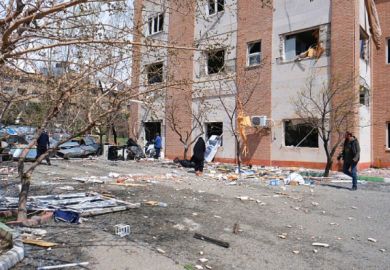
More than 30 Iranian academic, scientific and health institutions were reportedly hit in the recent attacks. At Sharif University of Technology, strikes damaged laboratories and an AI research centre. A plasma and laser lab at Shahid Beheshti university was also hit. The attack on the 106-year-old Pasteur Institute of Iran reportedly resulted in the loss of national reference laboratories for cholera and tuberculosis, as well as centres that collaborate with the World Health Organization and biological collections that had taken decades to build. Their destruction represents a loss to global public health, borne by a scientific community that had no part in the decisions that led to it.
The question, then, should not be whether universities must reshape their research agendas to avoid being targeted. The real question is whether the international community is willing to reaffirm the strict limits of such targeting – and to apply those standards consistently. We also need greater transparency in dual-use governance, stronger international oversight and diplomatic mechanisms that prevent the securitisation of academic research from escalating into open conflict.
The alternative is the gradual normalisation of scholasticide. During Israel’s 12 days of attacks on Iran in June 2025, more than 14 Iranian scientists were reportedly killed, in some cases along with their whole families. And over two decades, several Iranian researchers have been assassinated, including individuals connected to the Sesame synchrotron in Jordan, a rare scientific collaboration bringing together researchers from across the region, including Iran and Israel.
It is time to mount a defence of universities within the framework of international law and on genuinely universal terms. If we don’t, militaries will exploit the fog of ambiguity – and no scientist will be completely safe.
Alireza Qaiumzadeh is research professor in the Department of Physics at the Norwegian University of Science and Technology, Trondheim. Sara Gordafarid is an independent researcher in Iran.
Register to continue
Why register?
- Registration is free and only takes a moment
- Once registered, you can read 3 articles a month
- Sign up for our newsletter
Subscribe
Or subscribe for unlimited access to:
- Unlimited access to news, views, insights & reviews
- Digital editions
- Digital access to THE’s university and college rankings analysis
Already registered or a current subscriber?