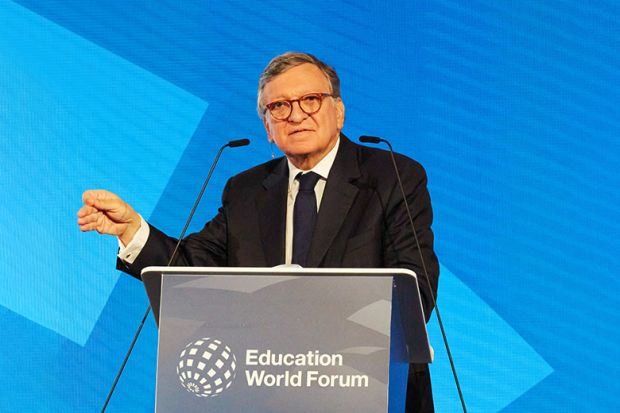
The former European Commission president who unveiled the first Horizon budget has defended the current leaders’ shift towards competitiveness, saying they need to justify the spending in a time of economic strain.
The commission plans to nearly double the budget for the next research framework programme, which will run from 2028 to 2034, while focusing on boosting Europe’s competitiveness to support financial growth.
This decision has been met with a backlash from some academics, who worry that the push could undermine universities’ broader social missions and damage the pursuit of scientific excellence.
Speaking to Times Higher Education at this week’s World Education Forum, José Manuel Barroso, former president of the European Commission, said he understood the current commission’s focus.
“It’s a difficult environment,” he said because of “budget constraints at national level, including [in] some of the richest countries”.
“I’m not sure if I [would] do it the same way, frankly, but I can understand the motives,” he said. “It’s very difficult for the commission to argue for, let’s say, education on its own without linking it to another issue that can also receive…wider support like growth, including by enhancing competitiveness”.
The commission is also keen to invest more in defence-focused research – another policy that has been unpopular with some academics.
But Barroso, who received a Nobel Peace Prize on behalf of the European Union in 2012, said he preferred to think of it as “expenditure for peace”.
“We have now a war in Europe in Ukraine, and so you have to show clearly to Mr Putin that he will not succeed if he has other ideas for other countries, including EU countries or Nato countries.”
Reflecting on his own time as president of the commission between 2004 to 2014, Barroso said one of his proudest moments in the education field was launching Horizon, with the first budget for the programme presented in 2014.
“At that time it was a revolution; the biggest programme ever of financing education [and] science,” he said. “In fact, it’s one of the very few cases where I had some support from the British government.”
Alongside his role in developing the European Research Council, Barroso also pointed to his creation of a high-level scientific advisory group for the commission for the first time, “including people from outside the EU, which I believe is the right approach to science”.
This included appointing a chief scientific advisor to the commission. “Many areas in the commission regulation were, in fact, quite over-politicised in my view. Issues of GMOs [Genetically Modified Organisms] for instance.”
He said he told the commission at the time: “Frankly, I find it ridiculous that we politicians now decide on that, so let’s try to have some expert opinion.”
In the years after he left his position in the EU, Barroso, who is now a part-time professor at the European University Institute, among other roles, said he was surprised to encounter a backlash against “experts”.
In 2016, former UK education secretary Michael Gove famously said the country had “had enough of experts”.
“I was living here in the UK for eight years…and I was quite surprised that in this country, that is one of the great symbols of enlightenment and science, some very important voices in the public debate were against experts, against science,” Barroso said.
“We should welcome scientists that bring us a more, let’s say, informed opinion than just one of political bias or prejudice.
“What I see today in the public debate, including about universities, is that the debate sometimes is dominated by the extremes – they are full of passion and intensity – while those who I believe...may advance the cause of knowledge and universities are not really present.”
Barroso, who is now chair of the advisory board for edtech company Efekta, added that, in some parts of the world, people are increasingly “against modern science”.
When it comes to the adoption of artificial intelligence (AI), he said he sees “some scepticism” but believes the debate “is going to be won clearly by those who are for the intelligent and responsible and ethical use of AI”.
Register to continue
Why register?
- Registration is free and only takes a moment
- Once registered, you can read 3 articles a month
- Sign up for our newsletter
Subscribe
Or subscribe for unlimited access to:
- Unlimited access to news, views, insights & reviews
- Digital editions
- Digital access to THE’s university and college rankings analysis
Already registered or a current subscriber?