A Nobel prizewinning astrophysicist has joined growing calls to reverse funding cuts likely to cause “long-term damage to the standing of UK science”, claiming the loss of postdoctoral researchers will threaten the country’s central role in several major international projects examining exoplanets.
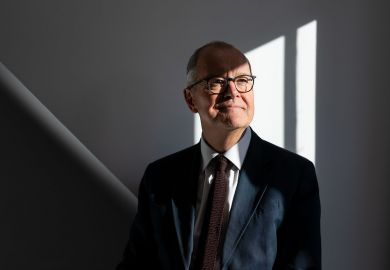
Backing an open letter signed by more than 100 UK planetary scientists, Swiss astronomer Didier Queloz endorsed a call to consider alternative options to the 30 per cent cuts proposed for the Science and Technology Facilities Council’s (STFC) particle physics, astronomy and nuclear physics (PPAN) programme.
Queloz, who is Jacksonian professor of natural philosophy at the University of Cambridge, won the Nobel Prize in Physics in 2019 for his discovery in 1995, with Michel Mayor, of the first “exoplanet” orbiting a Sun-like star outside the solar system.
Describing the advances by the UK science community in this area, the open letter states: “The UK exoplanet community has leading roles in virtually all major international exoplanet projects and cuts to PPAN funding threaten the vitality of the exoplanet community as well as its leadership on the world stage.”
“Cuts of this magnitude will do immense damage to PPAN research,” it continues, stating that “given that some of the most exciting advances in exoplanet science are likely to happen within the next couple of decades, if these cuts do go ahead it will risk the UK dropping out of its leadership position and losing the chance to make major contributions to one of the most exciting scientific advances of this generation.”
These projects include the launch of the European Space Agency’s (ESA) PLATO mission in 2027, first light of the Extremely Large Telescope (ELT) later this decade, and the launch of the UK-led Ariel mission in the early 2030s, the letter explains.
The UK exoplanet community is “also preparing for a major role in the Habitable Worlds Observatory (HWO), a space observatory with an expected launch date in the 2040s”, it adds.
Warning about the “long-term damage to the standing of UK science” caused by the cuts – in particular, the “very significant cuts” to postdoctoral researcher numbers that would bring them “to an historically low level”, the letter was sent to science minister Patrick Vallance and science secretary Liz Kendall among others on 14 May.
Further warnings about the state of UK physics have also been made in a separate open letter which calls on the University of Nottingham to “reverse its plans to impose compulsory redundancies on its staff in the School of Physics and Astronomy”.
According to the “Save Nottingham Physics” letter, the university is threatening to cut 20 members of Nottingham’s 70-strong physics and astronomy department, with 56 members of staff receiving letters warning them they are at risk of redundancy.
“The proposed reduction in staff is so significant that it endangers the sustainability of the undergraduate Physics degree programmes, falling short of what is needed to teach the current programme by the equivalent of eleven full-time members of staff,” it says.
Backing the petition, Scotland’s astronomer royal Catherine Heymans, based at the University of Edinburgh, described the department as “first-rate”. “Cutting its size by almost third is unthinkable and will be disastrous for undergraduates,” she said.
In the 2021 Research Excellence Framework Nottingham was rated seventh in the country, just above the University of Oxford, on grade point average, and ninth on research power.
After cutting 350 professional services staff posts last year, Nottingham is now looking to make a further 608 full-time job cuts, one of the largest university restructures seen in the current wave of redundancies. This comes after it reported an £85 million deficit in its most recent financial accounts – up from £17 million the year before.
Speaking to Times Higher Education this week, Jane Norman, who has led the university on a permanent basis since January 2025, acknowledged the scale of the cuts and said that the impact on staff is “at the forefront” of her mind.
“I know it’s a really difficult time for staff and [we’re] absolutely committed to being as transparent as we can with them, making sure staff have as much support as they possibly can.”
Register to continue
Why register?
- Registration is free and only takes a moment
- Once registered, you can read 3 articles a month
- Sign up for our newsletter
Subscribe
Or subscribe for unlimited access to:
- Unlimited access to news, views, insights & reviews
- Digital editions
- Digital access to THE’s university and college rankings analysis
Already registered or a current subscriber?