University leaders across Europe are increasingly worried about geopolitical tensions threatening their international research collaborations, the head of a body representing 900 institutions across the continent has warned.
Josep Garrell, the president of the European University Association (EUA), told Times Higher Education that rectors whose primary concern was funding and autonomy were now consumed with questions over whether governments would restrict which foreign academics and universities they could work with.
“Three years ago, [when I asked university leaders what are the main challenges you’re facing], everyone almost gave the same reply – institutional autonomy and funding,” he said. “Suddenly, everyone has begun talking about the uncertainty of geopolitics – eg, the impact of the war in Ukraine. They are concerned about research security.”
Garrell said universities were concerned about how international collaboration would change in an uncertain geopolitical climate and feared losing agency over making those decisions for themselves. “Will universities be free to work with other institutions from other countries or will they receive instructions from their governments depending on how geopolitical tensions [evolve]?” he asked.
According to an EUA survey conducted in 2020, European universities collaborate extensively with partners around the world. Outside the European Union, the strongest partnerships are with North America. Around three-quarters of institutions work with universities in non-EU European countries, China and other Asian countries, as well as South and Central America. Close to two-thirds collaborate with African institutions, and more than half work with partners in the Middle East, India and Oceania.
But global conflicts and political tensions, including the war in Ukraine, growing friction between Western governments and China, the return of Donald Trump to the White House, and the war in Gaza, have placed university partnerships under greater scrutiny.
Governments are increasingly worried that international partnerships could expose sensitive research and technology to foreign states. Public concern has also grown in recent years, particularly around partnerships linked to countries accused of human rights abuses.
In 2022, the EUA itself suspended 14 Russian universities that supported Russia’s invasion of Ukraine and condemned the country’s aggression. Meanwhile, the European Commission and EU member states have stepped up efforts to address research security risks linked to international collaboration.
Garrell said universities feel strongly about retaining the freedom to choose their own international partners. “Universities want to feel free to identify their own partners, wherever they are,” he said.
“In general, universities are very open to collaboration. If you tell a researcher not to work with others just because they are based in a specific country, they won’t be happy about it.”
He added that he believes universities have an important role to play in maintaining dialogue between countries even when political relationships deteriorate, describing higher education as a form of “academic diplomacy”.
“Universities are part of soft power,” he said. “They can build bridges, and people realise this when things go wrong. When governments are not talking to each other, why not continue talking at the academic level?”
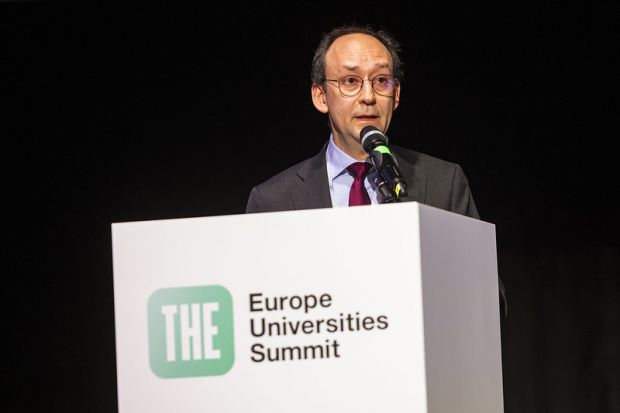
Speaking at THE’s Europe Universities Summit in Milan, Garrell also stressed the growing importance of leadership development in higher education, arguing that universities need strong leadership to navigate challenges, from sustainability and digital transformation to artificial intelligence, geopolitical instability and changing funding models.
“Leaders are overwhelmed,” he said, adding that incentives for taking on leadership roles in universities “are also very limited”.
To address this, the EUA has launched a leadership development programme in 2025 aimed at helping university leaders manage large-scale institutional transformation.
Register to continue
Why register?
- Registration is free and only takes a moment
- Once registered, you can read 3 articles a month
- Sign up for our newsletter
Subscribe
Or subscribe for unlimited access to:
- Unlimited access to news, views, insights & reviews
- Digital editions
- Digital access to THE’s university and college rankings analysis
Already registered or a current subscriber?