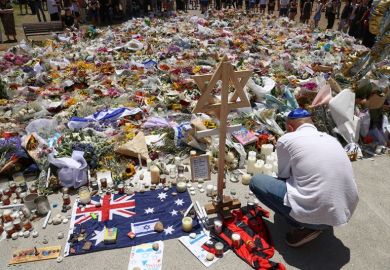
Last week’s attack on British Jews on the streets of north London was just the latest in a string of violent antisemitic incidents. These are attacks on Jews because they are Jews, but they are also an attack on the UK itself – all of us should care if parts of our own national family are unsafe to go about their business without fear of violence.
In the hours that followed, what I heard clearly from Jewish leaders was this. We want actions not words.
Quite right. We have a special responsibility as leaders of the UK university system to take this to heart. That is why I am pleased to be joining the prime minister’s meeting today, convening leaders from across UK public life.
There is no doubt in my mind that antisemitism continues to rise at universities despite the diligent efforts by thousands of people in positions of influence on campuses in all four nations of the UK.
Why is this the case? One reason is that we have a lot of young people on our campuses, and evidence suggests that people between the ages of 18 and 34 are disproportionately represented in those holding antisemitic, including extremely antisemitic, views.
The second is that universities are often centres of activism. This is broadly a good thing: it is why autocratic governments always seek to control universities. They are potentially dangerous places for those who want to preserve a status quo. From war to climate change to sex and drugs and rock and roll, students have a long history of mobilising, campaigning and challenging society on the issues they care most deeply about. Sometimes history judges them to have been entirely right to do so. My parents’ generation (although I should say, not my parents) were forever burning bras and making a nuisance of themselves over nuclear disarmament, civil and women’s rights.
Third, universities are attractive to outside influences who are keen to capitalise on young, activist students to promote their own ends. So we have a situation where thousands – perhaps hundreds of thousands – of people who feel strongly that what has happened in Gaza since 7 October 2023 is intolerable and must be stopped get swept up into movements which all too often slip into hatred of Jews and knowingly or unknowingly repeat statements which clearly call for Jews’ eradication. Into this situation, state actors – including both Iran and Russia – stick their oars, exploiting the opportunity to destabilise British society for their own ends.
I want to be clear. We have not been idle since the 7 October massacre or before it. Universities UK’s hottest ticket in the past two years has been our regular 8am calls on managing campus tensions, where we bring university leaders together to learn from each other.
As part of a wider series of calls on topics such as tackling anti-Muslim hatred and enabling freedom of speech and academic freedom, this has included a consistent focus on tackling antisemitism. It includes discussion about how to manage protest and how to protect Jewish students and staff, hearing from experts including the Community Security Trust and the excellent Union of Jewish Students.
We have issued guidance, shared practice among our membership, and coordinated regular and sustained channels of communication between representative groups and the university leadership so they understand and can act on requests for action, including in relation to security measures.
But I am not convinced that we have made a meaningful difference to the direction of travel. We can, I think, claim success in the management of the wave of university encampments in the summer of 2024 – university leaders in the UK acted robustly where they needed to, while remaining mindful of their legal duties to protect free speech and the right to protest. The encampments did not spiral out of control in the way that they did in the US, notwithstanding some extremely ugly individual incidents.
But I woke up on Thursday morning asking myself: “What does ‘action not words’ mean for me?”
I have written to vice-chancellors to ask them to review security arrangements in light of evidence of escalating violence. I will work with the Union of Jewish Students to promote their antisemitism training, and I will undertake it myself. I will work with others to implement the recommendations of their Time for Change report, and I will accept the responsibility that I personally have to be part of a wider societal move to counter extremism.
I believe that universities can be part of the solution – especially through our opportunity to educate a large number of young people on effective disagreement and on where the boundaries between legitimate protest and antisemitism lie. Universities are uniquely well placed to play this role, and to address a growing societal evil through taking a zero-tolerance approach to antisemitism on campuses.
But it will take all of us, working together, to make any difference.
Vivienne Stern is chief executive of Universities UK.
Register to continue
Why register?
- Registration is free and only takes a moment
- Once registered, you can read 3 articles a month
- Sign up for our newsletter
Subscribe
Or subscribe for unlimited access to:
- Unlimited access to news, views, insights & reviews
- Digital editions
- Digital access to THE’s university and college rankings analysis
Already registered or a current subscriber?