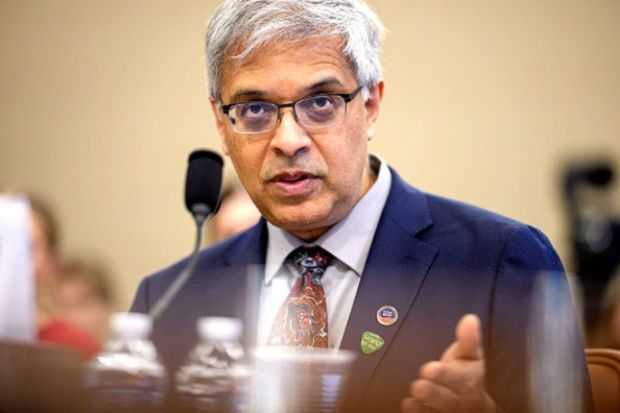
Jay Bhattacharya, director of the US National Institutes of Health, has been visiting universities in the US in his ostensible role as champion of academic freedom. It is a part to which he is ill-fitted.
It has been reported recently in The New York Times that in his capacity as acting director of the Centers for Disease Control and Prevention, Bhattacharya has suppressed the scheduled publication of an article that found that the Sars-CoV-2 vaccine reduced hospitalisations and emergency visits due to Covid-19 last winter. As one of the players in the US administration’s Covid revenge tour, he claims to oppose the methodology of the study, which previously had been widely accepted.
Before I proceed with the case against Bhattacharya, I would like to acknowledge one of his few positive acts. The number of measles cases in the past year in the US has surpassed the total number of cases that occurred between 2014 and 2024: the largest number of cases in a one-year period since 1991-92. In response, Bhattacharya has, through a disseminated video, laudably declared that “measles is preventable and vaccination remains the most effective way to protect yourself and those around you.”
The context is that there has been a decline in childhood vaccination for measles in both the US and the UK, resulting from completely unsubstantiated claims of harms from immunisation. This disinformation has been propagated by the secretary of health and human services Robert F. Kennedy Jr and his allies. The result has been the decline in measles herd immunity, defined as community protection from an infectious disease when a sufficient percentage (it varies by the nature of the infectious agent) of people are immune because of vaccination or previous exposure to the agent. The result is a reversal of the effective eradication of measles on both sides of the Atlantic.
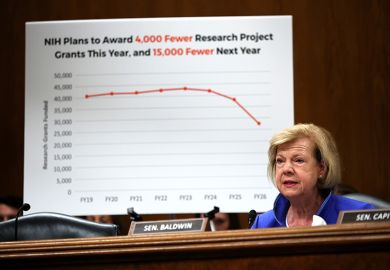
In contrast to his momentary burst of sanity displayed by his stating the obvious, Bhattacharya’s tenure as NIH director has largely not been positive for American health, research or universities. Cancelling grants and reducing those to early-career investigators, defunding mRNA vaccine research, promoting layoffs and inspiring resignations of many skilled and dedicated professionals, arbitrary awarding of grants without peer review, and establishing illegal caps on indirect costs are but a few of the offences of Bhattacharya’s reign.
I recently had the opportunity to hear Bhattacharya in person during his visit to Purdue University. I expected to endure scientific ignorance, right-wing pandering and claims of victimisation, and I was not disappointed.
When Bhattacharya discusses “academic freedom”, he exclusively refers to his own claims of being persecuted. His focus is on the response to the Covid-era Great Barrington Declaration, which claimed that the vulnerable could be kept safe without lockdowns and of which he is one of the authors. He falsely claimed that the rejection of the declaration by the scientific community was an attempt to prevent discussion.
In fact, the objection by scientists and physicians was to the novel and nonsensical definition given to herd immunity (“the point at which the rate of new infections is stable”), which has nothing in common with the standard definition given above, and to the suggestion that we could reach herd immunity through natural infection, which betrays how completely ignorant the authors were about virus evolution and immunology.
The propagation of their errors was highly dangerous to society and it was therefore the responsibility of scientists and public-health experts to state firmly that they were wrong. This is not shutting down debate; this is engaging in debate on the side of what we understand about virology and immunology.
There were other disturbing moments. When asked about his illegal NIH indirect-cost cap, he responded with some half-baked idea about only permitting institutions to build facilities on sites in the US where land was cheapest, demonstrating that he has no understanding of how either indirect-cost compensation or research-culture functions. Contrary to his apparent assumption, construction outlays do not count as indirect costs. I fully agree that the US indirect-cost system is in need of reform, but the approach of Bhattacharya is misguided at best.
When asked about the future of artificial intelligence (AI), he cited the example of radiology, apparently unaware that AI has been applied in radiology for more than a decade. When asked about his greatest achievement as NIH director, he gushed over his elimination of DEI (diversity, equity and inclusion) from NIH grants. First, only a small percentage of grants concerned those matters. Second, the axeing of “DEI” grants appeared to be based on a hunt through its grants database for the words “diversity”, “equity” and “inclusion” – which all have widespread use in biology that have nothing to do with DEI. And, third, it is appalling that the NIH director appears to believe that neither health outcomes for diverse populations nor equity in access to healthcare are issues worth investigating.
Finally, Bhattacharya revealed what he modestly refers to as “the second scientific revolution”. What is this momentous event, the equivalent of the advances of, say, Vesalius and Copernicus? It’s a button on articles to say when they have been replicated – or in Bhattacharya’s words, when they have been proven to be “true”– with a link to the replication study.
Now, I am all in favour of replication studies and have been at the forefront of investigating the reliability of the scientific literature. But I hardly think that a feature that links a reader to a replication study qualifies as a scientific revolution.
For something health-related that Bhattacharya thought had been proved by replication to be “true”, he referred to the fact that cigarette-smoking caused cancer. This is so obvious and was established so long ago that it is pointless to cite and shows a disturbing lack of courage and contemporary scientific knowledge.
I also am concerned about Bhattacharya’s repeated references to a scientific finding being “true” – and puzzled by his doing so in the context of references to his religious faith. Theology may be about “truth”, but natural science is not. It is about arriving at the best explanation for observed phenomena. We have statistical analyses for determining the accuracy and precision of our measurements, but most of science is about devising interpretations and testing whether ours is the most consistent with the data.
For example, is it true that the Earth rotates around an axis and revolves around the Sun? I would argue that this interpretation is the one most consistent with the evidence and that there are no countervailing data. For all practical and research purposes, we can assume it is true. But science is, by its nature, dynamic. Something that we think is “true” today may prove to be wrong tomorrow. That is indeed one of the strengths of science.
It is an expression of the contemporary dysfunction of our authorities that the director of the NIH is seemingly unappreciative of this fact – and that he believes that “academic freedom” is enhanced by suppressing research articles that are inconsistent with a political agenda.
David Sanders is associate professor of biological sciences at Purdue University.
Register to continue
Why register?
- Registration is free and only takes a moment
- Once registered, you can read 3 articles a month
- Sign up for our newsletter
Subscribe
Or subscribe for unlimited access to:
- Unlimited access to news, views, insights & reviews
- Digital editions
- Digital access to THE’s university and college rankings analysis
Already registered or a current subscriber?