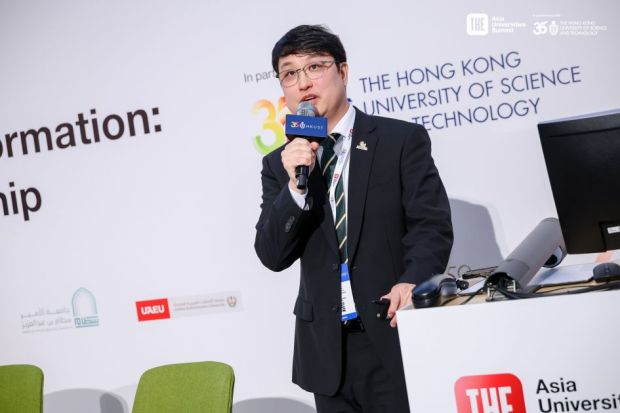
“Key constituent buy-in” is perhaps the most important – but arguably the least considered – factor when institutions are weighing up whether to launch transnational education (TNE) projects, a Hong Kong forum has heard.
Changes in leadership can also prove pivotal when universities are establishing offshore operations. “Whether it’s the president changing, provost changing, rector changing or – in our case – the president of the United States changing, those kinds of things will have…tremendous impacts,” international business law scholar Joshua Park told Times Higher Education’s Asia Universities Summit.
Support from faculty deans in the home institution, when their programmes are chosen for overseas delivery, is also crucial. “Buy-in is actually much more important than folks may realise,” Park told the summit at Hong Kong University of Science and Technology. “When we have changes in deans at the home campus, the support can wax or wane.”
Park is dean of George Mason University Korea, at the Incheon Global Campus near Seoul. He said university leaders sometimes neglected the important questions when contemplating offshore operations.
While they typically focused on the “obvious” legal and regulatory hurdles, many paid less attention to the “price point” – a crucial issue, because it determined staff’s salary levels.
Park said many offshore operations were only able to attract enrolments by keeping tuition fees substantially lower than those charged at home. But this could be hard to justify at home institutions that were publicly funded and deemed to be using taxpayers’ money to subsidise degrees in far-off campuses.
He said some institutions reasoned that imposing the “exact same tuition rate” at both campuses was “the only fair way to do it”, while others – including George Mason – charged slightly more for offshore students. “That’s not…a model that many other places might be able to do,” he conceded.
“Different places take on different models, but that also [has implications for] quality assurance. What kinds of faculty members will you be able to recruit? Are you able to [offer] the exact same types of curriculum?”
Another question that attracted too little attention, in Park’s view, was the degree to which offshore operations should be financially independent from home institutions. He said Korean branch campuses in countries like Kazakhstan and Uzbekistan – a hotspot region for Korean TNE – were often “very closely tied” financially to the universities back home, with “lots of cash flow going back and forth”.
George Mason University Korea, on the other hand, was “entirely independent” from the mother ship. This helped insulate the campus from funding cuts in the US, but left it “on our own” when revenue grew tight. And for universities hoping for “financial payouts” from their offshore ventures, complete independence made little sense.
Park said perhaps the most important consideration was to choose the right type of TNE, from a “partnership pyramid” ranging from relatively inexpensive collaborations and exchanges to dual degrees, offshore learning centres, joint ventures and fully fledged branch campuses.
He said international expansion had become a dominant narrative in academia, with universities highlighting their offshoots as “success stories” through marketing that emphasised prestige and reach. “Scaled back” partnerships received less attention, but more ambitious models carried financial, reputational, political, regulatory and operational risks.
Park said any TNE venture should be carefully thought through. “What is motivating the decision? Have you…looked at mechanisms outside of establishing a branch campus to [achieve] many of the same types of things? Do you have the necessary capacity, both at home as well as [in] the host area? Alignment of incentives with educational mission? Government structures that support accountability?”
He said it would be impossible, under current political circumstances, for a US university to establish a branch campus in China. But that could change in five or 10 years – and in the meantime, American institutions could consider “other types” of transnational partnerships. “Maybe that’s the way to maintain an international foothold while we’re looking at geopolitical environments to change.”
Register to continue
Why register?
- Registration is free and only takes a moment
- Once registered, you can read 3 articles a month
- Sign up for our newsletter
Subscribe
Or subscribe for unlimited access to:
- Unlimited access to news, views, insights & reviews
- Digital editions
- Digital access to THE’s university and college rankings analysis
Already registered or a current subscriber?