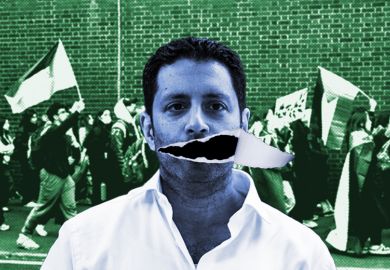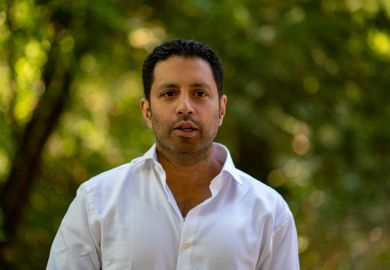
University leaders should “think carefully” about making political comments and institutions should strive for “neutrality”, the head of free speech at the Office for Students (OfS) has said.
Arif Ahmed, the university regulator’s director for freedom of speech and academic freedom, told a Westminster Education Forum conference that while academics “absolutely have the right to express political views”, which he said were “essential for a university to function”, the expectations for senior management teams and the institution itself should be different.
Institutional political statements “may be something that has a chilling effect on academics and students within their institutions, particularly those who are in more vulnerable positions such as academics on short-term contracts”, he said. “Therefore, we think there is a lot of value in universities adopting an approach of institutional neutrality.”
There is a “balance to be struck” for senior university leaders, but, he said, “the more senior you are, the more difficult it is for you to express publicly your view on certain matters without its appearing to be the view of the institution”.
Ahmed said senior officials should “certainly think carefully” about “expressing political views about contested matters”.
He added job descriptions that “place requirements on beliefs” are generally a “source of concern” for the OfS.
While it is “totally fine” for universities to underscore the need for staff to follow requirements in the Equality Act, “what’s not fine is having a requirement on beliefs”, he said.
“So having some kind of ideological test where it says you cannot be, for instance, a lecturer in maths unless you sign up to our equality values, or you cannot be a postdoctoral assistant in biology unless you believe in our sort of values on equality, diversity, and inclusion.
“These may be very fine things to believe, but it’s not the job of universities and colleges to make windows into men’s souls.”
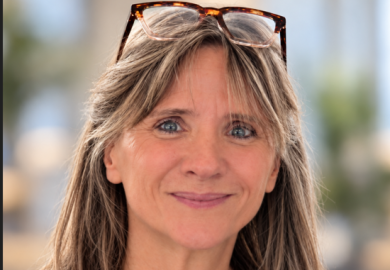
David Bass, director of inclusion and governance at Advance HE, said that challenges over free speech concerns in higher education can often be symptomatic of wider institutional problems.
“In almost all of my work with institutions, there have been challenges that start off as a disagreement about values or inclusion, but they’ve often ultimately pointed to the underlying issue over inconsistency, from provision and engagement with high-quality training, an over-reliance on a small number of internal experts, or ambiguity about escalation and ownership of decisions.”
Bass said ensuring institutional “competency” should be prioritised when trying to create effective policies.
“From what Advance HE has seen and from my experience, the best institutions here are not treating free speech compliance as a narrow legal problem or a policy challenge. They are looking at it from the perspective of how we develop institutional competence and confidence in actually dealing with these difficult decisions through our processes.
“And then, how does our governance, our training, our reporting, our escalation and our documentation enable us to move through that process and be confident that it’s been handled with integrity?”
Register to continue
Why register?
- Registration is free and only takes a moment
- Once registered, you can read 3 articles a month
- Sign up for our newsletter
Subscribe
Or subscribe for unlimited access to:
- Unlimited access to news, views, insights & reviews
- Digital editions
- Digital access to THE’s university and college rankings analysis
Already registered or a current subscriber?