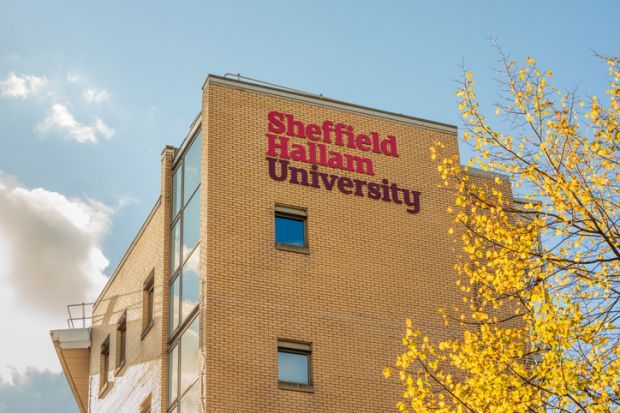
Teaching-only staff at Sheffield Hallam University are set to be moved into a subsidiary firm, leaving research-intensive scholars the only academics still being employed directly by the institution.
In a move unions are calling an “assault” on employment conditions at the university, annual teaching hours are also being increased and automatic progression between grades replaced by a “promotion-only” model.
Staff at Sheffield Hallam were told of the planned changes at a full staff briefing on 10 March, with the institution’s leaders saying it needed to save £26.6 million from its budget. Unions have responded with threats to strike.
The proposals seek to reduce the cost to the university of participation in the Teachers’ Pension Scheme, which has an employer contribution rate of 28.68 per cent that has widely been seen as unmanageable amid the sector’s financial crisis.
The university is proposing to create a different pension offer for different types of academics.
If the plans go ahead, all teaching-focused staff – the majority of academic employees at the university – will be moved into a subsidiary firm, which will see them stripped of their right to a TPS pension, and put on to the Local Government Pension Scheme (LGPS) instead, which has a lower employer contribution rate of 17.6 per cent.
Research-focused staff will remain employees at the university but will also be moved on to the LGPS. Only staff eligible for the Research Excellence Framework will remain employees of the university and retain their TPS pension. This reflects the need for staff to be direct employees of the university to be eligible for the REF.
A Sheffield Hallam University spokesperson said it was having to make ”tough decisions” owing to the “well-documented financial challenges” across the higher education sector, adding that the TPS is “unsustainable”.
The proposals will also see an increase to staff’s weekly and annual teaching hours, the removal of progression between staff grades to be replaced with a promotion-only model, and an increase in teaching responsibilities for research staff.
Ruth Beresford, a committee member of the University and College Union (UCU) branch, told Times Higher Education that the announcement was an “assault on working conditions” and had caused “anger, fear [and] confusion” among staff.
She added that the proposals would create “three levels of academic staff” and "dismantle" and “fragment” current academic structures. In moving teaching-focused staff into a subsidiary firm, it would block them from any research opportunities, Beresford added.
“This is actually a fundamental attack really on what it is to be an academic, and what it means to do academia and to be a university. By dividing us between research and teaching, it makes transitions between the two almost impossible,” she said.
“I think that has very big ramifications beyond working at Hallam. What does that mean for universities? What’s the rationale and motive behind this? Especially given that we’re always meant to have our teaching be informed by research.”
The university is looking to make savings of £26.6 million in its 2026-27 budget, and staff were told that the changes to pensions would save Sheffield Hallam about £6 million, resulting in concerns that there may be further job cuts coming.
The union has now opened an indicative ballot of members on whether it should hold a vote on conducting industrial action.
The university spokesperson added that post-92 universities are legally required to offer the TPS to academic staff, but the higher employer contribution rates have made this “financially unsustainable”. They noted that “most of our professional services staff” are on the LGPS, and claimed there will be “no difference in terms and conditions between those employed by the university and those employed through the subsidiary”.
“This issue is not unique to Sheffield Hallam and many other post-92 universities are already making changes to address pension costs.
“With the overall financial picture for universities likely to be challenging for some time, we must continue to make the difficult choices required to reduce costs and increase income, in order to emerge in a stronger, sustainable position for the future.”
Register to continue
Why register?
- Registration is free and only takes a moment
- Once registered, you can read 3 articles a month
- Sign up for our newsletter
Subscribe
Or subscribe for unlimited access to:
- Unlimited access to news, views, insights & reviews
- Digital editions
- Digital access to THE’s university and college rankings analysis
Already registered or a current subscriber?