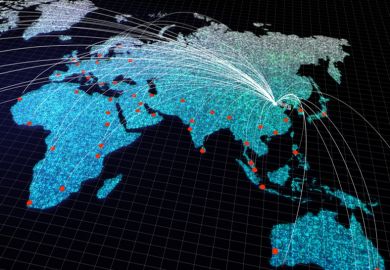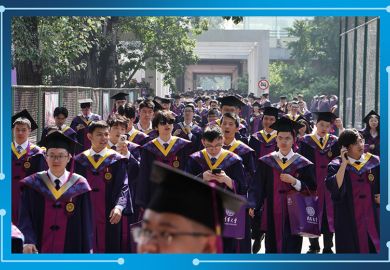
China’s introduction of a standardised admissions exam for international students shows that efforts to build a world-class university system matter more to the country than increasing enrolments, according to experts.
From the 2026 intake, most international applicants will be required to sit the China Scholastic Competency Assessment (CSCA), a centrally designed test intended to benchmark students from different education systems against a common academic standard.
The exam will be compulsory for recipients of Chinese government scholarships from this year and later phased in more widely, becoming mandatory for all international undergraduate applicants by 2028.
It will be delivered primarily as an online, remotely proctored test, with some countries also offering offline test centres.
Richard Coward, CEO at Global Admissions, an agency that helps international students apply to universities, said the policy was “one of the biggest changes” he had seen for international students studying in China.
“This is more about the shift in focus away from quantity to quality, which is happening all over the world. Previously China had the target of 500,000 students, now the target is towards world-class universities by 2050 with the double first-class initiative.
“There is a great deal of variation in students with different academic backgrounds and it can be challenging to assess,” Coward said. “There are also many countries that don’t have the equivalent level of maths compared with China.
“This change aims to make all international applicants have the same standard so they’ll be able to follow the education at Chinese universities and so they are at least at the same level as local students.”
Under the new framework, mathematics will be compulsory for all applicants, including those applying for arts and humanities degrees.
Coward said this reflected “the Chinese educational philosophy that quantitative reasoning is a fundamental baseline for any university-level scholar”.
Those applying to Chinese-taught programmes must also sit a “professional Chinese” paper, offered in humanities and STEM versions. Physics and chemistry are optional, depending on programme requirements. Mathematics, physics and chemistry can be taken in either Chinese or English.
Gerard Postiglione, emeritus professor at the University of Hong Kong, said the CSCA should be understood as part of a broader shift in China’s approach to internationalisation.
“The increasing narrative in China in all areas is to focus on quality,” he said. “That also means in higher education. If China has the plan by 2035 to become an education system that is globally influential, there’s going to be more emphasis on quality.”
Postiglione added that the move also reflected how China approaches admissions locally.
“If you look at how China selects students domestically, there is no back door,” he said, pointing to the importance of the gaokao university admissions test taken by local students. “The gaokao is the gaokao, and I don’t think there will be much of a back door for international students either.”
He cautioned, however, that the framework may favour applicants with certain backgrounds.
“Language proficiency and subject preparation will inevitably advantage some students over others,” he said. “Students who have already studied in Chinese, or who come from systems with stronger mathematics preparation, may find it easier to meet the requirements.”
While the exam framework is centrally set, Postiglione said universities are likely to retain autonomy over admissions decisions.
“The Ministry of Education will provide a framework and guidelines,” he said, “but it would be very difficult for a central agency to make individual admissions decisions across the entire system.”
Pass thresholds have not yet been standardised and Coward said in future universities may set minimum score requirements, but this is not in place yet.
He added that the additional requirement was unlikely to reduce demand. “Some more casual students may be deterred,” he said, “but for top-tier universities it reduces administrative burden by filtering for quality early.”
In the longer term though, “it signals that a Chinese degree is becoming more prestigious, which may actually increase demand from high-calibre students.”
Register to continue
Why register?
- Registration is free and only takes a moment
- Once registered, you can read 3 articles a month
- Sign up for our newsletter
Subscribe
Or subscribe for unlimited access to:
- Unlimited access to news, views, insights & reviews
- Digital editions
- Digital access to THE’s university and college rankings analysis
Already registered or a current subscriber?