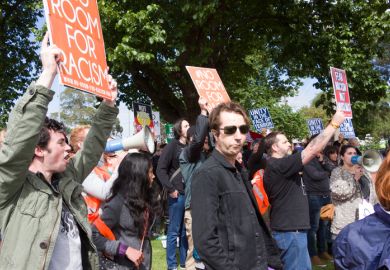
Up to four in 10 Australian university students, and close to half of humanities students at some institutions, do not feel free to express their views.
A report from the Menzies Research Institute, an independent thinktank associated with the centre-right Liberal Party, has revealed hitherto unpublished institutional-level statistics on students’ perceptions about their freedom of expression.
The report, by University of Sydney sociologist Salvatore Babones, analyses responses to a question about free speech in the Quality Indicators for Learning and Teaching suite of government-endorsed surveys.
The question, which has been included in the Student Experience Survey since 2021, seeks responses to the statement “I am free to express views”. Respondents can agree, agree strongly, disagree, disagree strongly, or neither agree nor disagree.
Aggregate results have been published for the past four years, and they show the agreement rate gradually deteriorating from about 77 per cent to 74 per cent. However, figures for each university have not previously been disclosed.
Babones’ analysis found that the proportion of domestic undergraduates who failed to agree with the statement ranged from 22.3 per cent at one university to 38.8 per cent at another. Among postgraduates, non-agreement rates ranged between 27.7 per cent and 40.2 per cent.
In “society and culture” disciplines, which include politics, law, languages and philosophy, non-agreement rates ranged up to 44.3 per cent for domestic undergraduates and 53.2 per cent for their postgraduate peers.
Babones, who said he had paid over A$1,000 (£525) for access to the data, said the information should be made freely available as an accountability measure. “Education depends on the free exchange of ideas,” his report says. “If education is to have any meaning beyond the simple communication of basic facts, students must feel free to express themselves in class and on campus.
“There are legitimate reasons why students might not be permitted to express themselves freely…[including] policies against hate speech, limitations on access to university property and other practical considerations. But when a quarter to a third of students do not feel free to express themselves at their universities, something is wrong.”
The findings come from a population census that yielded about 258,000 responses. While this constituted a response rate of just 37 per cent, the “available indicators” offered no evidence of sample bias, Babones said.
However, the dataset did not allow him to distinguish between respondents who disagreed with the statement and those who were “essentially dodging the question” by neither agreeing nor disagreeing.
Although the dataset also did not reveal why students felt constrained in expressing themselves, Babones said it allowed for “educated guesses”. He said that while universities’ regulation of on-campus demonstrations had garnered a lot of media coverage, only a small fraction of students attended these demonstrations.
“It seems very likely that when students do not feel free to express their views, most of them are answering the question with reference to their classroom experiences…[and] that the problem has more to do with the spirit of teaching than with the politics of teachers,” he said. “Students may simply feel that their views are unwelcome in the classroom, whatever the topic being taught.”
He said that without detailed data to support it, any suggestion that conservative students felt particularly constrained in expressing their views was “no more than a credible conjecture” – but one that warranted investigation, in light of its importance for “the health of Australian democracy”.
Register to continue
Why register?
- Registration is free and only takes a moment
- Once registered, you can read 3 articles a month
- Sign up for our newsletter
Subscribe
Or subscribe for unlimited access to:
- Unlimited access to news, views, insights & reviews
- Digital editions
- Digital access to THE’s university and college rankings analysis
Already registered or a current subscriber?