Financial pressures on UK universities are reducing the amount of time that academics spend on public engagement, new figures suggest.
Recent data from the Higher Education Statistics Agency (Hesa) show that academics across the UK registered 81,380 days – the equivalent of 223 years – spent working on public events in 2024-25.
Of this, 22 per cent of time was spent on performance arts, 19 per cent on public lectures, 9 per cent on exhibitions, and 2 per cent on museum education. The remaining 48 per cent was time given to other forms of public events.
When excluding providers that have not submitted consistent data, the figures show that the amount of time spent on such activities is declining.
Across these 129 institutions, 67,000 days were recorded in 2024-25 – which was down 3 per cent on the year before, and 11 per cent on 2022-23.
But rather than showing dampened enthusiasm among academic staff for public outreach, Richard Watermeyer, professor of education at the University of Bristol, said it reflected academics’ “work intensification and time deprivations”.
He said such events are currently viewed as low priority in university settings and are increasingly marginalised as a “non-core activity”.
“This may also of course be a case of self-preservation and task reorientation where academics are forced to reconsider what they prioritise at a time of acute precarity and where their employment is at risk.”
The analysis reveals that elite institutions are spending even less time on events than the rest of the sector.
The 20 members of the Russell Group with regular data recorded 17,117 days on public events last year – a 13 per cent drop from 2023-24, and almost half the number from a decade prior.
Watermeyer said institutional resource cuts will have played a role in the fall – with the number of administrative staff at many universities being reduced.
“Public events, unless tied to other key missions like student recruitment, are perhaps even lower on the agenda and reflected in professional services staff cuts.”
Some institutions, such as the University of Edinburgh, registered more time spent on public engagement (4,005 days) than ever before – and more than any other provider.
Despite operating in a challenging financial environment, Kim Graham, provost of Edinburgh, said public engagement is a central part of the university’s mission as a civic institution.
She cited a number of outreach events that academics do, including the Provocateurs programme at the Edinburgh Fringe which presents science-led comedy sets.
“Through activities like these, we aim to build closer links to our communities and partner organisations, working together to demonstrate the impact and societal benefits universities deliver every day.”
Edinburgh’s high level of public engagement was followed by the Royal College of Music (3,669 days) and Ulster University (3,669).
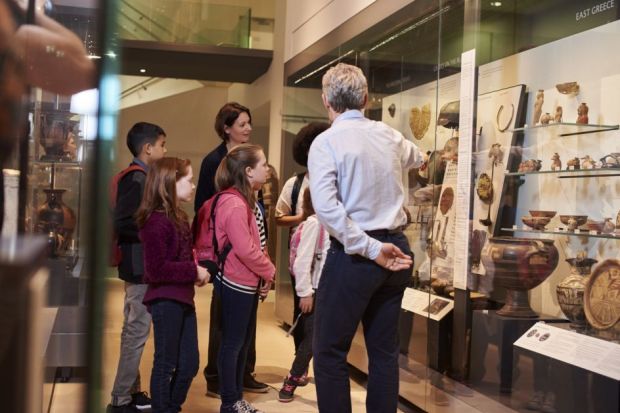
However the amount of time spent on exhibitions, which includes galleries and museums, fell to a record low for the period across the sector.
This was largely as a result of fewer free exhibitions taking place – the number that cost money rose to a record 16 per cent of the total.
Watermeyer said this could also be a reflection of the current financial situation, with universities having to charge for these events to recoup costs.
The Hesa data also show that the number of attendees at university public events fell by about 18 per cent year-on-year. But the volume attending paid events reached its highest level in six years.

Register to continue
Why register?
- Registration is free and only takes a moment
- Once registered, you can read 3 articles a month
- Sign up for our newsletter
Subscribe
Or subscribe for unlimited access to:
- Unlimited access to news, views, insights & reviews
- Digital editions
- Digital access to THE’s university and college rankings analysis
Already registered or a current subscriber?